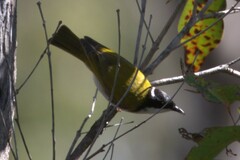
About the White-throated Honeyeater
The white-throated honeyeater (Melithreptus albogularis) is a bird of the honeyeater family Meliphagidae native to New Guinea and eastern and northern Australia. It is 11.5 to 14.5 cm (4.5 to 5.7 in) long, olive-green above and white below, with a black head, a white or pale blue patch over the eye, and a white stripe across the nape.
John Gould described the white-throated honeyeater in 1848. Its species name comes from the Latin words albus 'white', and gula 'throat'." English naturalist Charles Walter De Vis described Melithreptus vinitinctus from a specimen collected by K. Broadbent in the Kimberley in 1884. This was later synonymized with M. albogularis.
Traditionally, two subspecies have been recognised: subspecies albogularis from northwestern Australia, the Northern Territory and Cape York, and subspecies inopinatus from central and southeastern Queensland. However, genetic work published in 2010 surprisingly found that the Carpentarian Barrier (south of the Gulf of Carpentaria) fostered a split between lineages east and west of it in the Pliocene, between 2.4 and 5.2 million years ago, and that a more recent split took place between 1 and 2.8 million years ago... Wikipedia →