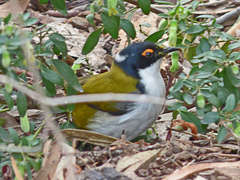
About the White-naped Honeyeater
The white-naped honeyeater (Melithreptus lunatus) is a passerine bird of the honeyeater family Meliphagidae native to eastern Australia. Birds from southwestern Australia have been shown to be a distinct species, Gilbert's honeyeater, and the eastern birds are more closely related to the black-headed honeyeater of Tasmania. One of several similar species of black-headed honeyeaters in the genus Melithreptus, it dwells in dry sclerophyll eucalypt woodland. Its diet consists of nectar from various flowers, and it also feeds on insects.
The white-naped honeyeater was originally described as Certhia lunata by French ornithologist Louis Pierre Vieillot in 1802. The specific epithet is derived from the Latin luna, meaning 'moon'; this refers to the crescent-shaped, white marking on its nape. It is a member of the genus Melithreptus, with several species of similar size and (apart from the brown-headed honeyeater) black-headed appearance, in the honeyeater family, Meliphagidae. The next closest relative outside the genus is the much larger, but similarly marked, blue-faced honeyeater. More recently, DNA analysis has shown honeyeaters to be related to the Pardalotidae (pardalotes... Wikipedia →