Trivittate Marsh Fly

Trivittate Marsh Fly

Helophilus trivittatus

Daily sighting probability ~10% · With luck
at Budapest

In 3 days ~10% in a week ~30%

5 Verified sightings at Budapest
128 In all 6 parks From 2019 to 2026
August Best month
☀️ Diurnal When it's spotted

About the Trivittate Marsh Fly

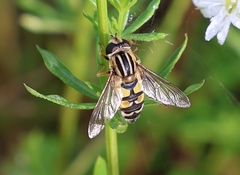
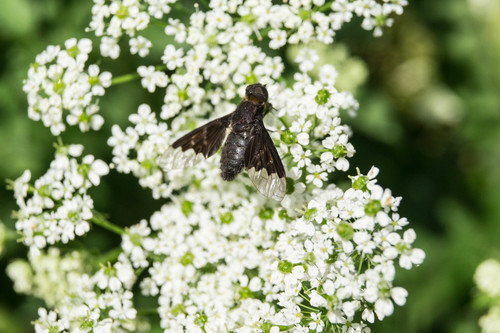
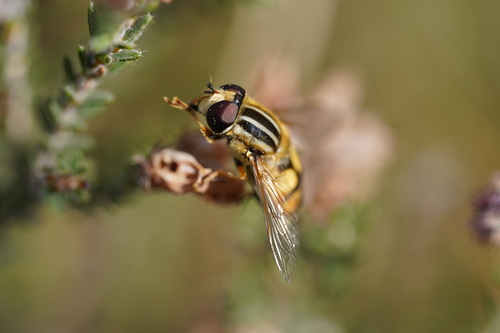
Helophilus trivittatus is a species of Palearctic hoverfly. The scientific genus name is composed of the parts helos (ἕλος, gr.), meaning "marsh" and philos (φίλος, gr.) meaning "friend". The species name is composed by "tri" (lat.), meaning "three" and "vitta" (lat.) meaning "band". This name refer to the preference of these insects for moist areas and to the fact that they carry three stripes on the breast shield.

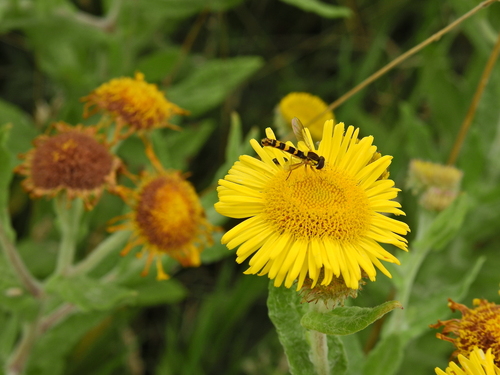
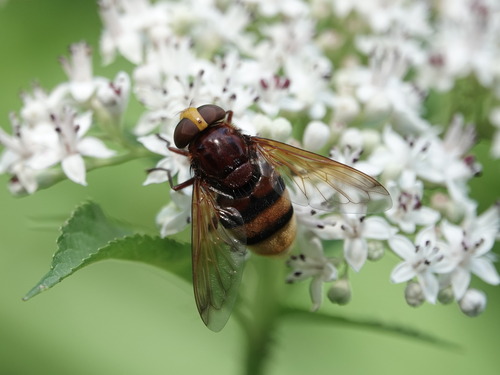
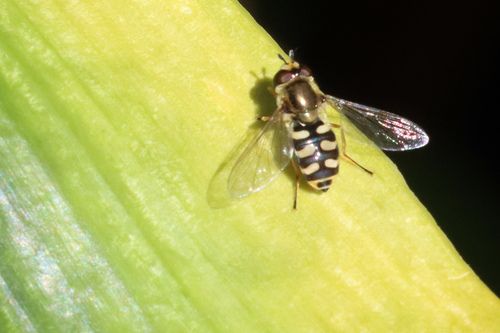
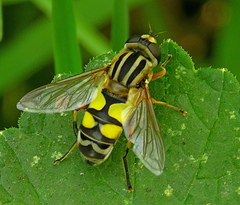
For terms see Morphology of Diptera Helophilus trivittatus has a wing length of 10.25–12.25 millimetres (0.404–0.482 in). The eyes are separated in both sexes, in the male a little less than in the female. The antennae are black, Face shows a wide yellow longitudinal stripe, with at most a central reddish-brown stripe. On the thorax four narrow pale yellow stripes alternate with three larger dark brown stripes. The drawing of the flattened abdomen is reminiscent of a wasp.

The drawing of the third and fourth segments of the abdomen is different in the two sexes. In the male, only the third segment carries a pale yellow to gray arc line. In the female, such a curve is found on the fourth and the fifth tergite. Tergites 2 and 3 have pale... Wikipedia →
Global Distribution

Parks Where Found

# Park Country Daily sighting probability
1 Kiskunság National Park 🇭🇺 Hungary
~20%
2 Wadden Sea National Park 🇩🇪 Germany
~10%
3 Białowieża National Park 🇵🇱 Poland
~10%
4 Fertő-Hanság National Park 🇭🇺 Hungary
~10%
5 Camargue 🇫🇷 France
~10%
6 Bavarian Forest National Park 🇩🇪 Germany
~10%

Cities Where Found

# City Country Daily sighting probability
1 Warsaw 🇵🇱 Poland
~10%
2 Helsinki 🇫🇮 Finland
~10%
3 Hamburg 🇩🇪 Germany
~10%
4 Amsterdam 🇳🇱 Netherlands
~10%
5 Rotterdam [The Hague] 🇳🇱 Netherlands
~10%
6 Munich 🇩🇪 Germany
~10%
7 Copenhagen 🇩🇰 Denmark
~10%
8 Budapest 🇭🇺 Hungary
~10%
9 Berlin 🇩🇪 Germany
~10%
10 Brussels 🇧🇪 Belgium
~10%

Before you go

What are the chances of seeing a Trivittate Marsh Fly in Budapest?

With luck

About 10% of wildlife watchers report a Trivittate Marsh Fly sighting in Budapest on a given day, based on 5 verified sightings from GBIF citizen-science data. It is the 342nd most-seen of the 404 insects we can rate there. Over three days the chance rises to about 10%, and over a week to about 30%, if each day is a fresh chance.

When is the best time to see a Trivittate Marsh Fly in Budapest?

July–August and October

In those months about 10% of wildlife watchers report a Trivittate Marsh Fly in Budapest on a given day, against under 5% in September and November–June, the lowest months.

What time of day is best to see a Trivittate Marsh Fly?

Between 11 am and 2 pm

Across all the parks we cover, that three-hour window holds the most Trivittate Marsh Fly sightings with a recorded time, and nearly all of them come between 6 am and 6 pm: it is a daytime animal.

Is Budapest the best place to see a Trivittate Marsh Fly?

Among the best

Of the 22 cities where we can rate Trivittate Marsh Fly sightings, Budapest ranks 8th at about 10%, level with the leaders once rounded. The best odds are in Warsaw (Poland, about 10%), Helsinki (Finland, about 10%) and Hamburg (Germany, about 10%).

Which relatives of the Trivittate Marsh Fly live in Budapest?

Same family: Syrphidae

The closest relatives of the Trivittate Marsh Fly that you can see in Budapest (family Syrphidae, Hover Flies) are Marmalade Hover Fly (about 20%), Common Drone Fly (about 10%) and Common Globetail (about 10%), with each one's daily chance of a sighting.

Where does the Trivittate Marsh Fly sighting chance come from?

GBIF citizen-science records

It is estimated from how often the Trivittate Marsh Fly is recorded against all the insects logged in Budapest (5 verified sightings), calibrated against known sighting rates. Figures are rounded to the nearest 10% because citizen-science data supports honest approximations, not decimals, and months with records from fewer than five people show "—". How it works.

← Back to Budapest