Eastern Slaty Thrush

Eastern Slaty Thrush

Turdus subalaris

Silhouette: Sharon Wegner-Larsen · PhyloPic

LCLeast ConcernNTVUENCR
Daily sighting probability <5% · Rare
at Buenos Aires

In 3 days ~10% in a week ~20%

7 Verified sightings at Buenos Aires
211 In all 4 parks From 2019 to 2026
October Best month
☀️ Diurnal When it's spotted

About the Eastern Slaty Thrush

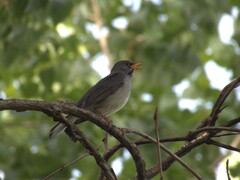
The blacksmith thrush or eastern slaty thrush (Turdus subalaris) is a passerine bird in the family Turdidae. It is found in Argentina, Brazil, Paraguay, and Uruguay. The blacksmith thrush was originally described as Merula subalaris. It was long considered as a subspecies of what is now the Andean slaty thrush (Turdus nigriceps) with the combination called the "slaty thrush". Following studies published in the early 2000s that showed they were not close relatives, taxonomic systems separated them.

The blacksmith thrush is monotypic. The blacksmith thrush is 20 to 22.5 cm (7.9 to 8.9 in) long and weighs 46 to 55 g (1.6 to 1.9 oz). The species is sexually dimorphic. Adult males have a mostly gray head with an orange-yellow to brown eye-ring and a black-streaked white throat. Their upperparts, wings, and tail are gray. Their breast is a lighter gray and their belly and vent white. They have a dark brown iris. Their bill is orange-yellow to brown with orange-yellow patches and their legs and feet yellowish brown to brownish gray. Adult females are very similar but have a yellowish green to olive brown eye-ring and somewhat paler upperparts... Wikipedia →

Sounds

Call0:28

Brazil · 2025

© JAYRSON ARAUJO DE OLIVEIRA · XC1019631 · CC BY-NC-SA 4.0

Song0:44

Brazil · 2024

© Carlos Henrique Luz Nunes de Almeida · XC942941 · CC BY-NC-SA 4.0

Song1:10

Brazil · 2019

© Miguel Angelo Biz · XC507114 · CC BY-NC-SA 4.0

Global Distribution

Parks Where Found

# Park Country Daily sighting probability
1 Itatiaia National Park 🇧🇷 Brazil
<5%
2 Serra da Canastra National Park 🇧🇷 Brazil
<5%
3 Iguazú National Park 🇦🇷 Argentina
<5%
4 Iguaçu National Park 🇧🇷 Brazil
<5%

Cities Where Found

# City Country Daily sighting probability
1 Buenos Aires 🇦🇷 Argentina
<5%
2 Curitiba 🇧🇷 Brazil
<5%
3 São Paulo 🇧🇷 Brazil
<5%

Before you go

What are the chances of seeing an Eastern Slaty Thrush in Buenos Aires?

Rare

Under 5% of wildlife watchers report an Eastern Slaty Thrush sighting in Buenos Aires on a given day, based on 7 verified sightings from GBIF citizen-science data. It is the 145th most-seen of the 274 birds we can rate there. Over three days the chance rises to about 10%, and over a week to about 20%, if each day is a fresh chance.

When is the best time to see an Eastern Slaty Thrush in Buenos Aires?

October

In that month about 10% of wildlife watchers report an Eastern Slaty Thrush in Buenos Aires on a given day, against under 5% in November to September, the lowest months.

What time of day is best to see an Eastern Slaty Thrush?

Between 7 and 10 am

Across all the parks we cover, that three-hour window holds the most Eastern Slaty Thrush sightings with a recorded time, and about 8 in 10 of them come between 6 am and 6 pm: it is a daytime animal.

Is Buenos Aires the best place to see an Eastern Slaty Thrush?

Yes

Of the 3 cities where we can rate Eastern Slaty Thrush sightings, Buenos Aires has the highest daily chance: under 5%. Next come Curitiba (Brazil, under 5%) and São Paulo (Brazil, under 5%).

Which relatives of the Eastern Slaty Thrush live in Buenos Aires?

Same genus: Turdus

The closest relatives of the Eastern Slaty Thrush that you can see in Buenos Aires (genus Turdus, Typical Thrushes) are Rufous-bellied Thrush (about 90%) and Creamy-bellied Thrush (about 40%), with each one's daily chance of a sighting.

Where does the Eastern Slaty Thrush sighting chance come from?

GBIF citizen-science records

It is estimated from how often the Eastern Slaty Thrush is recorded against all the birds logged in Buenos Aires (7 verified sightings), calibrated against known sighting rates. Figures are rounded to the nearest 10% because citizen-science data supports honest approximations, not decimals, and months with records from fewer than five people show "—". How it works.

← Back to Buenos Aires


