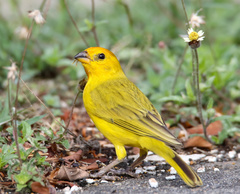

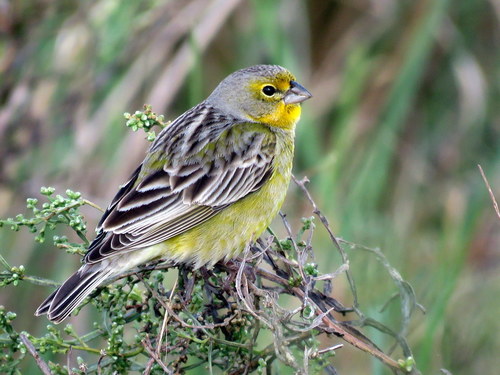
Saffron Finch

Saffron Finch

Sicalis flaveola

Silhouette: Sheatherius · PhyloPic

LCLeast ConcernNTVUENCR
Daily sighting probability ~60% · Likely
at Buenos Aires

In 3 days ~90% in a week >90%

9,204 Verified sightings at Buenos Aires
13,458 In all 30 parks From 2019 to 2026
January Best month
☀️ Diurnal When it's spotted

About the Saffron Finch

The saffron finch (Sicalis flaveola) is a tanager from South America that is common in open and semi-open areas in lowlands outside the Amazon Basin. They have a wide distribution in Colombia, northern Venezuela (where it is called "canario de tejado" or "roof canary"), western Ecuador, western Peru, eastern and southern Brazil (where it is called "canário-da-terra" or "native canary"), Bolivia, Paraguay, Uruguay, northern Argentina, and Trinidad and Tobago. It has also been introduced to Hawaii, Panama, Puerto Rico, Jamaica and elsewhere. Although commonly regarded as a canary, it is not related to the Atlantic canary. Formerly, it was placed in the Emberizidae but it is close to the seedeaters.

The saffron finch was formally described in 1766 by the Swedish naturalist Carl Linnaeus in the 12th edition of his Systema Naturae under the binomial name Fringilla flaveola. The specific epithet is a diminutive of the Latin flavus meaning "golden" or "yellow". The type locality is Suriname. The saffron finch is now placed in the genus Sicalis that was introduced in 1828 by the German zoologist Friedrich Boie.

Five subspecies are recognised: Wikipedia →

Sounds

Call0:09

Brazil · 2026

© JAYRSON ARAUJO DE OLIVEIRA · XC1135369 · CC BY-NC-SA 4.0

Song0:59

Brazil · 2025

© Robson Silva e Silva · XC1061030 · CC BY-NC-SA 4.0

Uncertain0:18

Ecuador · 2022

© Cristopher Rodríguez-Moreira · XC879458 · CC BY-NC-SA 4.0

Global Distribution

Parks Where Found

# Park Country Daily sighting probability
1 Serra da Canastra National Park 🇧🇷 Brazil
~80%
2 Serra dos Órgãos National Park 🇧🇷 Brazil
~70%
3 Emas National Park 🇧🇷 Brazil
~70%
4 Itatiaia National Park 🇧🇷 Brazil
~60%
5 El Palmar National Park 🇦🇷 Argentina
~60%
6 Chapada dos Guimarães National Park 🇧🇷 Brazil
~60%
7 Tijuca National Park 🇧🇷 Brazil
~50%
8 Farallones de Cali National Natural Park 🇨🇴 Colombia
~50%
9 Machalilla National Park 🇪🇨 Ecuador
~40%
10 Iberá National Park 🇦🇷 Argentina
~40%
11 Iguaçu National Park 🇧🇷 Brazil
~40%
12 Iguazú National Park 🇦🇷 Argentina
~30%
13 Chapada Diamantina National Park 🇧🇷 Brazil
~20%
14 Caroni Swamp 🇹🇹 Trinidad and Tobago
~20%
15 Henri Pittier National Park 🇻🇪 Venezuela
~20%
16 El Impenetrable National Park 🇦🇷 Argentina
~20%
17 Parque Natural Metropolitano 🇵🇦 Panama
~10%
18 Sierra de la Macarena National Park 🇨🇴 Colombia
~10%
19 Parque Estadual Encontro das Águas 🇧🇷 Brazil
~10%
20 Los Nevados National Natural Park 🇨🇴 Colombia
~10%
21 San Lorenzo Protected Forest 🇵🇦 Panama
<5%
22 Soberanía National Park 🇵🇦 Panama
<5%
23 Nahuel Huapi National Park 🇦🇷 Argentina
<5%
24 Chingaza National Natural Park 🇨🇴 Colombia
<5%
25 Amboró National Park 🇧🇴 Bolivia
<5%
26 Cuyabeno Wildlife Reserve 🇪🇨 Ecuador
<5%
27 Tambopata National Reserve 🇵🇪 Peru
<5%
28 Tayrona National Natural Park 🇨🇴 Colombia
<5%
29 Podocarpus National Park 🇪🇨 Ecuador
<5%
30 Yasuní National Park 🇪🇨 Ecuador
<5%

Cities Where Found

# City Country Daily sighting probability
1 Cali 🇨🇴 Colombia
~80%
2 Brasilia 🇧🇷 Brazil
~80%
3 Vitória 🇧🇷 Brazil
~70%
4 Asuncion 🇵🇾 Paraguay
~70%
5 Guayaquil 🇪🇨 Ecuador
~70%
6 Mendoza 🇦🇷 Argentina
~70%
7 Curitiba 🇧🇷 Brazil
~60%
8 Medellín 🇨🇴 Colombia
~60%
9 Valencia 🇻🇪 Venezuela
~60%
10 Campo Grande 🇧🇷 Brazil
~60%

Zoos & Centres Where Found

# Zoo / Centre Country
1 Zürich Zoo 🇨🇭 Switzerland In captivity
2 Parque das Aves 🇧🇷 Brazil In captivity
3 Zoological Garden of Belo Horizonte 🇧🇷 Brazil In captivity
4 Kansas City Zoo 🇺🇸 United States In captivity
5 Brookfield Zoo 🇺🇸 United States In captivity
6 Ukumarí Biopark 🇨🇴 Colombia In captivity
7 Berlin Zoological Garden 🇩🇪 Germany In captivity
8 Temaikén 🇦🇷 Argentina In captivity
9 Tierpark Hagenbeck 🇩🇪 Germany In captivity
10 Cologne Zoological Garden 🇩🇪 Germany In captivity
11 Philadelphia Zoo 🇺🇸 United States In captivity
12 Parque de las Leyendas 🇵🇪 Peru In captivity
13 Vogelpark Avifauna 🇳🇱 Netherlands In captivity
14 Reid Park Zoo 🇺🇸 United States In captivity
15 Como Park Zoo and Conservatory 🇺🇸 United States In captivity
16 Como Zoo 🇺🇸 United States In captivity
17 Parque de la Conservación 🇨🇴 Colombia In captivity
18 Mississippi Aquarium 🇺🇸 United States In captivity
19 Agroflori Parque de las Aves 🇧🇴 Bolivia In captivity
20 National Aviary 🇺🇸 United States In captivity
21 Texas State Aquarium 🇺🇸 United States In captivity
22 Aquarium Berlin 🇩🇪 Germany In captivity
23 Sobela Ocean Aquarium 🇺🇸 United States In captivity
24 Key West Butterfly and Nature Conservatory 🇺🇸 United States In captivity
25 Boston Aquarial Gardens 🇺🇸 United States In captivity
26 Cologne Zoo Aquarium 🇩🇪 Germany In captivity

Before you go

What are the chances of seeing a Saffron Finch in Buenos Aires?

Likely

About 60% of wildlife watchers report a Saffron Finch sighting in Buenos Aires on a given day, based on 9,204 verified sightings from GBIF citizen-science data. It is the 15th most-seen of the 274 birds we can rate there. Over three days the chance rises to about 90%, and over a week to over 90%, if each day is a fresh chance.

When is the best time to see a Saffron Finch in Buenos Aires?

June–July and October–February

In those months about 60% of wildlife watchers report a Saffron Finch in Buenos Aires on a given day, against about 50% in March–May and August–September, the lowest months.

What time of day is best to see a Saffron Finch?

Between 7 and 10 am

Across all the parks we cover, that three-hour window holds the most Saffron Finch sightings with a recorded time, and about 9 in 10 of them come between 6 am and 6 pm: it is a daytime animal.

Is Buenos Aires the best place to see a Saffron Finch?

18th of 38

Of the 38 cities where we can rate Saffron Finch sightings, Buenos Aires ranks 18th at about 60%. The best odds are in Cali (Colombia, about 80%), Brasilia (Brazil, about 80%) and Vitória (Brazil, about 70%).

Where does the Saffron Finch sighting chance come from?

GBIF citizen-science records

It is estimated from how often the Saffron Finch is recorded against all the birds logged in Buenos Aires (9,204 verified sightings), calibrated against known sighting rates. Figures are rounded to the nearest 10% because citizen-science data supports honest approximations, not decimals, and months with records from fewer than five people show "—". How it works.

← Back to Buenos Aires