Maccoa Duck

Maccoa Duck

Oxyura maccoa

Silhouette: Sheatherius · PhyloPic

LCNTVUENEndangeredCR
Daily sighting probability <5% · Rare
at Cape Town

In 3 days <5%

13 Verified sightings at Cape Town
184 In all 6 parks From 2019 to 2026
November Best month
☀️ Diurnal When it's spotted

About the Maccoa Duck

The Maccoa duck (Oxyura maccoa) is a stiff-tailed diving duck found across Eastern and Southern Africa. As members of the stiff-tailed duck group, Maccoas are often found wading in the water with their tail feathers cocked upwards. As diving ducks, their bodies are specialized for being agile underwater swimmers and thus have sacrificed the characteristics that allow them to move well on land. As a result, their legs are set further back on their bodies which makes them awkward when walking out of water.

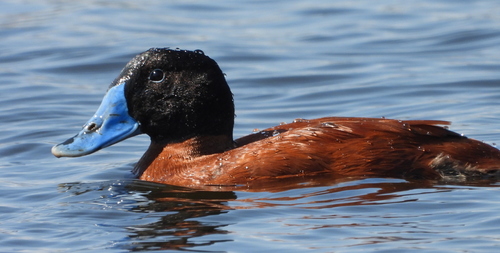
The breeding male Maccoa stands out with its cobalt blue bill extending from a completely black head and throat. The breast and back are chestnut coloured while the underparts are often greyish-brown, the rump is dark brown, and the tail and feet are black. In flight, the male's off-white underwing feathers and white axillaries can be seen. Non-breeding males closely resemble the females, except for a few points: a darker crown and hints of chestnut colour on the back.

The female Maccoa is less colourful. It boasts a greyish-black bill with a light tip, and a light brown face with a dark crown and cheek stripe, and an off-white throat. The female... Wikipedia →
Sounds

Call0:48

South Africa · 2018

© Lynette Rudman · XC434525 · CC BY-NC-SA 4.0

Call0:42

South Africa · 2017

© Faansie Peacock · XC388325 · CC BY-NC-SA 4.0

Global Distribution

Parks Where Found

# Park Country Daily sighting probability
1 Arusha National Park 🇹🇿 Tanzania
~10%
2 Garden Route National Park 🇿🇦 South Africa
<5%
3 De Hoop Nature Reserve 🇿🇦 South Africa
<5%
4 Ngorongoro Conservation Area 🇹🇿 Tanzania
<5%
5 Tarangire National Park 🇹🇿 Tanzania
<5%
6 Table Mountain National Park 🇿🇦 South Africa
<5%

Cities Where Found

# City Country Daily sighting probability
1 Cape Town 🇿🇦 South Africa
<5%
2 London 🇬🇧 United Kingdom
<5%

Zoos & Centres Where Found

# Zoo / Centre Country
1 Minnesota Zoo 🇺🇸 United States In captivity
2 Liberty's Owl, Raptor and Reptile Centre 🇬🇧 United Kingdom In captivity
3 Llys Nini 🇬🇧 United Kingdom In captivity
4 Portland Aquarium 🇺🇸 United States In captivity

Before you go

What are the chances of seeing a Maccoa Duck in Cape Town?

Rare

Under 5% of wildlife watchers report a Maccoa Duck sighting in Cape Town on a given day, based on 13 verified sightings from GBIF citizen-science data. It is the 171st most-seen of the 196 birds we can rate there. Over three days the chance rises to under 5%, if each day is a fresh chance.

When is the best time to see a Maccoa Duck in Cape Town?

Any time of year

In every month with enough records, under 5% of wildlife watchers report a Maccoa Duck in Cape Town on a given day, so our monthly data shows no clear season.

What time of day is best to see a Maccoa Duck?

Between 9 am and noon

Across all the parks we cover, that three-hour window holds the most Maccoa Duck sightings with a recorded time, and nearly all of them come between 6 am and 6 pm: it is a daytime animal.

Is Cape Town the best place to see a Maccoa Duck?

Yes

Of the 2 cities where we can rate Maccoa Duck sightings, Cape Town has the highest daily chance: under 5%. Next come London (United Kingdom, under 5%).

Which relatives of the Maccoa Duck live in Cape Town?

Same family: Anatidae

The closest relatives of the Maccoa Duck that you can see in Cape Town (family Anatidae, Ducks, Geese, and Swans) are Egyptian Goose (about 60%), Yellow-billed Duck (about 40%) and Cape Shoveler (about 20%), with each one's daily chance of a sighting.

Where does the Maccoa Duck sighting chance come from?

GBIF citizen-science records

It is estimated from how often the Maccoa Duck is recorded against all the birds logged in Cape Town (13 verified sightings), calibrated against known sighting rates. Figures are rounded to the nearest 10% because citizen-science data supports honest approximations, not decimals, and months with records from fewer than five people show "—". How it works.

← Back to Cape Town

