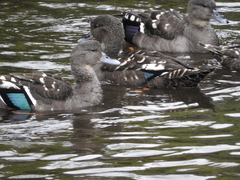
African Black Duck

African Black Duck

Anas sparsa

Silhouette: Sheatherius · PhyloPic

LCLeast ConcernNTVUENCR
Daily sighting probability <5% · Rare
at Cape Town

In 3 days ~10% in a week ~20%

140 Verified sightings at Cape Town
1,149 In all 15 parks From 2019 to 2026
September Best month
☀️ Diurnal When it's spotted

About the African Black Duck

The African black duck (Anas sparsa) is a species of duck of the genus Anas. It is genetically closest to the mallard group, but shows some peculiarities in its behavior and (as far as they can be discerned) plumage; it is accordingly placed in the subgenus Melananas pending further research.

The African black duck is a black duck with pronounced white marks on its back, a dark bill, and orange legs and feet. A purpish-blue speculum is often visible, especially in flight. It lives in central and southern Africa. It is also known as the black river duck, or (A. s. leucostigma) West African black duck or Ethiopian black duck. It is a medium-sized duck, with a length of 48–57 cm (19–22 in). The male is larger than the female.

The African black duck is mainly found in eastern and southern sub-Saharan Africa from South Africa north to South Sudan and Ethiopia with outlying populations in western equatorial Africa, in southeast Nigeria, Cameroon and Gabon.

It is a very shy and territorial duck. It is usually seen in pairs or small flocks. It breeds throughout the year in different areas. Incubation is about 30 days by... Wikipedia →

Sounds

Flight call0:07

South Africa · 1967

© Nature sounds by Simply Birding · XC615647 · CC BY-NC-ND 4.0

Call0:28

Ethiopia · 2009

© Rory Nefdt · XC41498 · CC BY-NC-ND 2.5

Call0:18

South Africa · 2019

© Lynette Rudman · XC464250 · CC BY-NC-SA 4.0

Global Distribution

Parks Where Found

# Park Country Daily sighting probability
1 Aberdare National Park 🇰🇪 Kenya
~20%
2 Bale Mountains National Park 🇪🇹 Ethiopia
~10%
3 Pilanesberg National Park 🇿🇦 South Africa
~10%
4 Golden Gate Highlands National Park 🇿🇦 South Africa
~10%
5 Arusha National Park 🇹🇿 Tanzania
~10%
6 Kruger National Park 🇿🇦 South Africa
<5%
7 Garden Route National Park 🇿🇦 South Africa
<5%
8 Lake Nakuru National Park 🇰🇪 Kenya
<5%
9 Bwindi Impenetrable National Park 🇺🇬 Uganda
<5%
10 Nairobi National Park 🇰🇪 Kenya
<5%
11 Table Mountain National Park 🇿🇦 South Africa
<5%
12 uMkhuze Game Reserve 🇿🇦 South Africa
<5%
13 Ngorongoro Conservation Area 🇹🇿 Tanzania
<5%
14 Kibale National Park 🇺🇬 Uganda
<5%
15 iSimangaliso Wetland Park 🇿🇦 South Africa
<5%

Cities Where Found

# City Country Daily sighting probability
1 Johannesburg 🇿🇦 South Africa
~10%
2 Lilongwe 🇲🇼 Malawi
~10%
3 Nairobi 🇰🇪 Kenya
~10%
4 Pretoria 🇿🇦 South Africa
~10%
5 Lubango 🇦🇴 Angola
~10%
6 Addis Ababa 🇪🇹 Ethiopia
<5%
7 Cape Town 🇿🇦 South Africa
<5%
8 Durban 🇿🇦 South Africa
<5%

Zoos & Centres Where Found

# Zoo / Centre Country
1 Prague Zoo 🇨🇿 Czechia In captivity
2 ZooParc de Beauval 🇫🇷 France In captivity
3 Réserve africaine de Sigean 🇫🇷 France In captivity
4 Cologne Zoological Garden 🇩🇪 Germany In captivity
5 Zoologischer Garten Magdeburg 🇩🇪 Germany In captivity
6 Valencia Bioparc 🇪🇸 Spain In captivity
7 World of Birds Wildlife Sanctuary and Monkey Park 🇿🇦 South Africa In captivity
8 Bali Bird Park 🇮🇩 Indonesia In captivity
9 Rákosův pavilon 🇨🇿 Czechia In captivity
10 Velemlokárium 🇨🇿 Czechia In captivity
11 Cologne Zoo Aquarium 🇩🇪 Germany In captivity
12 Vogelpark Turnersee 🇦🇹 Austria In captivity

Before you go

What are the chances of seeing an African Black Duck in Cape Town?

Rare

Under 5% of wildlife watchers report an African Black Duck sighting in Cape Town on a given day, based on 140 verified sightings from GBIF citizen-science data. It is the 117th most-seen of the 196 birds we can rate there. Over three days the chance rises to about 10%, and over a week to about 20%, if each day is a fresh chance.

When is the best time to see an African Black Duck in Cape Town?

July and September

In those months about 10% of wildlife watchers report an African Black Duck in Cape Town on a given day, against under 5% in August and October–June, the lowest months. Those are among Cape Town's wettest months, with about 95 mm of rain a month against 15 mm in February.

What time of day is best to see an African Black Duck?

Between 7 and 10 am

Across all the parks we cover, that three-hour window holds the most African Black Duck sightings with a recorded time, and about 9 in 10 of them come between 6 am and 6 pm: it is a daytime animal.

Is Cape Town the best place to see an African Black Duck?

7th of 8

Of the 8 cities where we can rate African Black Duck sightings, Cape Town ranks 7th at under 5%. The best odds are in Johannesburg (South Africa, about 10%), Lilongwe (Malawi, about 10%) and Nairobi (Kenya, about 10%).

Which relatives of the African Black Duck live in Cape Town?

Same genus: Anas

The closest relatives of the African Black Duck that you can see in Cape Town (genus Anas, Mallards, Pintails, and Allies) are Yellow-billed Duck (about 40%), Red-billed Teal (about 10%) and Cape Teal (about 10%), with each one's daily chance of a sighting.

Where does the African Black Duck sighting chance come from?

GBIF citizen-science records

It is estimated from how often the African Black Duck is recorded against all the birds logged in Cape Town (140 verified sightings), calibrated against known sighting rates. Figures are rounded to the nearest 10% because citizen-science data supports honest approximations, not decimals, and months with records from fewer than five people show "—". How it works.

← Back to Cape Town