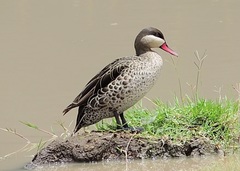
Red-billed Teal

Red-billed Teal

Anas erythrorhyncha

Silhouette: Sheatherius · PhyloPic

LCLeast ConcernNTVUENCR
Daily sighting probability ~10% · With luck
at Cape Town

In 3 days ~20% in a week ~40%

245 Verified sightings at Cape Town
4,289 In all 29 parks From 2019 to 2026
November Best month
☀️ Diurnal When it's spotted

About the Red-billed Teal

The red-billed teal or red-billed duck (Anas erythrorhyncha) is a dabbling duck which is an abundant resident breeder in southern and eastern Africa. typically south of 10° S. This duck is not migratory, but flies great distances to find suitable waters. It is highly gregarious outside the breeding season and forms large flocks.

The red-billed teal was formally described in 1789 by German naturalist Johann Friedrich Gmelin in his revised and expanded edition of Carl Linnaeus's Systema Naturae. He placed it with all the other ducks, geese, and swans in the genus Anas and coined the binomial name Anas erythrorhyncha. Gmelin based his description on the "crimson-billed duck" that had been described in 1785 by English ornithologist John Latham in his A General Synopsis of Birds. Latham specied the type locality as the Cape of Good Hope. The genus name Anas is the Latin word for a duck. The specific epithet erythrorhyncha combines the Ancient Greek eruthros meaning "red" with rhunkhos meaning "bill". The species is monotypic: no subspecies are recognised.

The red-billed teal is 43–48 cm (17–19 in) long and has a blackish cap and nape, contrasting pale face... Wikipedia →

Sounds

Call0:05

Tanzania · 2019

© Peter Boesman · XC509856 · CC BY-NC-ND 4.0

Call1:29

South Africa · 2021

© Lynette Rudman · XC649290 · CC BY-NC-SA 4.0

Call0:22

Madagascar · 2019

© Dries Van de Loock · XC536710 · CC BY-NC-SA 4.0

Global Distribution

Parks Where Found

# Park Country Daily sighting probability
1 Amboseli National Park 🇰🇪 Kenya
~50%
2 Hwange National Park 🇿🇼 Zimbabwe
~40%
3 Ngorongoro Conservation Area 🇹🇿 Tanzania
~30%
4 Lake Nakuru National Park 🇰🇪 Kenya
~20%
5 Pilanesberg National Park 🇿🇦 South Africa
~20%
6 De Hoop Nature Reserve 🇿🇦 South Africa
~20%
7 Nairobi National Park 🇰🇪 Kenya
~20%
8 Etosha National Park 🇳🇦 Namibia
~20%
9 Chobe National Park 🇧🇼 Botswana
~20%
10 Arusha National Park 🇹🇿 Tanzania
~20%
11 Moremi Game Reserve 🇧🇼 Botswana
~20%
12 iSimangaliso Wetland Park 🇿🇦 South Africa
~10%
13 Mantadia National Park 🇲🇬 Madagascar
~10%
14 Serengeti National Park 🇹🇿 Tanzania
~10%
15 Garden Route National Park 🇿🇦 South Africa
~10%
16 Akagera National Park 🇷🇼 Rwanda
~10%
17 Tsavo East National Park 🇰🇪 Kenya
~10%
18 Addo Elephant National Park 🇿🇦 South Africa
~10%
19 West Coast National Park 🇿🇦 South Africa
<5%
20 Tsavo West National Park 🇰🇪 Kenya
<5%
21 Berenty Reserve 🇲🇬 Madagascar
<5%
22 Lake Manyara National Park 🇹🇿 Tanzania
<5%
23 Kafue National Park 🇿🇲 Zambia
<5%
24 Liwonde National Park 🇲🇼 Malawi
<5%
25 Tarangire National Park 🇹🇿 Tanzania
<5%
26 Ranomafana National Park 🇲🇬 Madagascar
<5%
27 Kruger National Park 🇿🇦 South Africa
<5%
28 Masai Mara National Reserve 🇰🇪 Kenya
<5%
29 Table Mountain National Park 🇿🇦 South Africa
<5%

Cities Where Found

# City Country Daily sighting probability
1 Antananarivo 🇲🇬 Madagascar
~70%
2 Maputo 🇲🇿 Mozambique
~10%
3 Cape Town 🇿🇦 South Africa
~10%
4 Harare 🇿🇼 Zimbabwe
~10%
5 Pretoria 🇿🇦 South Africa
<5%
6 Johannesburg 🇿🇦 South Africa
<5%

Zoos & Centres Where Found

# Zoo / Centre Country
1 Disney's Animal Kingdom 🇺🇸 United States In captivity
2 San Diego Zoo 🇺🇸 United States In captivity
3 Tierpark Berlin 🇩🇪 Germany In captivity
4 Zürich Zoo 🇨🇭 Switzerland In captivity
5 Slimbridge Wetland Centre 🇬🇧 United Kingdom In captivity
6 Cologne Zoological Garden 🇩🇪 Germany In captivity
7 World of Birds Wildlife Sanctuary and Monkey Park 🇿🇦 South Africa In captivity
8 Lemur Island 🇲🇬 Madagascar In captivity
9 Birds of Eden 🇿🇦 South Africa In captivity
10 Cologne Zoo Aquarium 🇩🇪 Germany In captivity
11 Zooparque Itatiba 🇧🇷 Brazil In captivity

Before you go

What are the chances of seeing a Red-billed Teal in Cape Town?

With luck

About 10% of wildlife watchers report a Red-billed Teal sighting in Cape Town on a given day, based on 245 verified sightings from GBIF citizen-science data. It is the 69th most-seen of the 196 birds we can rate there. Over three days the chance rises to about 20%, and over a week to about 40%, if each day is a fresh chance.

When is the best time to see a Red-billed Teal in Cape Town?

May–July and September–February

In those months about 10% of wildlife watchers report a Red-billed Teal in Cape Town on a given day, against under 5% in March–April and August, the lowest months.

What time of day is best to see a Red-billed Teal?

Between 8 and 11 am

Across all the parks we cover, that three-hour window holds the most Red-billed Teal sightings with a recorded time, and about 9 in 10 of them come between 6 am and 6 pm: it is a daytime animal.

Is Cape Town the best place to see a Red-billed Teal?

3rd of 6

Of the 6 cities where we can rate Red-billed Teal sightings, Cape Town ranks 3rd at about 10%. The best odds are in Antananarivo (Madagascar, about 70%) and Maputo (Mozambique, about 10%).

Which relatives of the Red-billed Teal live in Cape Town?

Same genus: Anas

The closest relatives of the Red-billed Teal that you can see in Cape Town (genus Anas, Mallards, Pintails, and Allies) are Yellow-billed Duck (about 40%) and Cape Teal (about 10%), with each one's daily chance of a sighting.

Where does the Red-billed Teal sighting chance come from?

GBIF citizen-science records

It is estimated from how often the Red-billed Teal is recorded against all the birds logged in Cape Town (245 verified sightings), calibrated against known sighting rates. Figures are rounded to the nearest 10% because citizen-science data supports honest approximations, not decimals, and months with records from fewer than five people show "—". How it works.

← Back to Cape Town

