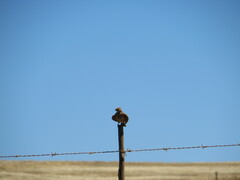
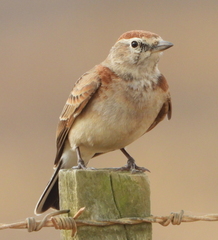
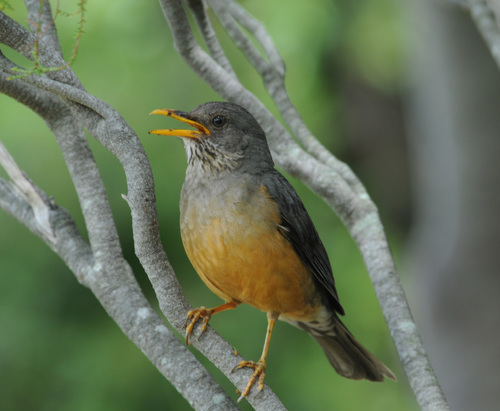
Red-capped Lark

Red-capped Lark

Calandrella cinerea

Silhouette: Gossipguy and T. Michael Keesey · PhyloPic

LCLeast ConcernNTVUENCR
Daily sighting probability <5% · Rare
at Cape Town

In 3 days <5%

16 Verified sightings at Cape Town
3,842 In all 20 parks From 2019 to 2026
December Best month
☀️ Diurnal When it's spotted

About the Red-capped Lark

The red-capped lark (Calandrella cinerea) is a small passerine bird that breeds in the highlands of eastern Africa southwards from Ethiopia and Somaliland. In the south, its range stretches across the continent to Angola and south to the Cape in South Africa.

The red-capped lark was formally described in 1789 by the German naturalist Johann Friedrich Gmelin in his revised and expanded edition of Carl Linnaeus's Systema Naturae. He placed it with the larks in the genus Alauda and coined the binomial name Alauda cinerea. Gmelin based his description on "la Cendrille" from the Cape of Good Hope that had been described by the French polymath Comte de Buffon in 1778 and the "cinereous lark" that had been described by the English ornithologist John Latham in 1783. The red-capped lark is now one of six species placed in the genus Calandrella that was introduced in 1829 by the German naturalist Johann Jakob Kaup. The genus name is a diminutive of Ancient Greek kalandros, the calandra lark. The specific epithet cinerea is from Latin cinereus meaning "ash-grey" or "ash-coloured".

The red-capped lark was formerly considered to be conspecific with the Mongolian lark (Calandrella... Wikipedia →

Sounds

Song0:44

Tanzania · 2026

Kileo Jumah · XC1149005 · CC0

Call0:17

South Africa · 2025

© Ehren Eksteen · XC1005404 · CC BY-NC-SA 4.0

Flight call0:10

Zambia · 2022

© Dries Van de Loock · XC745609 · CC BY-NC-SA 4.0

Global Distribution

Parks Where Found

# Park Country Daily sighting probability
1 Etosha National Park 🇳🇦 Namibia
~40%
2 Ngorongoro Conservation Area 🇹🇿 Tanzania
~30%
3 De Hoop Nature Reserve 🇿🇦 South Africa
~30%
4 Amboseli National Park 🇰🇪 Kenya
~20%
5 Masai Mara National Reserve 🇰🇪 Kenya
~20%
6 Serengeti National Park 🇹🇿 Tanzania
~10%
7 Addo Elephant National Park 🇿🇦 South Africa
~10%
8 West Coast National Park 🇿🇦 South Africa
~10%
9 Nairobi National Park 🇰🇪 Kenya
~10%
10 Lake Nakuru National Park 🇰🇪 Kenya
~10%
11 Queen Elizabeth National Park 🇺🇬 Uganda
~10%
12 Golden Gate Highlands National Park 🇿🇦 South Africa
~10%
13 Kafue National Park 🇿🇲 Zambia
~10%
14 Hwange National Park 🇿🇼 Zimbabwe
<5%
15 Akagera National Park 🇷🇼 Rwanda
<5%
16 Virunga National Park 🇨🇩 Democratic Republic of the Congo
<5%
17 Kruger National Park 🇿🇦 South Africa
<5%
18 Garden Route National Park 🇿🇦 South Africa
<5%
19 Moremi Game Reserve 🇧🇼 Botswana
<5%
20 Chobe National Park 🇧🇼 Botswana
<5%

Cities Where Found

# City Country Daily sighting probability
1 Cape Town 🇿🇦 South Africa
<5%

Before you go

What are the chances of seeing a Red-capped Lark in Cape Town?

Rare

Under 5% of wildlife watchers report a Red-capped Lark sighting in Cape Town on a given day, based on 16 verified sightings from GBIF citizen-science data. It is the 167th most-seen of the 196 birds we can rate there. Over three days the chance rises to under 5%, if each day is a fresh chance.

When is the best time to see a Red-capped Lark in Cape Town?

Any time of year

In every month with enough records, under 5% of wildlife watchers report a Red-capped Lark in Cape Town on a given day, so our monthly data shows no clear season.

What time of day is best to see a Red-capped Lark?

Between 9 am and noon

Across all the parks we cover, that three-hour window holds the most Red-capped Lark sightings with a recorded time, and about 9 in 10 of them come between 6 am and 6 pm: it is a daytime animal.

Where else can you see a Red-capped Lark?

Only Cape Town, in our data

Cape Town is the only city on Wallace's Line with enough records to rate Red-capped Lark sightings: under 5% of wildlife watchers there report one on a given day.

Which relatives of the Red-capped Lark live in Cape Town?

Same order: Passeriformes

The closest relatives of the Red-capped Lark that you can see in Cape Town (order Passeriformes, Perching Birds) are Cape White-eye (about 70%), European Starling (about 70%) and Cape Sparrow (about 70%), with each one's daily chance of a sighting.

Where does the Red-capped Lark sighting chance come from?

GBIF citizen-science records

It is estimated from how often the Red-capped Lark is recorded against all the birds logged in Cape Town (16 verified sightings), calibrated against known sighting rates. Figures are rounded to the nearest 10% because citizen-science data supports honest approximations, not decimals, and months with records from fewer than five people show "—". How it works.

← Back to Cape Town