
Rock Kestrel

Rock Kestrel

Falco rupicolus

Silhouette: Shyamal · PhyloPic

Daily sighting probability ~10% · With luck
at Cape Town

In 3 days ~20% in a week ~40%

333 Verified sightings at Cape Town
2,908 In all 13 parks From 2019 to 2026
September Best month
☀️ Diurnal When it's spotted

About the Rock Kestrel

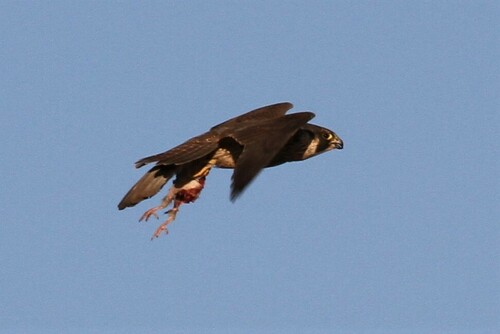
The rock kestrel (Falco rupicolus) is a bird of prey species belonging to the kestrel group of the falcon family Falconidae. It was previously considered a subspecies of the common kestrel (Falco tinnunculus). This species occurs in Africa, from northwestern Angola and southern Democratic Republic of Congo to southern Tanzania, and south to South Africa.

A slender, medium-sized kestrel, between 30 and 33 centimeters tall. Adult male kestrels weigh between 183g and 254g, while females weigh between 190g and 280g. The species occurs from Angola, south through the Democratic Republic of Congo as well as Tanzania, further south to South Africa, and in most of the places between. Noticeable places of scarcity include north and north east Namibia, Botswana, south Mozambique and tropical Lowveld, while in Zimbabwe it is restricted to high-lying central and eastern regions. The kestrel is usually associated with arid areas, but may also be found in open and/or semi-arid areas.

Rock kestrels feed on a wide variety of organisms. They eat primarily invertebrates, but have been known to consume rodents... Wikipedia →

Sounds

Call0:27

South Africa · 2014

© Peter Boesman · XC280308 · CC BY-NC-ND 4.0

Flight call0:41

South Africa · 2019

© Lynette Rudman · XC459239 · CC BY-NC-SA 4.0

Call0:04

South Africa · 2024

© Nick Talbot · XC947439 · CC BY-NC-SA 4.0

Global Distribution

Parks Where Found

# Park Country Daily sighting probability
1 West Coast National Park 🇿🇦 South Africa
~70%
2 Golden Gate Highlands National Park 🇿🇦 South Africa
~30%
3 De Hoop Nature Reserve 🇿🇦 South Africa
~30%
4 Waterberg Plateau Park 🇳🇦 Namibia
~30%
5 Kgalagadi Transfrontier Park 🇿🇦 South Africa
~20%
6 Namib-Naukluft National Park 🇳🇦 Namibia
~10%
7 Table Mountain National Park 🇿🇦 South Africa
~10%
8 Addo Elephant National Park 🇿🇦 South Africa
~10%
9 Etosha National Park 🇳🇦 Namibia
~10%
10 Pilanesberg National Park 🇿🇦 South Africa
<5%
11 Garden Route National Park 🇿🇦 South Africa
<5%
12 Kruger National Park 🇿🇦 South Africa
<5%
13 Moremi Game Reserve 🇧🇼 Botswana
<5%

Cities Where Found

# City Country Daily sighting probability
1 Luanda 🇦🇴 Angola
~20%
2 Cape Town 🇿🇦 South Africa
~10%

Zoos & Centres Where Found

# Zoo / Centre Country
1 Dullstroom Bird Of Prey & Rehabilitation Centre 🇿🇦 South Africa In captivity
2 World of Birds Wildlife Sanctuary and Monkey Park 🇿🇦 South Africa In captivity

Before you go

What are the chances of seeing a Rock Kestrel in Cape Town?

With luck

About 10% of wildlife watchers report a Rock Kestrel sighting in Cape Town on a given day, based on 333 verified sightings from GBIF citizen-science data. It is the 66th most-seen of the 196 birds we can rate there. Over three days the chance rises to about 20%, and over a week to about 40%, if each day is a fresh chance.

When is the best time to see a Rock Kestrel in Cape Town?

March–October and December–January

In those months about 10% of wildlife watchers report a Rock Kestrel in Cape Town on a given day, against under 5% in February and November, the lowest months.

What time of day is best to see a Rock Kestrel?

Between 10 am and 1 pm

Across all the parks we cover, that three-hour window holds the most Rock Kestrel sightings with a recorded time, and nearly all of them come between 6 am and 6 pm: it is a daytime animal.

Is Cape Town the best place to see a Rock Kestrel?

2nd of 2

Of the 2 cities where we can rate Rock Kestrel sightings, Cape Town ranks 2nd at about 10%. The best odds are in Luanda (Angola, about 20%).

Where does the Rock Kestrel sighting chance come from?

GBIF citizen-science records

It is estimated from how often the Rock Kestrel is recorded against all the birds logged in Cape Town (333 verified sightings), calibrated against known sighting rates. Figures are rounded to the nearest 10% because citizen-science data supports honest approximations, not decimals, and months with records from fewer than five people show "—". How it works.

← Back to Cape Town