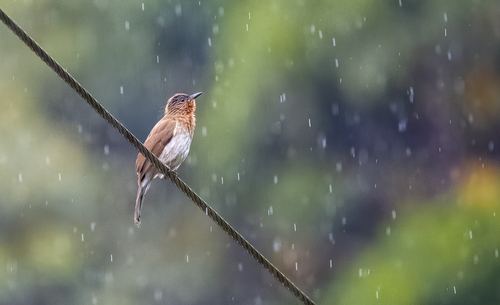
About the Tawny Grassbird
The tawny grassbird (Cincloramphus timoriensis) is a large songbird that is a member of the family Locustellidae commonly found in grassland and reedbed habitats. It is streaked above and has a distinctive rich brown cap. Its underside is paler and it has a long graduated tail. They call often with "loud, grumpy churring calls and a longer call that starts tick-tick-tick-tick and ends with an explosive descending trill".
The tawny grassbird has 10 identified sub-species found in Australia, Indonesia, Papua New Guinea and the Philippines. The family Locustellidae was named by Bonaparte in 1854 and is derived from the genus name Locustella named by Kemp in 1829. The term "grassbird" was used by Gould during the mid 19th century to signify a strong correlation to long grass habitats. The tawny grassbird has also been known as tawny sphenoeacus, grassbird, tawny or rufous-capped marshbird, rufous-capped grass-warbler and rufous-capped grassbird. Grass-warbler tends to be used in Asia rather than Australia. Genetic studies indicate a close relationship to songlarks.
Ten subspecies are recognised: Wikipedia →