Orange Ladybird

Orange Ladybird

Halyzia sedecimguttata

Daily sighting probability ~10% · With luck
at Copenhagen

In 3 days ~20% in a week ~40%

28 Verified sightings at Copenhagen
160 In all 9 parks From 2019 to 2026
October Best month
☀️🌙 Day & Night When it's spotted

About the Orange Ladybird

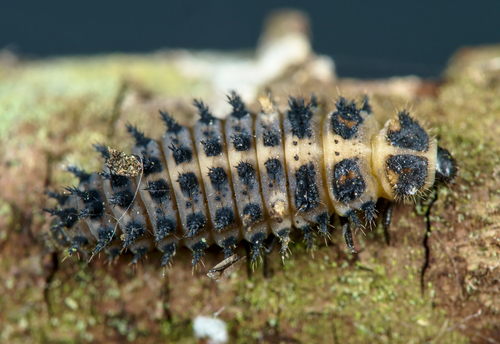
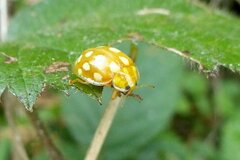
Halyzia sedecimguttata, the orange ladybird, is a species of Coccinellidae (ladybirds) family. Halyzia sedecimguttata is common in Europe, European Russia, the Caucasus, Siberia, the Russian Far East, Belarus, Ukraine, Transcaucasia, Kazakhstan, Asia Minor, Mongolia, Northern China, Japan.

It was formerly uncommon in the Ireland and Britain but the species has established itself over the 20th-century and it is now common in many parts. Common in woodlands, it is more frequent in dry areas, mainly in deciduous woodland (Western European broadleaf forests, Palearctic temperate broadleaf and mixed forest) and in parkland, at forest edges, and on hedges.

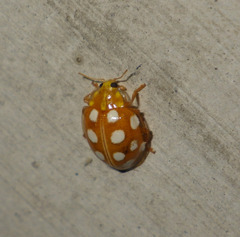
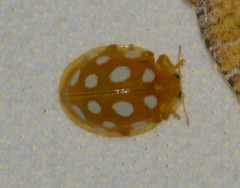
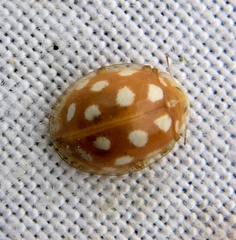
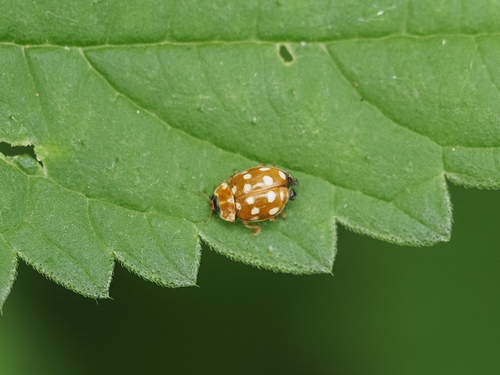
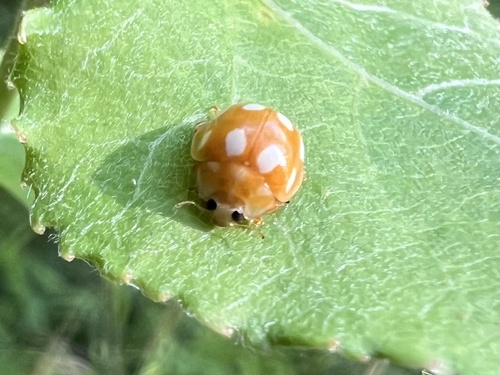
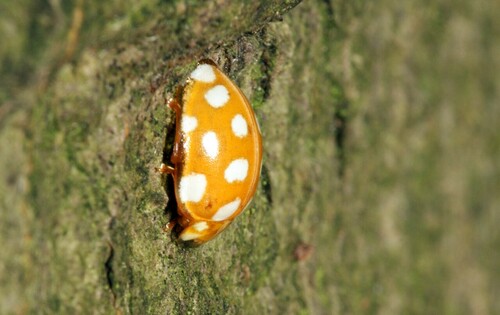
Halyzia sedecimguttata can reach a length of 5–6 millimetres (0.20–0.24 in). These beetles have an oval shaped body, rather round than elongated. Compound eyes are black. The antennae are light-brown, quite long and slightly thickened at the end. Their physical appearance is marked by a striking orange colour and the presence of 16 (sometimes less) creamy white large spots on the elytra (eight spots on each elytron). The neck shield usually covers the head and shows orange colored spots... Wikipedia →
Global Distribution

Parks Where Found

# Park Country Daily sighting probability
1 Aigüestortes National Park 🇪🇸 Spain
~20%
2 Snowdonia National Park 🇬🇧 United Kingdom
~10%
3 Cairngorms National Park 🇬🇧 United Kingdom
~10%
4 Vanoise National Park 🇫🇷 France
~10%
5 Mercantour National Park 🇫🇷 France
~10%
6 Bavarian Forest National Park 🇩🇪 Germany
~10%
7 Pyrénées National Park 🇫🇷 France
~10%
8 Wadden Sea National Park 🇩🇪 Germany
~10%
9 Cévennes National Park 🇫🇷 France
<5%

Cities Where Found

# City Country Daily sighting probability
1 Liverpool 🇬🇧 United Kingdom
~20%
2 London 🇬🇧 United Kingdom
~20%
3 Nizhny Novgorod 🇷🇺 Russia
~10%
4 Paris 🇫🇷 France
~10%
5 Brussels 🇧🇪 Belgium
~10%
6 Birmingham 🇬🇧 United Kingdom
~10%
7 Manchester 🇬🇧 United Kingdom
~10%
8 Helsinki 🇫🇮 Finland
~10%
9 Novosibirsk 🇷🇺 Russia
~10%
10 Essen 🇩🇪 Germany
~10%

Before you go

What are the chances of seeing an Orange Ladybird in Copenhagen?

With luck

About 10% of wildlife watchers report an Orange Ladybird sighting in Copenhagen on a given day, based on 28 verified sightings from GBIF citizen-science data. It is the 123rd most-seen of the 476 insects we can rate there. Over three days the chance rises to about 20%, and over a week to about 40%, if each day is a fresh chance.

When is the best time to see an Orange Ladybird in Copenhagen?

October

In that month about 20% of wildlife watchers report an Orange Ladybird in Copenhagen on a given day, against under 5% in June and November–February, the lowest months.

What time of day is best to see an Orange Ladybird?

Between 2 and 5 pm

Across all the parks we cover, that three-hour window holds the most Orange Ladybird sightings with a recorded time, and about 6 in 10 of them come between 6 am and 6 pm: it is seen both by day and at night.

Is Copenhagen the best place to see an Orange Ladybird?

22nd of 30

Of the 30 cities where we can rate Orange Ladybird sightings, Copenhagen ranks 22nd at about 10%. The best odds are in Liverpool (United Kingdom, about 20%), London (United Kingdom, about 20%) and Nizhny Novgorod (Russia, about 10%).

Where does the Orange Ladybird sighting chance come from?

GBIF citizen-science records

It is estimated from how often the Orange Ladybird is recorded against all the insects logged in Copenhagen (28 verified sightings), calibrated against known sighting rates. Figures are rounded to the nearest 10% because citizen-science data supports honest approximations, not decimals, and months with records from fewer than five people show "—". How it works.

← Back to Copenhagen