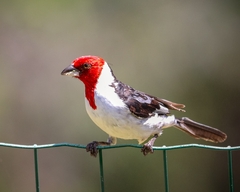
Red-cowled Cardinal

Red-cowled Cardinal

Paroaria dominicana

Silhouette: Sheatherius · PhyloPic

LCLeast ConcernNTVUENCR Endemic
Daily sighting probability <5% · Rare
at Curitiba

In 3 days <5%

7 Verified sightings at Curitiba
411 In all 2 parks From 2019 to 2026
August Best month
☀️ Diurnal When it's spotted

About the Red-cowled Cardinal

The red-cowled cardinal (Paroaria dominicana) is a bird species in the tanager family (Thraupidae). It is not very closely related to the cardinals proper (Cardinalidae). It is endemic to Brazil. It occurs in a wide range of dry to semi-humid open to semi-open habitats in north-eastern Brazil, especially the Caatinga region. It has been introduced (probably by means of escaped caged individuals) to Rio de Janeiro and São Paulo, being locally common even in urban areas.

The red-cowled cardinal was formally described in 1758 by the Swedish naturalist Carl Linnaeus in the tenth edition of his Systema Naturae. He placed it with the crossbills in the genus Loxia and coined the binomial name Loxia dominica. The specific epithet alludes to the black and white habits of members of the Dominican Order. The red-cowled cardinal is now one of six species placed in the genus Paroaria that was introduced by Charles Lucien Bonaparte in 1832. The species is monotypic: no subspecies are recognised.

Red-cowled Cardinal videos on the Internet Bird Collection Red-cowled Cardinal photo gallery Archived 2011-05-16 at the Wayback Machine VIREO Photo-High... Wikipedia →

Sounds

Call0:36

Brazil · 2026

© JAYRSON ARAUJO DE OLIVEIRA · XC1162314 · CC BY-NC-SA 4.0

Song1:09

Brazil · 2004

© Peter Boesman · XC405370 · CC BY-NC-ND 4.0

?0:31

Brazil · 2010

© Jose Raimundo Nascimento · XC66946 · CC BY-NC-ND 2.5

Global Distribution

Parks Where Found

# Park Country Daily sighting probability
1 Chapada Diamantina National Park 🇧🇷 Brazil
~50%
2 Tijuca National Park 🇧🇷 Brazil
<5%

Cities Where Found

# City Country Daily sighting probability
1 Natal 🇧🇷 Brazil
~40%
2 Salvador 🇧🇷 Brazil
~20%
3 Vitória 🇧🇷 Brazil
~20%
4 Fortaleza 🇧🇷 Brazil
~10%
5 Brasilia 🇧🇷 Brazil
~10%
6 São Paulo 🇧🇷 Brazil
<5%
7 Rio de Janeiro 🇧🇷 Brazil
<5%
8 João Pessoa 🇧🇷 Brazil
<5%
9 Goiânia 🇧🇷 Brazil
<5%
10 Santos 🇧🇷 Brazil
<5%

Zoos & Centres Where Found

# Zoo / Centre Country
1 Prague Zoo 🇨🇿 Czechia In captivity
2 Parque das Aves 🇧🇷 Brazil In captivity
3 Parc des oiseaux 🇫🇷 France In captivity
4 Zoo Aquarium de Madrid 🇪🇸 Spain In captivity
5 London Zoo 🇬🇧 United Kingdom In captivity
6 Zoo das Aves 🇧🇷 Brazil In captivity
7 Rákosův pavilon 🇨🇿 Czechia In captivity
8 Velemlokárium 🇨🇿 Czechia In captivity

Before you go

What are the chances of seeing a Red-cowled Cardinal in Curitiba?

Rare

Under 5% of wildlife watchers report a Red-cowled Cardinal sighting in Curitiba on a given day, based on 7 verified sightings from GBIF citizen-science data. It is the 233rd most-seen of the 247 birds we can rate there. Over three days the chance rises to under 5%, if each day is a fresh chance.

When is the best time to see a Red-cowled Cardinal in Curitiba?

Any time of year

In every month with enough records, under 5% of wildlife watchers report a Red-cowled Cardinal in Curitiba on a given day, so our monthly data shows no clear season.

What time of day is best to see a Red-cowled Cardinal?

Between 1 and 4 pm

Across all the parks we cover, that three-hour window holds the most Red-cowled Cardinal sightings with a recorded time, and about 9 in 10 of them come between 6 am and 6 pm: it is a daytime animal.

Is Curitiba the best place to see a Red-cowled Cardinal?

11th of 11

Of the 11 cities where we can rate Red-cowled Cardinal sightings, Curitiba ranks 11th at under 5%. The best odds are in Natal (Brazil, about 40%), Salvador (Brazil, about 20%) and Vitória (Brazil, about 20%).

Where does the Red-cowled Cardinal sighting chance come from?

GBIF citizen-science records

It is estimated from how often the Red-cowled Cardinal is recorded against all the birds logged in Curitiba (7 verified sightings), calibrated against known sighting rates. Figures are rounded to the nearest 10% because citizen-science data supports honest approximations, not decimals, and months with records from fewer than five people show "—". How it works.

← Back to Curitiba