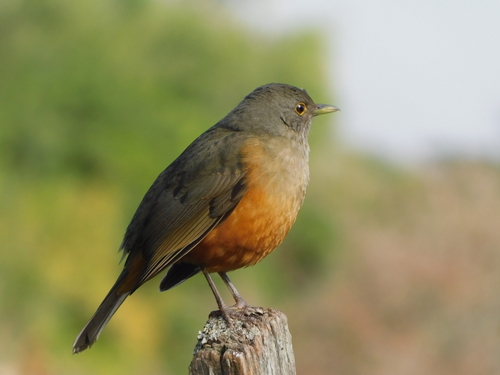
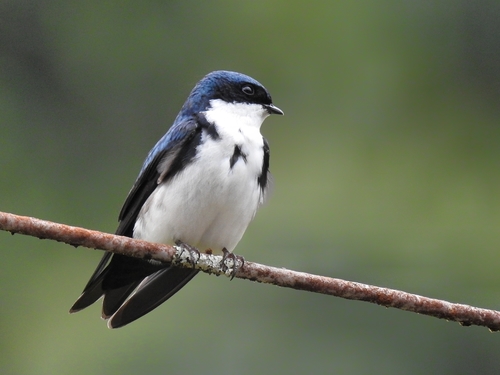
Rufous Gnateater

Rufous Gnateater

Conopophaga lineata

Silhouette: Sheatherius · PhyloPic

LCLeast ConcernNTVUENCR
Daily sighting probability <5% · Rare
at Curitiba

In 3 days ~10% in a week ~20%

42 Verified sightings at Curitiba
1,281 In all 5 parks From 2019 to 2026
March Best month
☀️ Diurnal When it's spotted

About the Rufous Gnateater

The rufous gnateater (Conopophaga lineata) is a passerine bird of the gnateater family, Conopophagidae. It is found in forest understory and bushes in eastern Brazil from Rio Grande do Sul north to central Brazil. Its range also extends into eastern Paraguay and north-eastern Argentina and it has recently been recorded in Uruguay. It is often elusive and hard to see, but is commoner and less shy than other gnateaters.

It is a small, rounded bird, 13 cm in length with a short tail and fairly long legs. The plumage is mostly reddish brown. There is a white stripe above the eye (grey in the female) which ends in a tuft of feathers which can be hidden. The call is a series of quiet cheeps which become faster and higher-pitched. At dusk and dawn the males make a buzzing sound with their wing feathers as they fly around their territory.

The rufous gnateater feeds by moving quickly from one perch to another through undergrowth close to the ground. When it sees an insect it makes a short flight down to the ground or to overhead leaves to catch it. The cup-shaped nest is built in a tree and made of sticks and moss. The female lays two buff-coloured eggs, oval or slightly conical... Wikipedia →

Sounds

Call0:11

Argentina · 2026

© Marcos E. Sosa · XC1138314 · CC BY-NC-SA 4.0

Song0:31

Brazil · 2025

© Joost van Bruggen · XC1050559 · CC BY-NC-ND 4.0

Alarm call1:22

Brazil · 2020

© Ciro Albano · XC576482 · CC BY-NC-SA 4.0

Global Distribution

Parks Where Found

# Park Country Daily sighting probability
1 Itatiaia National Park 🇧🇷 Brazil
~20%
2 Serra dos Órgãos National Park 🇧🇷 Brazil
~10%
3 Iguazú National Park 🇦🇷 Argentina
~10%
4 Iguaçu National Park 🇧🇷 Brazil
~10%
5 Serra da Canastra National Park 🇧🇷 Brazil
<5%

Cities Where Found

# City Country Daily sighting probability
1 Curitiba 🇧🇷 Brazil
<5%
2 Campinas 🇧🇷 Brazil
<5%
3 São Paulo 🇧🇷 Brazil
<5%
4 Belo Horizonte 🇧🇷 Brazil
<5%

Before you go

What are the chances of seeing a Rufous Gnateater in Curitiba?

Rare

Under 5% of wildlife watchers report a Rufous Gnateater sighting in Curitiba on a given day, based on 42 verified sightings from GBIF citizen-science data. It is the 143rd most-seen of the 247 birds we can rate there. Over three days the chance rises to about 10%, and over a week to about 20%, if each day is a fresh chance.

When is the best time to see a Rufous Gnateater in Curitiba?

March, May and July–August

In those months about 10% of wildlife watchers report a Rufous Gnateater in Curitiba on a given day, against under 5% in April, June and September–February, the lowest months.

What time of day is best to see a Rufous Gnateater?

Between 9 am and noon

Across all the parks we cover, that three-hour window holds the most Rufous Gnateater sightings with a recorded time, and nearly all of them come between 6 am and 6 pm: it is a daytime animal.

Is Curitiba the best place to see a Rufous Gnateater?

Yes

Of the 4 cities where we can rate Rufous Gnateater sightings, Curitiba has the highest daily chance: under 5%. Next come Campinas (Brazil, under 5%) and São Paulo (Brazil, under 5%).

Which relatives of the Rufous Gnateater live in Curitiba?

Same order: Passeriformes

The closest relatives of the Rufous Gnateater that you can see in Curitiba (order Passeriformes, Perching Birds) are Great Kiskadee (about 90%), Rufous-bellied Thrush (about 90%) and Rufous Hornero (about 90%), with each one's daily chance of a sighting.

Where does the Rufous Gnateater sighting chance come from?

GBIF citizen-science records

It is estimated from how often the Rufous Gnateater is recorded against all the birds logged in Curitiba (42 verified sightings), calibrated against known sighting rates. Figures are rounded to the nearest 10% because citizen-science data supports honest approximations, not decimals, and months with records from fewer than five people show "—". How it works.

← Back to Curitiba