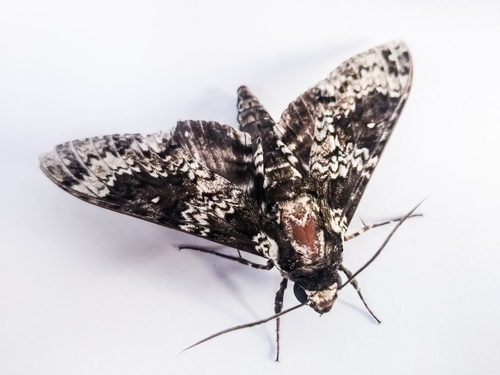
Snowberry Clearwing

Snowberry Clearwing

Hemaris diffinis

Daily sighting probability ~10% · With luck
at Dallas

In 3 days ~20% in a week ~50%

193 Verified sightings at Dallas
138 In all 5 parks From 2019 to 2026
July Best month
☀️ Diurnal When it's spotted

About the Snowberry Clearwing

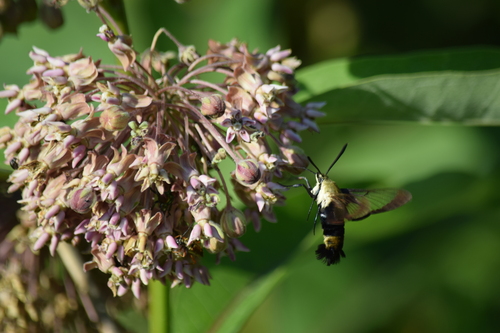
Hemaris diffinis, the snowberry clearwing, is a moth of the family Sphingidae. This moth is sometimes called "hummingbird moth" or "flying lobster". This moth should not be confused with the hummingbird hawk-moth of Europe.

It is about 32–51 millimetres (1.25–2 in). The moth's abdomen has yellow and black segments much like those of the bumblebee, for which it might be mistaken due to its color and flight pattern similarities. The moth's wings lack the large amount of scales found in most other lepidopterans, particularly in the centralized regions, making them appear clear. It loses the scales on its wings early after the pupa stage due to its highly active flight tendencies.

It flies during the daylight much like the other hummingbird moths, but it may also continue flight into the evening, particularly if it has found a good source of nectar. The moth is found in the Northwest Territories, British Columbia (including the Cariboo region), southern Ontario, eastern Manitoba, and western Quebec in Canada. In the United States, this species has been located in southern California and Baja California Norte, Illinois, and east through most... Wikipedia →
Global Distribution

Parks Where Found

# Park Country Daily sighting probability
1 Isle Royale National Park 🇺🇸 United States
~30%
2 Shenandoah National Park 🇺🇸 United States
~20%
3 Great Smoky Mountains National Park 🇺🇸 United States
~10%
4 Point Pelee National Park 🇨🇦 Canada
~10%
5 Acadia National Park 🇺🇸 United States
~10%

Cities Where Found

# City Country Daily sighting probability
1 Austin 🇺🇸 United States
~10%
2 Dallas 🇺🇸 United States
~10%
3 Baltimore 🇺🇸 United States
~10%
4 Washington 🇺🇸 United States
~10%
5 Minneapolis [Saint Paul] 🇺🇸 United States
~10%
6 Detroit 🇺🇸 United States
~10%
7 Philadelphia 🇺🇸 United States
<5%
8 Chicago 🇺🇸 United States
<5%
9 Montreal 🇨🇦 Canada
<5%
10 Boston 🇺🇸 United States
<5%

Before you go

What are the chances of seeing a Snowberry Clearwing in Dallas?

With luck

About 10% of wildlife watchers report a Snowberry Clearwing sighting in Dallas on a given day, based on 193 verified sightings from GBIF citizen-science data. It is the 98th most-seen of the 1412 insects we can rate there. Over three days the chance rises to about 20%, and over a week to about 50%, if each day is a fresh chance.

When is the best time to see a Snowberry Clearwing in Dallas?

March to October

In those months about 10% of wildlife watchers report a Snowberry Clearwing in Dallas on a given day, against under 5% in November to February, the lowest months.

What time of day is best to see a Snowberry Clearwing?

Between 11 am and 2 pm

Across all the parks we cover, that three-hour window holds the most Snowberry Clearwing sightings with a recorded time, and about 9 in 10 of them come between 6 am and 6 pm: it is a daytime animal.

Is Dallas the best place to see a Snowberry Clearwing?

Among the best

Of the 14 cities where we can rate Snowberry Clearwing sightings, Dallas ranks 2nd at about 10%, level with the leaders once rounded. The best odds are in Austin (United States, about 10%).

Which relatives of the Snowberry Clearwing live in Dallas?

Same family: Sphingidae

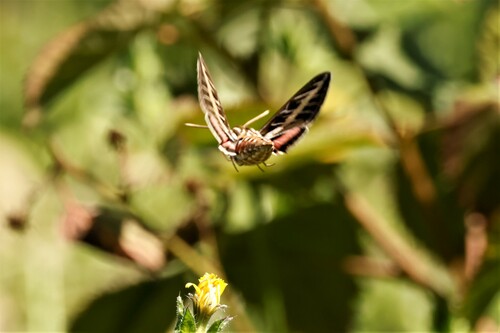
The closest relatives of the Snowberry Clearwing that you can see in Dallas (family Sphingidae, Sphinx Moths) are White-Lined Sphinx (about 10%), Walnut Sphinx (about 10%) and Carolina Sphinx (about 10%), with each one's daily chance of a sighting.

Where does the Snowberry Clearwing sighting chance come from?

GBIF citizen-science records

It is estimated from how often the Snowberry Clearwing is recorded against all the insects logged in Dallas (193 verified sightings), calibrated against known sighting rates. Figures are rounded to the nearest 10% because citizen-science data supports honest approximations, not decimals, and months with records from fewer than five people show "—". How it works.

← Back to Dallas