Buff-breasted Sandpiper

Buff-breasted Sandpiper

Calidris subruficollis

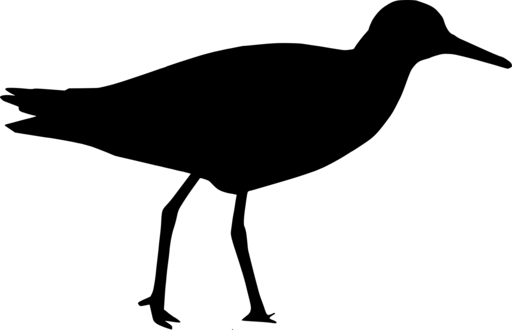
Silhouette: Edwin Price · PhyloPic

LCNTVUVulnerableENCR
Daily sighting probability <5% · Rare
at Denver

In 3 days <5%

19 Verified sightings at Denver
166 In all 10 parks From 2019 to 2026
September Best month
☀️ Diurnal When it's spotted

About the Buff-breasted Sandpiper

The buff-breasted sandpiper (Calidris subruficollis) is a small shorebird. The species name subruficollis is from Latin subrufus, "reddish" (from sub, "somewhat", and rufus, "rufous") and collis, "-necked/-throated" (from collum, "neck"). It is a calidrid sandpiper, notable for its long annual migration, from the artic region of North America to the pampas region of South America.

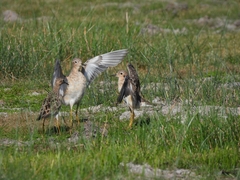
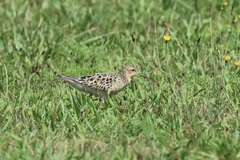
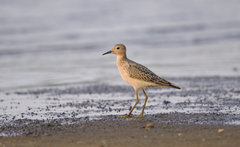
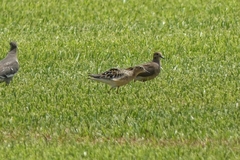
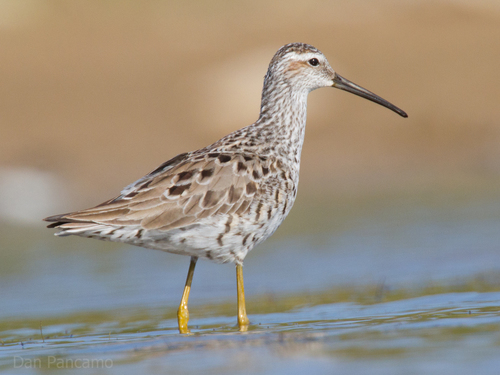
This species is brown above and has a buff face and underparts in all plumages. It has a short bill and yellow legs. Males are larger than females. Juveniles resemble the adults but may be paler on the rear underparts. C. subruficollis breeds in the open arctic tundra of North America and is a very long-distance migrant, spending the non-breeding season mainly in South America, especially in Argentina and Uruguay.

It migrates mainly through central North America and is uncommon on the coasts. It occurs as a regular wanderer in Western Europe and is not classed as rare in Great Britain or Ireland, where small flocks have occurred. Only the pectoral sandpiper is a more common American shorebird visitor to Europe.

This species nests as far north as Canada including... Wikipedia →
Sounds

Flight call0:07

Ireland · 2022

© Paul Kelly · XC747826 · CC BY-NC-SA 4.0

Alarm call0:09

Uruguay · 2005

© Bernabe Lopez-Lanus · XC48603 · CC BY-NC-SA 3.0

Global Distribution

Parks Where Found

# Park Country Daily sighting probability
1 iSimangaliso Wetland Park 🇿🇦 South Africa
~10%
2 Hortobágy National Park 🇭🇺 Hungary
<5%
3 Caroni Swamp 🇹🇹 Trinidad and Tobago
<5%
4 Amacayacu National Natural Park 🇨🇴 Colombia
<5%
5 Tambopata National Reserve 🇵🇪 Peru
<5%
6 Wadden Sea National Park 🇩🇪 Germany
<5%
7 Point Pelee National Park 🇨🇦 Canada
<5%
8 Manu National Park 🇵🇪 Peru
<5%
9 La Amistad International Park (Panama) 🇵🇦 Panama
<5%
10 Everglades National Park 🇺🇸 United States
<5%

Cities Where Found

# City Country Daily sighting probability
1 San Diego 🇺🇸 United States
<5%
2 Asuncion 🇵🇾 Paraguay
<5%
3 San José 🇨🇷 Costa Rica
<5%
4 São Paulo 🇧🇷 Brazil
<5%
5 Chicago 🇺🇸 United States
<5%
6 Denver 🇺🇸 United States
<5%
7 New York City 🇺🇸 United States
<5%

Before you go

What are the chances of seeing a Buff-breasted Sandpiper in Denver?

Rare

Under 5% of wildlife watchers report a Buff-breasted Sandpiper sighting in Denver on a given day, based on 19 verified sightings from GBIF citizen-science data. It is the 272nd most-seen of the 299 birds we can rate there. Over three days the chance rises to under 5%, if each day is a fresh chance.

When is the best time to see a Buff-breasted Sandpiper in Denver?

Any time of year

In every month with enough records, under 5% of wildlife watchers report a Buff-breasted Sandpiper in Denver on a given day, so our monthly data shows no clear season.

What time of day is best to see a Buff-breasted Sandpiper?

Between 8 and 11 am

Across all the parks we cover, that three-hour window holds the most Buff-breasted Sandpiper sightings with a recorded time, and about 9 in 10 of them come between 6 am and 6 pm: it is a daytime animal.

Is Denver the best place to see a Buff-breasted Sandpiper?

Among the best

Of the 7 cities where we can rate Buff-breasted Sandpiper sightings, Denver ranks 6th at under 5%, level with the leaders once rounded. The best odds are in San Diego (United States, under 5%), Asuncion (Paraguay, under 5%) and San José (Costa Rica, under 5%).

Where does the Buff-breasted Sandpiper sighting chance come from?

GBIF citizen-science records

It is estimated from how often the Buff-breasted Sandpiper is recorded against all the birds logged in Denver (19 verified sightings), calibrated against known sighting rates. Figures are rounded to the nearest 10% because citizen-science data supports honest approximations, not decimals, and months with records from fewer than five people show "—". How it works.

← Back to Denver