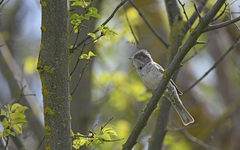
Barred Warbler

Barred Warbler

Sylvia nisoria

Silhouette: Martin Bulla, based on John Cox's illustration · PhyloPic

Daily sighting probability <5% · Rare
at Dubai

In 3 days <5% in a week ~10%

30 Verified sightings at Dubai
491 In all 10 parks From 2019 to 2026
December Best month
☀️ Diurnal When it's spotted

About the Barred Warbler

The barred warbler (Curruca nisoria) is a species of bird in the warbler family Sylviidae which breeds across temperate regions of central and eastern Europe and western and central Asia. This passerine bird is strongly migratory, and winters in tropical eastern Africa.

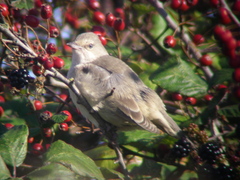
It is the largest Curruca warbler, 15.5–17 cm in length and weighing 22–36 g, mainly grey above and whitish below. Adult males are dark grey above with white tips on the wing coverts and tail feathers, and heavily barred below. The female is similar but slightly paler and has only light barring. Young birds are buffy grey-brown above, pale buff below, and have very little barring, with few obvious distinctive features; they can easily be confused with garden warblers, differing in the slight barring on the tail coverts and the pale fringes on the wing feathers, and their slightly larger size. The eye has a yellow iris in adults, dark in immatures; the bill is blackish with a paler base, and the legs stout, grey-brown.

Within the genus Curruca it is highly distinctive; the barred underside is shared only with the Cyprus warbler, which has black barring and an entirely different overall colour pattern. The... Wikipedia →

Sounds

Recording0:48

Czechia · 2024

© Martina Kišelová · iNaturalist · CC BY-NC 4.0

Recording0:53

Russia · 2025

© Natalia Melnikova · iNaturalist · CC BY-NC 4.0

Recording0:24

Austria · 2024

© Michael Bierbaumer · iNaturalist · CC BY 4.0

Global Distribution

Parks Where Found

# Park Country Daily sighting probability
1 Gobi Gurvansaikhan National Park 🇲🇳 Mongolia
~20%
2 Białowieża National Park 🇵🇱 Poland
~10%
3 Fertő-Hanság National Park 🇭🇺 Hungary
~10%
4 Tsavo West National Park 🇰🇪 Kenya
~10%
5 Biebrza National Park 🇵🇱 Poland
<5%
6 Samburu National Reserve 🇰🇪 Kenya
<5%
7 Hortobágy National Park 🇭🇺 Hungary
<5%
8 Kiskunság National Park 🇭🇺 Hungary
<5%
9 Tsavo East National Park 🇰🇪 Kenya
<5%
10 Wadden Sea National Park 🇩🇪 Germany
<5%

Cities Where Found

# City Country Daily sighting probability
1 Abu Dhabi 🇦🇪 United Arab Emirates
~10%
2 Jerusalem 🇮🇱 Israel
~10%
3 Doha 🇶🇦 Qatar
~10%
4 Kuwait City 🇰🇼 Kuwait
~10%
5 Almaty 🇰🇿 Kazakhstan
~10%
6 Istanbul 🇹🇷 Turkey
~10%
7 Ankara 🇹🇷 Turkey
<5%
8 Beirut 🇱🇧 Lebanon
<5%
9 Warsaw 🇵🇱 Poland
<5%
10 Antalya 🇹🇷 Turkey
<5%

Before you go

What are the chances of seeing a Barred Warbler in Dubai?

Rare

Under 5% of wildlife watchers report a Barred Warbler sighting in Dubai on a given day, based on 30 verified sightings from GBIF citizen-science data. It is the 89th most-seen of the 170 birds we can rate there. Over three days the chance rises to under 5%, and over a week to about 10%, if each day is a fresh chance.

When is the best time to see a Barred Warbler in Dubai?

Any time of year

In every month with enough records, under 5% of wildlife watchers report a Barred Warbler in Dubai on a given day, so our monthly data shows no clear season.

What time of day is best to see a Barred Warbler?

Between 8 and 11 am

Across all the parks we cover, that three-hour window holds the most Barred Warbler sightings with a recorded time, and about 8 in 10 of them come between 6 am and 6 pm: it is a daytime animal.

Is Dubai the best place to see a Barred Warbler?

11th of 16

Of the 16 cities where we can rate Barred Warbler sightings, Dubai ranks 11th at under 5%. The best odds are in Abu Dhabi (United Arab Emirates, about 10%), Jerusalem (Israel, about 10%) and Doha (Qatar, about 10%).

Where does the Barred Warbler sighting chance come from?

GBIF citizen-science records

It is estimated from how often the Barred Warbler is recorded against all the birds logged in Dubai (30 verified sightings), calibrated against known sighting rates. Figures are rounded to the nearest 10% because citizen-science data supports honest approximations, not decimals, and months with records from fewer than five people show "—". How it works.

← Back to Dubai