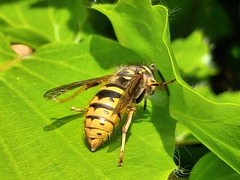
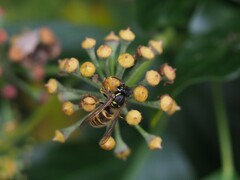
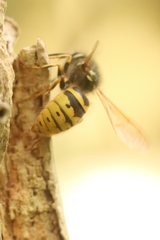
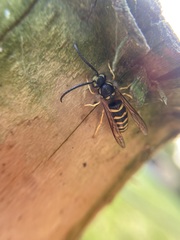
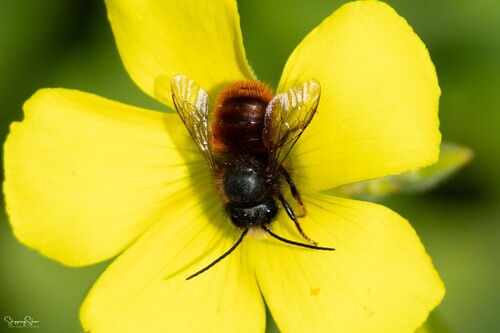
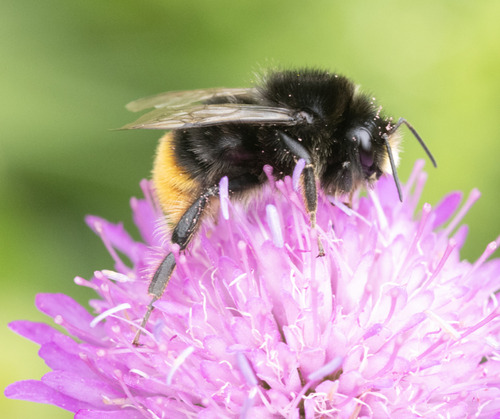
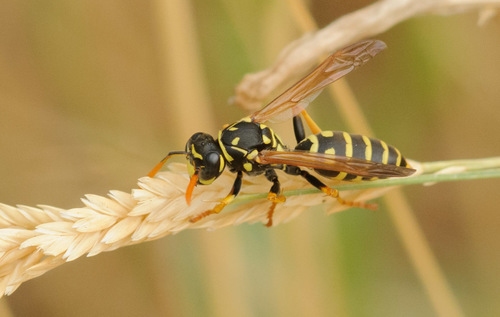
Common European Yellowjacket

Common European Yellowjacket

Vespula vulgaris

Daily sighting probability ~10% · With luck
at Essen

In 3 days ~40% in a week ~70%

75 Verified sightings at Essen
136 In all 11 parks From 2019 to 2026
September Best month
☀️ Diurnal When it's spotted

About the Common European Yellowjacket

Vespula vulgaris, known as the common wasp, is a species of wasp found in regions that include the United Kingdom, Ireland, Germany, India, China, New Zealand and Australia. It is sometimes known in English as the European wasp, but the same name is used for the species Vespula germanica or German wasp. In 2010, the ostensibly Vespula vulgaris wasps in North America were found to be a different species, Vespula alascensis.

Vespula vulgaris is a eusocial vespid that builds its tan paper nest in or on a structure capable of supporting it. A founding queen searches for a hollow tree, wall cavity, rock crevice, or even a hole made by other animals to build a nest. The extraordinary adaptation skills of V. vulgaris enable it to live in a wide range of habitats, from very humid areas to artificial environments such as gardens and human structures. This species, along with other wasp species such as V. germanica, has impacted ecosystems, especially those in New Zealand and Australia, where they were imported by humans, and frequently cause damage to fruit crops and endanger humans.

The name Vespula vulgaris comes from the origin of the word vulgaris, which... Wikipedia →
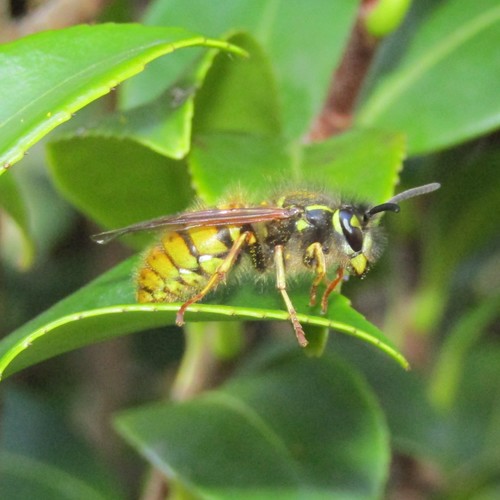
Global Distribution

Parks Where Found

# Park Country Daily sighting probability
1 Tierra del Fuego National Park 🇦🇷 Argentina
~20%
2 Abel Tasman National Park 🇳🇿 New Zealand
~20%
3 Rakiura National Park 🇳🇿 New Zealand
~20%
4 Nahuel Huapi National Park 🇦🇷 Argentina
~10%
5 Arthur's Pass National Park 🇳🇿 New Zealand
~10%
6 Egmont National Park 🇳🇿 New Zealand
~10%
7 Bavarian Forest National Park 🇩🇪 Germany
~10%
8 Fiordland National Park 🇳🇿 New Zealand
~10%
9 Snowdonia National Park 🇬🇧 United Kingdom
~10%
10 Cairngorms National Park 🇬🇧 United Kingdom
~10%
11 Wadden Sea National Park 🇩🇪 Germany
~10%

Cities Where Found

# City Country Daily sighting probability
1 Liverpool 🇬🇧 United Kingdom
~30%
2 Birmingham 🇬🇧 United Kingdom
~20%
3 London 🇬🇧 United Kingdom
~20%
4 Hamburg 🇩🇪 Germany
~20%
5 Manchester 🇬🇧 United Kingdom
~20%
6 Dublin 🇮🇪 Ireland
~20%
7 Essen 🇩🇪 Germany
~10%
8 Auckland 🇳🇿 New Zealand
~10%
9 Copenhagen 🇩🇰 Denmark
~10%
10 Warsaw 🇵🇱 Poland
~10%

Before you go

What are the chances of seeing a Common European Yellowjacket in Essen?

With luck

About 10% of wildlife watchers report a Common European Yellowjacket sighting in Essen on a given day, based on 75 verified sightings from GBIF citizen-science data. It is the 21st most-seen of the 434 insects we can rate there. Over three days the chance rises to about 40%, and over a week to about 70%, if each day is a fresh chance.

When is the best time to see a Common European Yellowjacket in Essen?

March–April and September–November

In those months about 20% of wildlife watchers report a Common European Yellowjacket in Essen on a given day, against under 5% in December, the lowest month.

What time of day is best to see a Common European Yellowjacket?

Between noon and 3 pm

Across all the parks we cover, that three-hour window holds the most Common European Yellowjacket sightings with a recorded time, and about 9 in 10 of them come between 6 am and 6 pm: it is a daytime animal.

Is Essen the best place to see a Common European Yellowjacket?

7th of 31

Of the 31 cities where we can rate Common European Yellowjacket sightings, Essen ranks 7th at about 10%. The best odds are in Liverpool (United Kingdom, about 30%), Birmingham (United Kingdom, about 20%) and London (United Kingdom, about 20%).

Where does the Common European Yellowjacket sighting chance come from?

GBIF citizen-science records

It is estimated from how often the Common European Yellowjacket is recorded against all the insects logged in Essen (75 verified sightings), calibrated against known sighting rates. Figures are rounded to the nearest 10% because citizen-science data supports honest approximations, not decimals, and months with records from fewer than five people show "—". How it works.

← Back to Essen