Pale-legged Hornero

Pale-legged Hornero

Furnarius leucopus

Silhouette: Abraão B. Leite · PhyloPic

LCLeast ConcernNTVUENCR
Daily sighting probability <5% · Rare
at Fortaleza

In 3 days ~10% in a week ~20%

12 Verified sightings at Fortaleza
2,608 In all 7 parks From 2019 to 2026
August Best month
☀️ Diurnal When it's spotted

About the Pale-legged Hornero

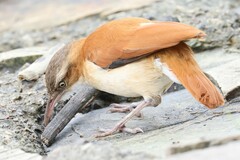
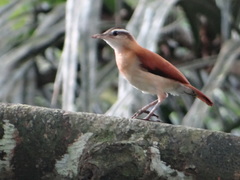
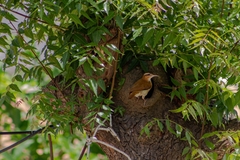
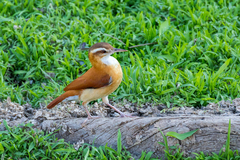
The pale-legged hornero (Furnarius leucopus) is a species of bird in the Furnariinae subfamily of the ovenbird family Furnariidae. It is found in Bolivia, Brazil, Guyana, and Peru. The pale-legged hornero's taxonomy is unsettled. The International Ornithological Committee (IOC), BirdLife International's Handbook of the Birds of the World (HBW), and the Clements taxonomy assign it these four subspecies:

The IOC, HBW, and Clements treat cinnamomeus as the species Pacific hornero and the other two as the Caribbean hornero. Early authors (e.g. Chapman) had treated them separately. The SACC accepts that cinnamomeus may deserve species rank but declined to make the split due to "insufficient published data".

Some authors have treated what is now the pale-billed hornero (F. torridus) as a subspecies of the pale-legged... Wikipedia →

Sounds

Call0:38

Brazil · 2024

© JAYRSON ARAUJO DE OLIVEIRA · XC939933 · CC BY-NC-SA 4.0

Song0:09

Venezuela · 2023

© Francisco contreras · XC838838 · CC BY-NC-SA 4.0

Canto0:10

Brazil · 2017

© Caio Brito · XC427398 · CC BY-NC-SA 4.0

Global Distribution

Parks Where Found

# Park Country Daily sighting probability
1 Parque Estadual Encontro das Águas 🇧🇷 Brazil
~50%
2 Machalilla National Park 🇪🇨 Ecuador
~40%
3 Manu National Park 🇵🇪 Peru
~20%
4 Tambopata National Reserve 🇵🇪 Peru
~10%
5 Podocarpus National Park 🇪🇨 Ecuador
<5%
6 Amacayacu National Natural Park 🇨🇴 Colombia
<5%
7 Chapada Diamantina National Park 🇧🇷 Brazil
<5%

Cities Where Found

# City Country Daily sighting probability
1 Guayaquil 🇪🇨 Ecuador
~60%
2 Fortaleza 🇧🇷 Brazil
<5%

Zoos & Centres Where Found

# Zoo / Centre Country
1 Pairi Daiza 🇧🇪 Belgium In captivity

Before you go

What are the chances of seeing a Pale-legged Hornero in Fortaleza?

Rare

Under 5% of wildlife watchers report a Pale-legged Hornero sighting in Fortaleza on a given day, based on 12 verified sightings from GBIF citizen-science data. It is the 96th most-seen of the 129 birds we can rate there. Over three days the chance rises to about 10%, and over a week to about 20%, if each day is a fresh chance.

When is the best time to see a Pale-legged Hornero in Fortaleza?

July–August and October

In those months about 10% of wildlife watchers report a Pale-legged Hornero in Fortaleza on a given day, against under 5% in September and November–June, the lowest months. Those are among Fortaleza's driest months, with about 20 mm of rain a month against 240 mm in April.

What time of day is best to see a Pale-legged Hornero?

Between 7 and 10 am

Across all the parks we cover, that three-hour window holds the most Pale-legged Hornero sightings with a recorded time, and about 8 in 10 of them come between 6 am and 6 pm: it is a daytime animal.

Is Fortaleza the best place to see a Pale-legged Hornero?

2nd of 2

Of the 2 cities where we can rate Pale-legged Hornero sightings, Fortaleza ranks 2nd at under 5%. The best odds are in Guayaquil (Ecuador, about 60%).

Where does the Pale-legged Hornero sighting chance come from?

GBIF citizen-science records

It is estimated from how often the Pale-legged Hornero is recorded against all the birds logged in Fortaleza (12 verified sightings), calibrated against known sighting rates. Figures are rounded to the nearest 10% because citizen-science data supports honest approximations, not decimals, and months with records from fewer than five people show "—". How it works.

← Back to Fortaleza