

Golden-bellied Grosbeak

Golden-bellied Grosbeak

Pheucticus chrysogaster

Silhouette: Sheatherius · PhyloPic

LCLeast ConcernNTVUENCR
Daily sighting probability ~10% · With luck
at Guayaquil

In 3 days ~20% in a week ~40%

56 Verified sightings at Guayaquil
272 In all 2 parks From 2019 to 2026
December Best month
☀️ Diurnal When it's spotted

About the Golden-bellied Grosbeak

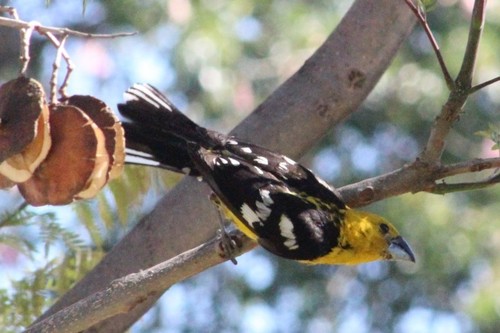
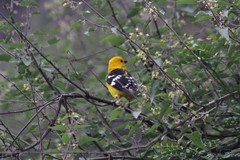
The golden grosbeak (Pheucticus chrysogaster) is a species of bird in the family Cardinalidae, the cardinals, grosbeaks, and “tanager” allies. It is found in Colombia, Ecuador, Peru, and Venezuela. The golden grosbeak was formally described in 1832 with the binomial Pitylus chrysogaster. It is now one of six species in the genus Pheucticus. This name derives from Greek and means "shy". Some authors have treated it, the black-thighed grosbeak (P. tibialis), and the yellow grosbeak (P. chrysopeplus) as conspecific. A 2013 phylogenetic study supports their separation and suggests that the golden grosbeak is more closely related to the black-backed grosbeak (P. aureiventris) than to the black-thighed or yellow. It has also been called the golden-bellied grosbeak and southern yellow grosbeak.

The golden grosbeak is 21.5 cm (8.5 in) long and weighs about 54 to 60 g (1.9 to 2.1 oz). Adult males of the nominate subspecies have an orange-tinged deep yellow head and nape. Their back is black, their rump yellow... Wikipedia →

Sounds

Call0:12

Peru · 2026

© Étienne Leroy · XC1185157 · CC BY-NC-SA 4.0

Song0:56

Ecuador · 2022

© Leonardo Ordóñez-Delgado · XC742152 · CC BY-NC-ND 4.0

Begging call0:04

Ecuador · 2012

© Manuel Sanchez-Nivicela · XC652740 · CC BY-NC-SA 4.0

Global Distribution

Parks Where Found

# Park Country Daily sighting probability
1 Machalilla National Park 🇪🇨 Ecuador
~30%
2 Podocarpus National Park 🇪🇨 Ecuador
<5%

Cities Where Found

# City Country Daily sighting probability
1 Quito 🇪🇨 Ecuador
~60%
2 Guayaquil 🇪🇨 Ecuador
~10%
3 Caracas 🇻🇪 Venezuela
<5%

Before you go

What are the chances of seeing a Golden-bellied Grosbeak in Guayaquil?

With luck

About 10% of wildlife watchers report a Golden-bellied Grosbeak sighting in Guayaquil on a given day, based on 56 verified sightings from GBIF citizen-science data. It is the 75th most-seen of the 167 birds we can rate there. Over three days the chance rises to about 20%, and over a week to about 40%, if each day is a fresh chance.

When is the best time to see a Golden-bellied Grosbeak in Guayaquil?

December

In that month about 20% of wildlife watchers report a Golden-bellied Grosbeak in Guayaquil on a given day, against under 5% in January, March–April and June–October, the lowest months. That is one of Guayaquil's driest months, with about 25 mm of rain against 220 mm in February.

What time of day is best to see a Golden-bellied Grosbeak?

Between 7 and 10 am

Across all the parks we cover, that three-hour window holds the most Golden-bellied Grosbeak sightings with a recorded time, and about 9 in 10 of them come between 6 am and 6 pm: it is a daytime animal.

Is Guayaquil the best place to see a Golden-bellied Grosbeak?

2nd of 3

Of the 3 cities where we can rate Golden-bellied Grosbeak sightings, Guayaquil ranks 2nd at about 10%. The best odds are in Quito (Ecuador, about 60%).

Where does the Golden-bellied Grosbeak sighting chance come from?

GBIF citizen-science records

It is estimated from how often the Golden-bellied Grosbeak is recorded against all the birds logged in Guayaquil (56 verified sightings), calibrated against known sighting rates. Figures are rounded to the nearest 10% because citizen-science data supports honest approximations, not decimals, and months with records from fewer than five people show "—". How it works.

← Back to Guayaquil