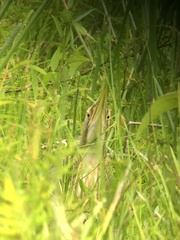
Pinnated Bittern

Pinnated Bittern

Botaurus pinnatus

Silhouette: Sheatherius · PhyloPic

LCLeast ConcernNTVUENCR
Daily sighting probability <5% · Rare
at Guayaquil

In 3 days <5%

5 Verified sightings at Guayaquil
301 In all 7 parks From 2019 to 2026
April Best month
☀️ Diurnal When it's spotted

About the Pinnated Bittern

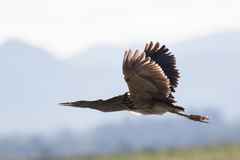
The pinnated bittern (Botaurus pinnatus), also known as the South American bittern, is a large member of the heron family (Ardeidae) found in the New World tropics. Like the other Botaurus bitterns, its plumage is mostly buffy-brown and cryptically patterned. Though it is a widespread species, it is rarely seen – presumably due to its skulking habits – and much about its life history remains little known.

The pinnated bittern is a large heron, measuring between 25–30 in (64–76 cm) with a weight that ranges from 554 to 1,157 g (1.2 to 2.6 lb); males typically weigh considerably more than females. Sexes are similarly plumaged, but females tend to be smaller than males and have brown instead of black on the tail.

Both adults and immature birds are generally buffy, though heavily marked with cryptic patterning. Juveniles tend to have a somewhat more reddish ground color. The throat is unmarked white, the foreneck is white broadly streaked with pale brown, and the rest of the neck is buff with thin black barring. The breast and belly are white with broad pale brown streaks, while the back is buff, heavily streaked and barred with black. Rectrices are black in males and... Wikipedia →

Sounds

Song0:26

Brazil · 2018

© Marco Cruz · XC439759 · CC BY-NC-SA 4.0

Call0:12

French Guiana · 2026

© Paul Lenrumé · XC1156571 · CC BY-NC-SA 4.0

Flight call0:06

Brazil · 2019

© Guy Kirwan · XC483745 · CC BY-NC-SA 4.0

Global Distribution

Parks Where Found

# Park Country Daily sighting probability
1 Lago de Yojoa 🇭🇳 Honduras
~10%
2 Caroni Swamp 🇹🇹 Trinidad and Tobago
<5%
3 Cerro Azul Meámbar National Park 🇭🇳 Honduras
<5%
4 Bastimentos Island National Marine Park 🇵🇦 Panama
<5%
5 Palo Verde National Park 🇨🇷 Costa Rica
<5%
6 La Amistad International Park (Panama) 🇵🇦 Panama
<5%
7 Tortuguero National Park 🇨🇷 Costa Rica
<5%

Cities Where Found

# City Country Daily sighting probability
1 Guayaquil 🇪🇨 Ecuador
<5%

Before you go

What are the chances of seeing a Pinnated Bittern in Guayaquil?

Rare

Under 5% of wildlife watchers report a Pinnated Bittern sighting in Guayaquil on a given day, based on 5 verified sightings from GBIF citizen-science data. It is the 161st most-seen of the 167 birds we can rate there. Over three days the chance rises to under 5%, if each day is a fresh chance.

When is the best time to see a Pinnated Bittern in Guayaquil?

April

In that month about 10% of wildlife watchers report a Pinnated Bittern in Guayaquil on a given day, against under 5% in May to March, the lowest months. That is one of Guayaquil's wettest months, with about 130 mm of rain against almost none in September.

What time of day is best to see a Pinnated Bittern?

Between 7 and 10 am

Across all the parks we cover, that three-hour window holds the most Pinnated Bittern sightings with a recorded time, and about 9 in 10 of them come between 6 am and 6 pm: it is a daytime animal.

Where else can you see a Pinnated Bittern?

Only Guayaquil, in our data

Guayaquil is the only city on Wallace's Line with enough records to rate Pinnated Bittern sightings: under 5% of wildlife watchers there report one on a given day.

Which relatives of the Pinnated Bittern live in Guayaquil?

Same family: Ardeidae

The closest relatives of the Pinnated Bittern that you can see in Guayaquil (family Ardeidae, Herons, Egrets, and Bitterns) are Snowy Egret (about 40%), Great Egret (about 40%) and Yellow-crowned Night-Heron (about 30%), with each one's daily chance of a sighting.

Where does the Pinnated Bittern sighting chance come from?

GBIF citizen-science records

It is estimated from how often the Pinnated Bittern is recorded against all the birds logged in Guayaquil (5 verified sightings), calibrated against known sighting rates. Figures are rounded to the nearest 10% because citizen-science data supports honest approximations, not decimals, and months with records from fewer than five people show "—". How it works.

← Back to Guayaquil