White-capped Redstart

White-capped Redstart

Chaimarrornis leucocephalus

Silhouette: Martin Bulla, based on François Desbordes' illustration · PhyloPic

Daily sighting probability ~10% · With luck
at Guiyang

In 3 days ~20% in a week ~50%

7 Verified sightings at Guiyang
2,773 In all 7 parks From 2019 to 2026
December Best month
☀️ Diurnal When it's spotted

About the White-capped Redstart

The white-capped redstart or white-capped water redstart (Phoenicurus leucocephalus) is a passerine bird of the Old World flycatcher family Muscicapidae native to the Indian subcontinent, Southeast Asia, much of China, and to certain regions of Central Asia.

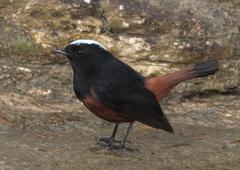
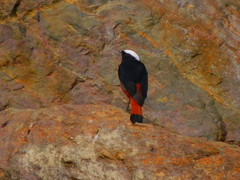
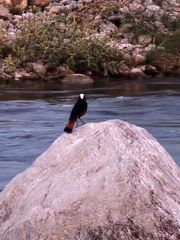
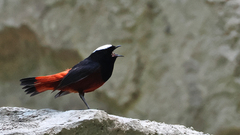
Both sexes are black with red underparts and white crown atop their heads. Males have a larger white pattern on top of the head and brown or red spots under the wings. It is found in the Indian subcontinent and Southeast Asia, as well as some adjoining areas. The species ranges across Afghanistan, Bangladesh, Bhutan, Cambodia, India, Laos, Myanmar, Nepal, Tajikistan, Thailand, Tibet and Vietnam. Its natural habitat is temperate forests.

This species was formerly placed in the monotypic genus Chaimarrornis but was moved to Phoenicurus based on the results of a molecular phylogenetic study published in 2010. Wikipedia →

Sounds

Recording0:08

China · 2024

© Elliot Liu · iNaturalist · CC BY-NC 4.0

Global Distribution

Parks Where Found

# Park Country Daily sighting probability
1 Namdapha National Park 🇮🇳 India
~40%
2 Royal Manas National Park 🇧🇹 Bhutan
~40%
3 Jiuzhaigou National Park 🇨🇳 China
~30%
4 Langtang National Park 🇳🇵 Nepal
~30%
5 Doi Inthanon National Park 🇹🇭 Thailand
~30%
6 Jim Corbett National Park 🇮🇳 India
~20%
7 Manas National Park 🇮🇳 India
~10%

Cities Where Found

# City Country Daily sighting probability
1 Guiyang 🇨🇳 China
~10%
2 Kathmandu 🇳🇵 Nepal
~10%
3 Dushanbe 🇹🇯 Tajikistan
<5%
4 Islamabad 🇵🇰 Pakistan
<5%
5 Dehradun 🇮🇳 India
<5%
6 Srinagar 🇮🇳 India
<5%
7 Chengdu 🇨🇳 China
<5%
8 Shanghai 🇨🇳 China
<5%

Zoos & Centres Where Found

# Zoo / Centre Country
1 Dallas World Aquarium 🇺🇸 United States In captivity

Before you go

What are the chances of seeing a White-capped Redstart in Guiyang?

With luck

About 10% of wildlife watchers report a White-capped Redstart sighting in Guiyang on a given day, based on 7 verified sightings from GBIF citizen-science data. It is the 68th most-seen of the 79 birds we can rate there. Over three days the chance rises to about 20%, and over a week to about 50%, if each day is a fresh chance.

When is the best time to see a White-capped Redstart in Guiyang?

December

In that month about 20% of wildlife watchers report a White-capped Redstart in Guiyang on a given day, against under 5% in January, May, July and November, the lowest months. That is one of Guiyang's driest months, with about 25 mm of rain against 230 mm in June. February has too few records to rate.

What time of day is best to see a White-capped Redstart?

Between 10 am and 1 pm

Across all the parks we cover, that three-hour window holds the most White-capped Redstart sightings with a recorded time, and about 9 in 10 of them come between 6 am and 6 pm: it is a daytime animal.

Is Guiyang the best place to see a White-capped Redstart?

Yes

Of the 8 cities where we can rate White-capped Redstart sightings, Guiyang has the highest daily chance: about 10%. Next come Kathmandu (Nepal, about 10%) and Dushanbe (Tajikistan, under 5%).

Which relatives of the White-capped Redstart live in Guiyang?

Same family: Muscicapidae

The closest relatives of the White-capped Redstart that you can see in Guiyang (family Muscicapidae, Old World Flycatchers, Robins, and Chats) are Oriental Magpie-Robin (about 60%), Daurian Redstart (about 50%) and Plumbeous Water Redstart (about 30%), with each one's daily chance of a sighting.

Where does the White-capped Redstart sighting chance come from?

GBIF citizen-science records

It is estimated from how often the White-capped Redstart is recorded against all the birds logged in Guiyang (7 verified sightings), calibrated against known sighting rates. Figures are rounded to the nearest 10% because citizen-science data supports honest approximations, not decimals, and months with records from fewer than five people show "—". How it works.

← Back to Guiyang