White-browed Piculet

White-browed Piculet

Sasia ochracea

Silhouette: Pepe Reigada · PhyloPic

LCLeast ConcernNTVUENCR
Daily sighting probability <5% · Rare
at Guwahati

In 3 days <5%

7 Verified sightings at Guwahati
853 In all 9 parks From 2019 to 2026
May Best month
☀️ Diurnal When it's spotted

About the White-browed Piculet

The white-browed piculet (Sasia ochracea) is a species of bird in the family Picidae. It is found in Bangladesh, Bhutan, Cambodia, India, Laos, Myanmar, Nepal, Thailand, and Vietnam. Its natural habitats are temperate forests and subtropical or tropical moist montane forests.

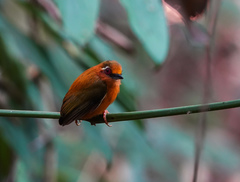
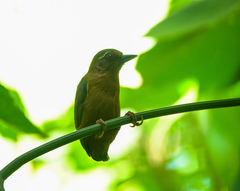
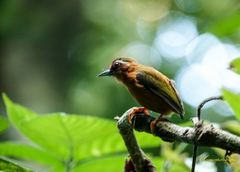
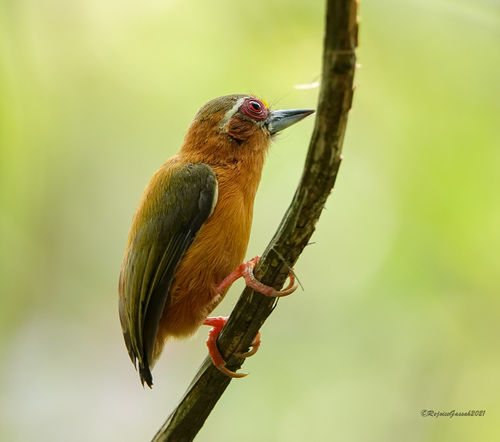
This small piculet has olive-green upper parts tinged with chestnut and grows to a length of up to 10 cm (4 in). The under parts are cinnamon or rufous, sometimes yellowish on the flanks. The stubby tail is blackish. The crown is green, and there is a white streak above and immediately behind the eye, the latter being surrounded by a ring of bare pinkish or reddish skin. Males have a small golden-yellow patch on the forehead which females lack. Juveniles are duller in colour than adults, greener above and greyer beneath. The beak is grey, the iris is red and the legs are yellow or orange, the feet having just three toes, (four being the norm in the woodpecker family). In southern Myanmar and southeastern Thailand, where their ranges overlap, the white-browed piculet can be confused with the very similar rufous piculet (Sasia abnormis), but differs in the white streak above the eye and the darker... Wikipedia →
Sounds

Drumming0:47

China · 2026

© JJSUN · XC1086717 · CC BY-NC-SA 4.0

Call0:56

Laos · 2024

© Bram Piot · XC897858 · CC BY-NC-SA 4.0

Song0:17

India · 2017

© George Wagner · XC374355 · CC BY-NC-SA 4.0

Global Distribution

Parks Where Found

# Park Country Daily sighting probability
1 Namdapha National Park 🇮🇳 India
~10%
2 Cat Tien National Park 🇻🇳 Vietnam
~10%
3 Royal Manas National Park 🇧🇹 Bhutan
~10%
4 Kaeng Krachan National Park 🇹🇭 Thailand
~10%
5 Khao Sok National Park 🇹🇭 Thailand
~10%
6 Cuc Phuong National Park 🇻🇳 Vietnam
~10%
7 Doi Inthanon National Park 🇹🇭 Thailand
<5%
8 Chitwan National Park 🇳🇵 Nepal
<5%
9 Manas National Park 🇮🇳 India
<5%

Cities Where Found

# City Country Daily sighting probability
1 Guwahati 🇮🇳 India
<5%

Before you go

What are the chances of seeing a White-browed Piculet in Guwahati?

Rare

Under 5% of wildlife watchers report a White-browed Piculet sighting in Guwahati on a given day, based on 7 verified sightings from GBIF citizen-science data. It is the 170th most-seen of the 185 birds we can rate there. Over three days the chance rises to under 5%, if each day is a fresh chance.

When is the best time to see a White-browed Piculet in Guwahati?

Any time of year

In every month with enough records, under 5% of wildlife watchers report a White-browed Piculet in Guwahati on a given day, so our monthly data shows no clear season.

What time of day is best to see a White-browed Piculet?

Between 8 and 11 am

Across all the parks we cover, that three-hour window holds the most White-browed Piculet sightings with a recorded time, and about 9 in 10 of them come between 6 am and 6 pm: it is a daytime animal.

Where else can you see a White-browed Piculet?

Only Guwahati, in our data

Guwahati is the only city on Wallace's Line with enough records to rate White-browed Piculet sightings: under 5% of wildlife watchers there report one on a given day.

Which relatives of the White-browed Piculet live in Guwahati?

Same family: Picidae

The closest relatives of the White-browed Piculet that you can see in Guwahati (family Picidae, Woodpeckers) are Black-rumped Flameback (about 30%) and Fulvous-breasted Woodpecker (about 20%), with each one's daily chance of a sighting.

Where does the White-browed Piculet sighting chance come from?

GBIF citizen-science records

It is estimated from how often the White-browed Piculet is recorded against all the birds logged in Guwahati (7 verified sightings), calibrated against known sighting rates. Figures are rounded to the nearest 10% because citizen-science data supports honest approximations, not decimals, and months with records from fewer than five people show "—". How it works.

← Back to Guwahati