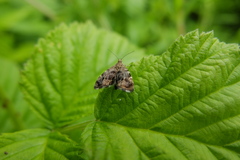
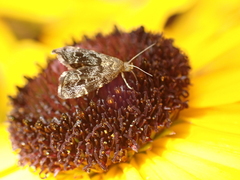
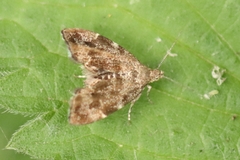
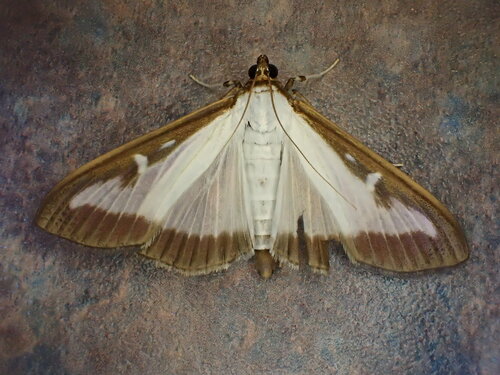
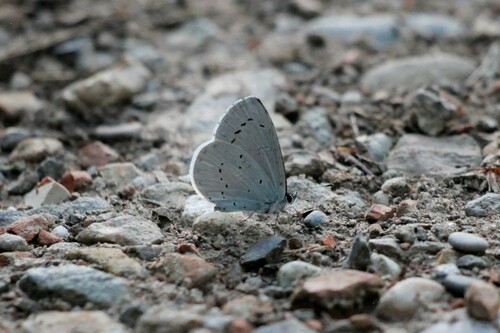
Common Nettle-Tap

Common Nettle-Tap

Anthophila fabriciana

Daily sighting probability <5% · Rare
at Hamburg

In 3 days ~10% in a week ~20%

11 Verified sightings at Hamburg
45 In all 5 parks From 2019 to 2026
September Best month
☀️ Diurnal When it's spotted

About the Common Nettle-Tap

Anthophila fabriciana, also known as the common nettle-tap, is a moth of the family Choreutidae first described in 1767 by Carl Linnaeus. The moth can be found flying around stinging nettles during the day. This species can be found in most of Europe and it occurs throughout Britain. It is also widespread from China (Taiwan, Xinjiang), the Himalaya, Mongolia, Russia, Korea, Japan (Hokkaido, Honshu, Shikoku), Afghanistan, Kazakhstan, the Canary Islands, Madeira, Asia Minor, Zakavkazye and the Oriental region. In 2013 it was reported to be present in Canada (Manitoba).

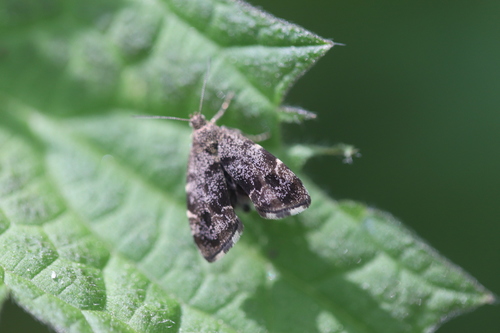
The moth flies in two generation per year from May to October depending on the location and are active during the day. Some adults may overwinter. They can occur wherever stinging nettles occur. Anthophila fabriciana has a wingspan of 10–15 millimetres (0.39–0.59 in). The forewings are a patchwork of dark brownish fuscous marbled with pale grey, with yellowish white costal spot and post-median fascia. The abdomen shows large pale bands.

This species is rather similar to Choreutis pariana, which has whitish markings only along costa. Eggs are laid on the stem, or on either surface... Wikipedia →
Global Distribution

Parks Where Found

# Park Country Daily sighting probability
1 Snowdonia National Park 🇬🇧 United Kingdom
~10%
2 Bavarian Forest National Park 🇩🇪 Germany
~10%
3 Cairngorms National Park 🇬🇧 United Kingdom
~10%
4 Wadden Sea National Park 🇩🇪 Germany
<5%
5 Pyrénées National Park 🇫🇷 France
<5%

Cities Where Found

# City Country Daily sighting probability
1 Birmingham 🇬🇧 United Kingdom
~10%
2 Liverpool 🇬🇧 United Kingdom
~10%
3 Manchester 🇬🇧 United Kingdom
~10%
4 London 🇬🇧 United Kingdom
~10%
5 Leeds 🇬🇧 United Kingdom
~10%
6 Helsinki 🇫🇮 Finland
~10%
7 Rotterdam [The Hague] 🇳🇱 Netherlands
~10%
8 Dublin 🇮🇪 Ireland
~10%
9 Brussels 🇧🇪 Belgium
~10%
10 Paris 🇫🇷 France
<5%

Before you go

What are the chances of seeing a Common Nettle-Tap in Hamburg?

Rare

Under 5% of wildlife watchers report a Common Nettle-Tap sighting in Hamburg on a given day, based on 11 verified sightings from GBIF citizen-science data. It is the 326th most-seen of the 423 insects we can rate there. Over three days the chance rises to about 10%, and over a week to about 20%, if each day is a fresh chance.

When is the best time to see a Common Nettle-Tap in Hamburg?

June and August–September

In those months about 10% of wildlife watchers report a Common Nettle-Tap in Hamburg on a given day, against under 5% in July and October–May, the lowest months.

What time of day is best to see a Common Nettle-Tap?

Between 3 and 6 pm

Across all the parks we cover, that three-hour window holds the most Common Nettle-Tap sightings with a recorded time, and nearly all of them come between 6 am and 6 pm: it is a daytime animal.

Is Hamburg the best place to see a Common Nettle-Tap?

11th of 14

Of the 14 cities where we can rate Common Nettle-Tap sightings, Hamburg ranks 11th at under 5%. The best odds are in Birmingham (United Kingdom, about 10%), Liverpool (United Kingdom, about 10%) and Manchester (United Kingdom, about 10%).

Which relatives of the Common Nettle-Tap live in Hamburg?

Same order: Lepidoptera

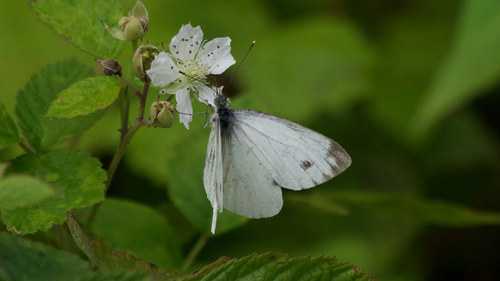
The closest relatives of the Common Nettle-Tap that you can see in Hamburg (order Lepidoptera, Butterflies and Moths) are European Peacock Butterfly (about 20%), Red Admiral (about 20%) and Green-Veined White (about 20%), with each one's daily chance of a sighting.

Where does the Common Nettle-Tap sighting chance come from?

GBIF citizen-science records

It is estimated from how often the Common Nettle-Tap is recorded against all the insects logged in Hamburg (11 verified sightings), calibrated against known sighting rates. Figures are rounded to the nearest 10% because citizen-science data supports honest approximations, not decimals, and months with records from fewer than five people show "—". How it works.

← Back to Hamburg