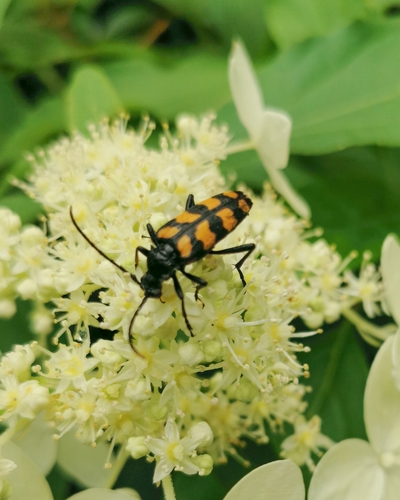
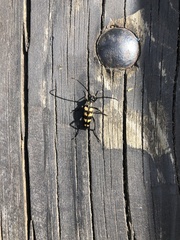
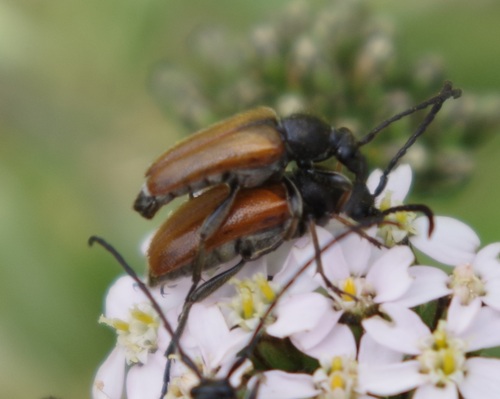
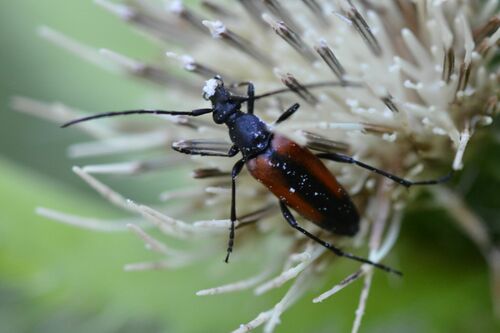
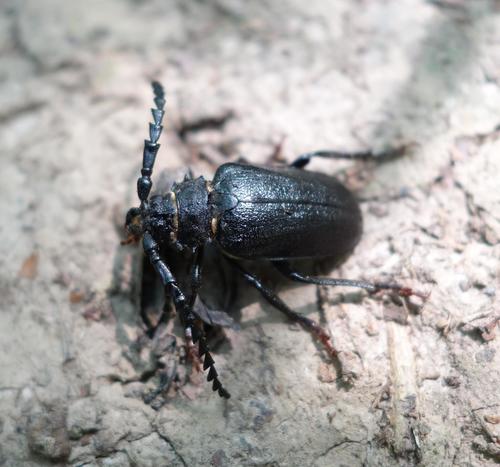
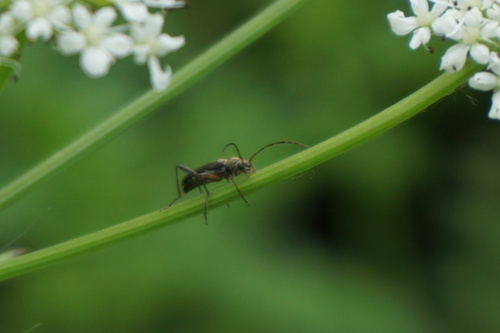
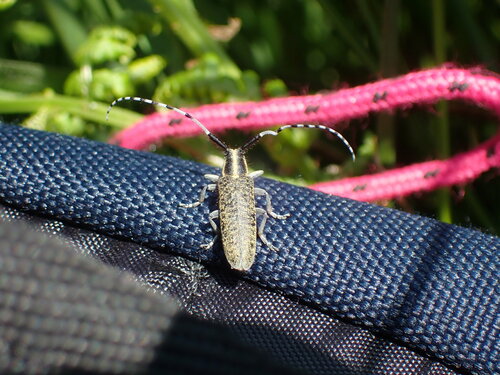
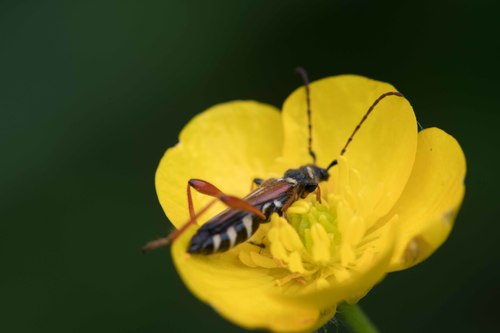


Four-Banded Longhorn Beetle

Four-Banded Longhorn Beetle

Leptura quadrifasciata

Daily sighting probability ~10% · With luck
at Hamburg

In 3 days ~20% in a week ~40%

24 Verified sightings at Hamburg
97 In all 9 parks From 2019 to 2026
July Best month
☀️ Diurnal When it's spotted

About the Four-Banded Longhorn Beetle

Leptura quadrifasciata, the four-banded longhorn beetle, is a species of beetle in the family Cerambycidae. It was described by Carl Linnaeus in his landmark 1758 10th edition of Systema Naturae. Adult beetles are 11–20 mm long, black with four more or less continuous transverse yellow bands. In extreme cases the elytra may be almost entirely black. It is found throughout the northern and central Palearctic realm. The species is distributed in northern and central regions of Europe and Asia. It is particularly common in Scandinavia, Finland and Great Britain and is typically seen during the summer months. Larvae make meandering galleries in various trees, including oak, beech, birch, willow, alder, elder and spruce; typically in dead and decaying trees, with a preference for damp areas. The life cycle lasts two to three years. Wikipedia →

Global Distribution

Parks Where Found

# Park Country Daily sighting probability
1 Białowieża National Park 🇵🇱 Poland
~20%
2 Biebrza National Park 🇵🇱 Poland
~20%
3 Cairngorms National Park 🇬🇧 United Kingdom
~10%
4 Tatra National Park 🇸🇰 Slovakia
~10%
5 Snowdonia National Park 🇬🇧 United Kingdom
~10%
6 Ecrins National Park 🇫🇷 France
~10%
7 Bavarian Forest National Park 🇩🇪 Germany
~10%
8 Pyrénées National Park 🇫🇷 France
<5%
9 Wadden Sea National Park 🇩🇪 Germany
<5%

Cities Where Found

# City Country Daily sighting probability
1 Helsinki 🇫🇮 Finland
~10%
2 Warsaw 🇵🇱 Poland
~10%
3 Amsterdam 🇳🇱 Netherlands
~10%
4 Hamburg 🇩🇪 Germany
~10%
5 Novosibirsk 🇷🇺 Russia
~10%
6 Rotterdam [The Hague] 🇳🇱 Netherlands
~10%
7 Essen 🇩🇪 Germany
~10%
8 Berlin 🇩🇪 Germany
<5%
9 Copenhagen 🇩🇰 Denmark
<5%
10 Minsk 🇧🇾 Belarus
<5%

Before you go

What are the chances of seeing a Four-Banded Longhorn Beetle in Hamburg?

With luck

About 10% of wildlife watchers report a Four-Banded Longhorn Beetle sighting in Hamburg on a given day, based on 24 verified sightings from GBIF citizen-science data. It is the 107th most-seen of the 423 insects we can rate there. Over three days the chance rises to about 20%, and over a week to about 40%, if each day is a fresh chance.

When is the best time to see a Four-Banded Longhorn Beetle in Hamburg?

July

In that month about 20% of wildlife watchers report a Four-Banded Longhorn Beetle in Hamburg on a given day, against under 5% in September to May, the lowest months.

What time of day is best to see a Four-Banded Longhorn Beetle?

Between 1 and 4 pm

Across all the parks we cover, that three-hour window holds the most Four-Banded Longhorn Beetle sightings with a recorded time, and about 9 in 10 of them come between 6 am and 6 pm: it is a daytime animal.

Is Hamburg the best place to see a Four-Banded Longhorn Beetle?

Among the best

Of the 19 cities where we can rate Four-Banded Longhorn Beetle sightings, Hamburg ranks 4th at about 10%, level with the leaders once rounded. The best odds are in Helsinki (Finland, about 10%), Warsaw (Poland, about 10%) and Amsterdam (Netherlands, about 10%).

Which relatives of the Four-Banded Longhorn Beetle live in Hamburg?

Same family: Cerambycidae

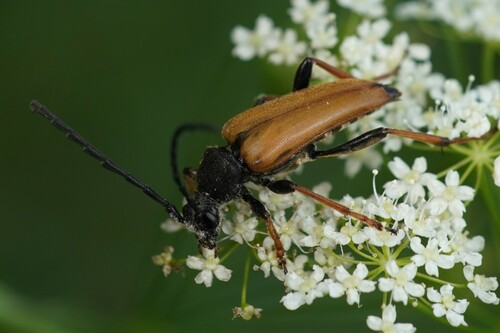
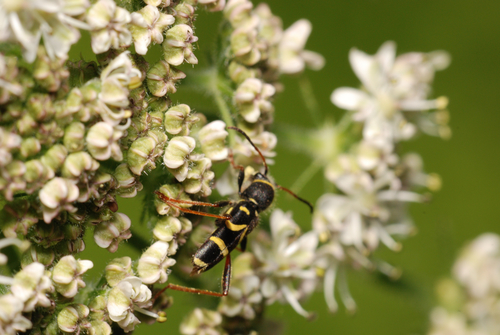
The closest relatives of the Four-Banded Longhorn Beetle that you can see in Hamburg (family Cerambycidae, Longhorn Beetles) are Red Pine Longhorn Beetle (about 10%), Wasp Beetle (about 10%) and Fairy-Ring Longhorn Beetle (about 10%), with each one's daily chance of a sighting.

Where does the Four-Banded Longhorn Beetle sighting chance come from?

GBIF citizen-science records

It is estimated from how often the Four-Banded Longhorn Beetle is recorded against all the insects logged in Hamburg (24 verified sightings), calibrated against known sighting rates. Figures are rounded to the nearest 10% because citizen-science data supports honest approximations, not decimals, and months with records from fewer than five people show "—". How it works.

← Back to Hamburg