About the White Plume Moth
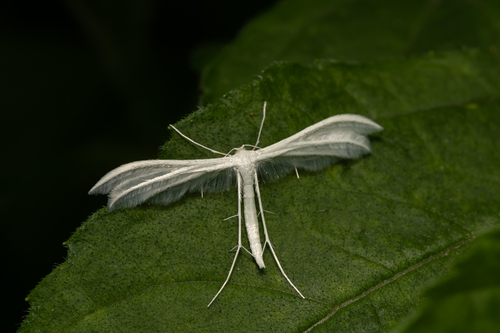
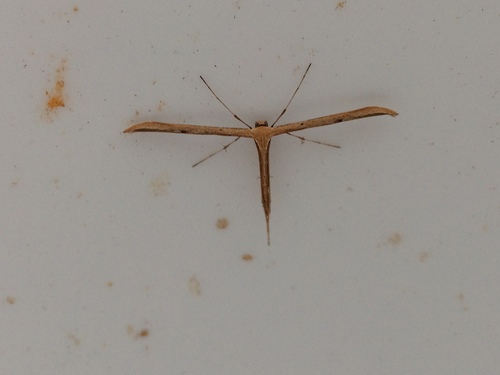
Pterophorus pentadactyla, commonly known as the white plume moth, is a moth in the family Pterophoridae. It is found in the West Palearctic including North Africa and Europe. The wingspan is 26–34 mm (1.0–1.3 in). It is uniformly white, with the hind wing pair divided in three feathery plumes and the front pair in another two. The moths fly from June to August. The larvae feed on bindweed (Convolvulus species).
This moth was first described by Carl Linnaeus in 1758 in the 10th edition of Systema Naturae. He gave it the name Aciptilia pentadactyla, with the specific epithet being descriptive of the appearance of the wings, and coming from the Greek meaning "five fingers"; the insect was later transferred to the genus Pterophorus.
The white plume moth is a distinctive insect with a wingspan of 26 to 34 mm (1.0 to 1.3 in). The adult is pure white, the wings being divided into five slender feather-like plumes, two forming part of the forewing and three part of the hind wing. The insect is nocturnal, emerging at dusk, and is on the wing during June and July. The larvae are green, with a yellow dorsal stripe and tufts of pale hairs. The plume moth has a very... Wikipedia →