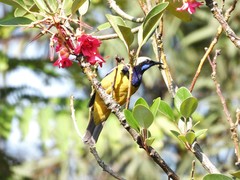

Orange-bellied Leafbird

Orange-bellied Leafbird

Chloropsis hardwickii

Silhouette: Sheatherius · PhyloPic

LCLeast ConcernNTVUENCR
Daily sighting probability <5% · Rare
at Hangzhou

In 3 days ~10% in a week ~20%

60 Verified sightings at Hangzhou
2,248 In all 6 parks From 2019 to 2026
January Best month
🌅 Crepuscular When it's spotted

About the Orange-bellied Leafbird

The orange-bellied leafbird (Chloropsis hardwickii) is a bird native to the central and eastern Himalayas, Yunnan and northern parts of Southeast Asia. The greyish-crowned leafbird, which is found in Hainan, is again considered conspecific. The scientific name commemorates the English naturalist Thomas Hardwicke.

It is brightly coloured with an orange belly, a green back, a blue tail and flight feathers, and a black and blue patch over its throat and chest. It has a long, curved beak. It feeds on insects, spiders and nectar. Orange-bellied leafbirds make their nests from roots and fibers which are suspended from the edges of twigs at the end of a tree branch. They do not migrate.

Birds of the World by Colin Harrison and Alan Greensmith, Eyewitness Handbooks Wikipedia →

Sounds

Imitation0:46

China · 2026

© Dave Guo · XC1147262 · CC BY-NC-SA 4.0

Song1:25

China · 2026

© Bo Shunqi 薄顺奇 · XC1094799 · CC BY-NC-SA 4.0

Call0:16

China · 2025

© Feather V · XC992127 · CC BY-NC-SA 4.0

Global Distribution

Parks Where Found

# Park Country Daily sighting probability
1 Royal Manas National Park 🇧🇹 Bhutan
~50%
2 Namdapha National Park 🇮🇳 India
~30%
3 Doi Inthanon National Park 🇹🇭 Thailand
~20%
4 Manas National Park 🇮🇳 India
~10%
5 Kaeng Krachan National Park 🇹🇭 Thailand
<5%
6 Jim Corbett National Park 🇮🇳 India
<5%

Cities Where Found

# City Country Daily sighting probability
1 Guiyang 🇨🇳 China
~20%
2 Hangzhou 🇨🇳 China
<5%
3 Kathmandu 🇳🇵 Nepal
<5%
4 Guangzhou 🇨🇳 China
<5%
5 Hong Kong 🇨🇳 China
<5%
6 Dehradun 🇮🇳 India
<5%

Zoos & Centres Where Found

# Zoo / Centre Country
1 Basel Zoo 🇨🇭 Switzerland In captivity
2 Philadelphia Zoo 🇺🇸 United States In captivity
3 Hong Kong Zoological and Botanical Gardens 🇨🇳 China In captivity
4 Edward Youde Aviary 🇭🇰 Hong Kong SAR China In captivity

Before you go

What are the chances of seeing an Orange-bellied Leafbird in Hangzhou?

Rare

Under 5% of wildlife watchers report an Orange-bellied Leafbird sighting in Hangzhou on a given day, based on 60 verified sightings from GBIF citizen-science data. It is the 107th most-seen of the 219 birds we can rate there. Over three days the chance rises to about 10%, and over a week to about 20%, if each day is a fresh chance.

When is the best time to see an Orange-bellied Leafbird in Hangzhou?

December to February

In those months about 10% of wildlife watchers report an Orange-bellied Leafbird in Hangzhou on a given day, against under 5% in March to November, the lowest months.

What time of day is best to see an Orange-bellied Leafbird?

Between 3 and 6 am

Across all the parks we cover, that three-hour window holds the most Orange-bellied Leafbird sightings with a recorded time, and about half of them come between 6 am and 6 pm: it is most active around dawn and dusk.

Is Hangzhou the best place to see an Orange-bellied Leafbird?

2nd of 6

Of the 6 cities where we can rate Orange-bellied Leafbird sightings, Hangzhou ranks 2nd at under 5%. The best odds are in Guiyang (China, about 20%).

Which relatives of the Orange-bellied Leafbird live in Hangzhou?

Same order: Passeriformes

The closest relatives of the Orange-bellied Leafbird that you can see in Hangzhou (order Passeriformes, Perching Birds) are Light-vented Bulbul (about 80%), Chinese Blackbird (about 70%) and Oriental Magpie-Robin (about 60%), with each one's daily chance of a sighting.

Where does the Orange-bellied Leafbird sighting chance come from?

GBIF citizen-science records

It is estimated from how often the Orange-bellied Leafbird is recorded against all the birds logged in Hangzhou (60 verified sightings), calibrated against known sighting rates. Figures are rounded to the nearest 10% because citizen-science data supports honest approximations, not decimals, and months with records from fewer than five people show "—". How it works.

← Back to Hangzhou