White-crowned Forktail

White-crowned Forktail

Enicurus leschenaulti

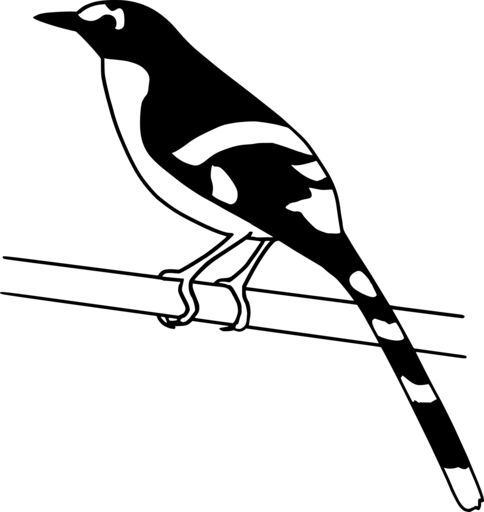
Silhouette: Andy Wilson · PhyloPic

LCLeast ConcernNTVUENCR
Daily sighting probability <5% · Rare
at Hangzhou

In 3 days <5% in a week ~10%

16 Verified sightings at Hangzhou
1,541 In all 9 parks From 2019 to 2026
July Best month
🌅 Crepuscular When it's spotted

About the White-crowned Forktail

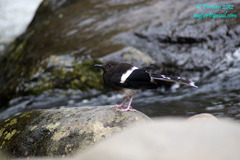
The white-crowned forktail (Enicurus leschenaulti) is a species of forktail in the family Muscicapidae. Formally described in 1818, it has five subspecies, each occupying a different geographic range. The largest of the forktails, Enicurus leschenaulti, is between 25 and 28 centimetres (9.8 and 11.0 in) long. It has a black throat and breast, black mantle, and largely black wings. The rump and lower back are white, and the bird has a prominent white crown, from which it gets its name. As with other forktails, the tail is long, deeply forked, and banded in black and white. A variety of whistling and clicking calls have been described. Slight morphological differences have been observed between subspecies.

A shy bird, the white-crowned forktail stays near water, and forages on the edges of rivers and streams for invertebrates. Its breeding season is between March and September, and possibly extends till October. Its nests are also built near the water, and are constructed of plant material. The eggs are between two and five in number, though there is latitudinal variation. Multiple broods in a year have been observed in China. The white-crowned forktail is found in China, Southeast Asia and also in northeastern parts of the Indian subcontinent. Its natural habitats are subtropical or tropical moist lowland forests and subtropical or tropical moist montane forests. Its elevational range varies across its range, from a minimum of 185 metres (607 ft) above sea level to a maximum of 2,400 metres (7,900 ft). It is categorized as a species of least concern by the International Union for Conservation of Nature. Wikipedia →

Sounds

Call0:20

China · 2026

© He Wenjin/文进 · XC1083368 · CC BY-NC-SA 4.0

Uncertain1:20

China · 2022

© JJSUN · XC1069639 · CC BY-NC-SA 4.0

Alarm call0:05

China · 2025

© 小菜鸟 · XC1007914 · CC BY-NC-SA 4.0

Global Distribution

Parks Where Found

# Park Country Daily sighting probability
1 Danum Valley Conservation Area 🇲🇾 Malaysia
~30%
2 Namdapha National Park 🇮🇳 India
~30%
3 Doi Inthanon National Park 🇹🇭 Thailand
~10%
4 Taman Negara National Park 🇲🇾 Malaysia
~10%
5 Khao Luang National Park 🇹🇭 Thailand
<5%
6 Khao Yai National Park 🇹🇭 Thailand
<5%
7 Sepilok 🇲🇾 Malaysia
<5%
8 Kerinci Seblat National Park 🇮🇩 Indonesia
<5%
9 Kinabalu Park 🇲🇾 Malaysia
<5%

Cities Where Found

# City Country Daily sighting probability
1 Hangzhou 🇨🇳 China
<5%

Before you go

What are the chances of seeing a White-crowned Forktail in Hangzhou?

Rare

Under 5% of wildlife watchers report a White-crowned Forktail sighting in Hangzhou on a given day, based on 16 verified sightings from GBIF citizen-science data. It is the 162nd most-seen of the 219 birds we can rate there. Over three days the chance rises to under 5%, and over a week to about 10%, if each day is a fresh chance.

When is the best time to see a White-crowned Forktail in Hangzhou?

Any time of year

In every month with enough records, under 5% of wildlife watchers report a White-crowned Forktail in Hangzhou on a given day, so our monthly data shows no clear season.

What time of day is best to see a White-crowned Forktail?

Between 7 and 10 am

Across all the parks we cover, that three-hour window holds the most White-crowned Forktail sightings with a recorded time, and about half of them come between 6 am and 6 pm: it is most active around dawn and dusk.

Where else can you see a White-crowned Forktail?

Only Hangzhou, in our data

Hangzhou is the only city on Wallace's Line with enough records to rate White-crowned Forktail sightings: under 5% of wildlife watchers there report one on a given day.

Which relatives of the White-crowned Forktail live in Hangzhou?

Same family: Muscicapidae

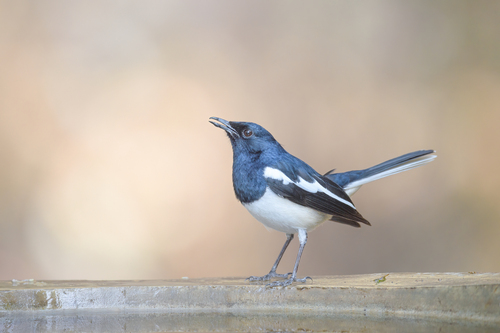
The closest relatives of the White-crowned Forktail that you can see in Hangzhou (family Muscicapidae, Old World Flycatchers, Robins, and Chats) are Oriental Magpie-Robin (about 60%), Daurian Redstart (about 30%) and Red-flanked Bluetail (about 20%), with each one's daily chance of a sighting.

Where does the White-crowned Forktail sighting chance come from?

GBIF citizen-science records

It is estimated from how often the White-crowned Forktail is recorded against all the birds logged in Hangzhou (16 verified sightings), calibrated against known sighting rates. Figures are rounded to the nearest 10% because citizen-science data supports honest approximations, not decimals, and months with records from fewer than five people show "—". How it works.

← Back to Hangzhou