
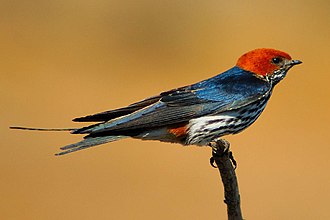
Pearl-breasted Swallow

Pearl-breasted Swallow

Hirundo dimidiata

Silhouette: Matt Wilkins · PhyloPic

LCLeast ConcernNTVUENCR
Daily sighting probability <5% · Rare
at Harare

In 3 days <5% in a week ~10%

7 Verified sightings at Harare
990 In all 12 parks From 2019 to 2026
June Best month
☀️ Diurnal When it's spotted

About the Pearl-breasted Swallow

The pearl-breasted swallow (Hirundo dimidiata) is a small swallow. The pearl-breasted swallow is 13–14 cm long. It has glossy blue upperparts and grey-white underparts. The upper wings, underwing flight feathers and forked tail are blackish-blue. The underwing coverts are a darker shade of grey-white. The lack of white in the tail is a distinction from similar Hirundo species. The outer feathers are slightly longer in the male than the female. Juveniles are duller and browner than the adult, with shorter outer tail feathers.

The pearl-breasted swallow breeds in southern Africa from Angola, southern Congo and Tanzania southwards. It is sparsely distributed, but can be locally common. It is partially migratory with many birds from the southwest of South Africa wintering further north. This is a bird of dry scrub, farmland and clearings. It is often found around human habitation.

The pearl-breasted swallow feeds mainly on flying insects, with a fast direct flight. The... Wikipedia →

Sounds

Call0:38

South Africa · 2019

© Frank Lambert · XC512664 · CC BY-NC-ND 4.0

Begging call0:33

South Africa · 2021

© Lynette Rudman · XC623414 · CC BY-NC-SA 4.0

Call1:04

South Africa · 2021

© Tim Cockcroft · XC622640 · CC BY-NC-SA 4.0

Global Distribution

Parks Where Found

# Park Country Daily sighting probability
1 De Hoop Nature Reserve 🇿🇦 South Africa
~30%
2 West Coast National Park 🇿🇦 South Africa
~30%
3 Addo Elephant National Park 🇿🇦 South Africa
~20%
4 Pilanesberg National Park 🇿🇦 South Africa
~20%
5 Gonarezhou National Park 🇿🇼 Zimbabwe
<5%
6 Moremi Game Reserve 🇧🇼 Botswana
<5%
7 Chobe National Park 🇧🇼 Botswana
<5%
8 Hwange National Park 🇿🇼 Zimbabwe
<5%
9 Kruger National Park 🇿🇦 South Africa
<5%
10 Kafue National Park 🇿🇲 Zambia
<5%
11 Etosha National Park 🇳🇦 Namibia
<5%
12 Table Mountain National Park 🇿🇦 South Africa
<5%

Cities Where Found

# City Country Daily sighting probability
1 Harare 🇿🇼 Zimbabwe
<5%
2 Cape Town 🇿🇦 South Africa
<5%
3 Johannesburg 🇿🇦 South Africa
<5%

Before you go

What are the chances of seeing a Pearl-breasted Swallow in Harare?

Rare

Under 5% of wildlife watchers report a Pearl-breasted Swallow sighting in Harare on a given day, based on 7 verified sightings from GBIF citizen-science data. It is the 195th most-seen of the 213 birds we can rate there. Over three days the chance rises to under 5%, and over a week to about 10%, if each day is a fresh chance.

When is the best time to see a Pearl-breasted Swallow in Harare?

Any time of year

In every month with enough records, under 5% of wildlife watchers report a Pearl-breasted Swallow in Harare on a given day, so our monthly data shows no clear season.

What time of day is best to see a Pearl-breasted Swallow?

Between 6 and 9 am

Across all the parks we cover, that three-hour window holds the most Pearl-breasted Swallow sightings with a recorded time, and about 9 in 10 of them come between 6 am and 6 pm: it is a daytime animal.

Is Harare the best place to see a Pearl-breasted Swallow?

Yes

Of the 3 cities where we can rate Pearl-breasted Swallow sightings, Harare has the highest daily chance: under 5%. Next come Cape Town (South Africa, under 5%) and Johannesburg (South Africa, under 5%).

Which relatives of the Pearl-breasted Swallow live in Harare?

Same genus: Hirundo

The closest relatives of the Pearl-breasted Swallow that you can see in Harare (genus Hirundo, Typical Swallows) are Wire-tailed Swallow (about 10%) and Barn Swallow (about 10%), with each one's daily chance of a sighting.

Where does the Pearl-breasted Swallow sighting chance come from?

GBIF citizen-science records

It is estimated from how often the Pearl-breasted Swallow is recorded against all the birds logged in Harare (7 verified sightings), calibrated against known sighting rates. Figures are rounded to the nearest 10% because citizen-science data supports honest approximations, not decimals, and months with records from fewer than five people show "—". How it works.

← Back to Harare