Southern Yellow White-eye

Southern Yellow White-eye

Zosterops anderssoni

Silhouette: Ferran Sayol · PhyloPic

Daily sighting probability ~20% · Possible
at Harare

In 3 days ~50% in a week ~80%

125 Verified sightings at Harare
684 In all 16 parks From 2019 to 2026
September Best month
☀️ Diurnal When it's spotted

About the Southern Yellow White-eye

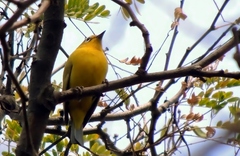
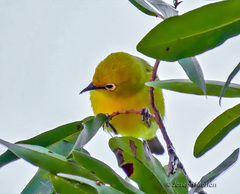
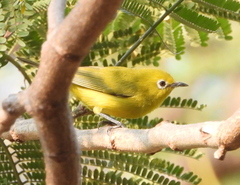
The southern yellow white-eye (Zosterops anderssoni) is a bird species in the family Zosteropidae. It is found in parts of southern Africa. It was formerly considered conspecific with the African yellow white-eye. The southern yellow white-eye was formerly treated as a subspecies of the African yellow white-eye (Zosterops senegalensis; renamed the northern yellow white-eye), but it is now considered as a separate species based on the phylogenetic relationships determined in a molecular study in 2013.

Three subspecies are recognised: Its diet consists of insects, fruits, seeds, and grains. Wikipedia →

Sounds

Call0:33

Tanzania · 2026

Kileo Jumah · XC1143775 · CC0

Alarm call0:16

Zambia · 2021

© Dries Van de Loock · XC682074 · CC BY-NC-SA 4.0

Song0:57

Tanzania · 2019

© Peter Boesman · XC510482 · CC BY-NC-ND 4.0

Global Distribution

Parks Where Found

# Park Country Daily sighting probability
1 uMkhuze Game Reserve 🇿🇦 South Africa
~10%
2 iSimangaliso Wetland Park 🇿🇦 South Africa
~10%
3 Ruaha National Park 🇹🇿 Tanzania
~10%
4 Chobe National Park 🇧🇼 Botswana
~10%
5 Gonarezhou National Park 🇿🇼 Zimbabwe
~10%
6 Kafue National Park 🇿🇲 Zambia
~10%
7 Lower Zambezi National Park 🇿🇲 Zambia
~10%
8 Mana Pools National Park 🇿🇼 Zimbabwe
~10%
9 Hwange National Park 🇿🇼 Zimbabwe
<5%
10 Gorongosa National Park 🇲🇿 Mozambique
<5%
11 Moremi Game Reserve 🇧🇼 Botswana
<5%
12 Hluhluwe-Imfolozi Park 🇿🇦 South Africa
<5%
13 Etosha National Park 🇳🇦 Namibia
<5%
14 Lake Manyara National Park 🇹🇿 Tanzania
<5%
15 Ngorongoro Conservation Area 🇹🇿 Tanzania
<5%
16 Kruger National Park 🇿🇦 South Africa
<5%

Cities Where Found

# City Country Daily sighting probability
1 Harare 🇿🇼 Zimbabwe
~20%
2 Lusaka 🇿🇲 Zambia
~20%
3 Lilongwe 🇲🇼 Malawi
~10%
4 Maputo 🇲🇿 Mozambique
~10%

Before you go

What are the chances of seeing a Southern Yellow White-eye in Harare?

Possible

About 20% of wildlife watchers report a Southern Yellow White-eye sighting in Harare on a given day, based on 125 verified sightings from GBIF citizen-science data. It is the 37th most-seen of the 213 birds we can rate there. Over three days the chance rises to about 50%, and over a week to about 80%, if each day is a fresh chance.

When is the best time to see a Southern Yellow White-eye in Harare?

September

In that month about 40% of wildlife watchers report a Southern Yellow White-eye in Harare on a given day, against about 10% in January and June–July, the lowest months. That is one of Harare's driest months, with about 5 mm of rain against 200 mm in December.

What time of day is best to see a Southern Yellow White-eye?

Between 7 and 10 am

Across all the parks we cover, that three-hour window holds the most Southern Yellow White-eye sightings with a recorded time, and about 9 in 10 of them come between 6 am and 6 pm: it is a daytime animal.

Is Harare the best place to see a Southern Yellow White-eye?

Yes

Of the 4 cities where we can rate Southern Yellow White-eye sightings, Harare has the highest daily chance: about 20%. Next come Lusaka (Zambia, about 20%) and Lilongwe (Malawi, about 10%).

Which relatives of the Southern Yellow White-eye live in Harare?

Same order: Passeriformes

The closest relatives of the Southern Yellow White-eye that you can see in Harare (order Passeriformes, Perching Birds) are Common Bulbul (about 90%), Pied Crow (about 90%) and Blue-breasted Cordonbleu (about 70%), with each one's daily chance of a sighting.

Where does the Southern Yellow White-eye sighting chance come from?

GBIF citizen-science records

It is estimated from how often the Southern Yellow White-eye is recorded against all the birds logged in Harare (125 verified sightings), calibrated against known sighting rates. Figures are rounded to the nearest 10% because citizen-science data supports honest approximations, not decimals, and months with records from fewer than five people show "—". How it works.

← Back to Harare