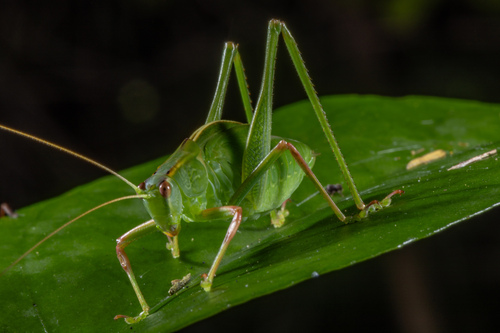
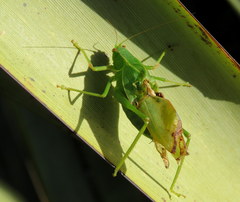
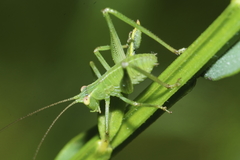

Australian Common Garden Katydid

Australian Common Garden Katydid

Caedicia simplex

Daily sighting probability ~10% · With luck
at Hobart

In 3 days ~30% in a week ~60%

13 Verified sightings at Hobart
43 In all 4 parks From 2019 to 2026
April Best month
☀️🌙 Day & Night When it's spotted

About the Australian Common Garden Katydid

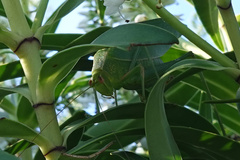
Caedicia simplex is a species of bush cricket or katydid, native to New Zealand and Australia. A common name is the "common garden katydid". Species found in the family Tettigoniidae are differentiated from other ensifera by the presence of forewings that can be held away from the body modified to help with both leaf mimicry and acoustics, as well as the female ovipositor. Generally speaking, katydids have extremely long antennae in proportion to their body size, as well as a body that is cylindrical or laterally compressed with 3 sets of long, spindly legs that are used for long-distance jumping. Among all katydids, Caedicia simplex is considered an unremarkable species in appearance. The common garden katydid strongly resembles a small leaf in appearance with a grass-like, green coloration, measuring at about 4–6 cm as an adult. In the nymph stage, however, C. simplex are sometimes a vibrant red-pink color, lacking the leaf-like appearance of their adult counterparts. Caedicia simplex has a distinctly small, oval head with a velvety green appearance and bright, orange-red eyes. The velvety pronotum on common garden katydids are distinctly keeled, marked with a yellow... Wikipedia →

Global Distribution

Parks Where Found

# Park Country Daily sighting probability
1 Egmont National Park 🇳🇿 New Zealand
~10%
2 Abel Tasman National Park 🇳🇿 New Zealand
~10%
3 Blue Mountains National Park 🇦🇺 Australia
~10%
4 Great Otway National Park 🇦🇺 Australia
~10%

Cities Where Found

# City Country Daily sighting probability
1 Auckland 🇳🇿 New Zealand
~20%
2 Hobart 🇦🇺 Australia
~10%
3 Sydney 🇦🇺 Australia
~10%
4 Melbourne 🇦🇺 Australia
~10%

Before you go

What are the chances of seeing an Australian Common Garden Katydid in Hobart?

With luck

About 10% of wildlife watchers report an Australian Common Garden Katydid sighting in Hobart on a given day, based on 13 verified sightings from GBIF citizen-science data. It is the 15th most-seen of the 42 insects we can rate there. Over three days the chance rises to about 30%, and over a week to about 60%, if each day is a fresh chance.

When is the best time to see an Australian Common Garden Katydid in Hobart?

April

In that month about 30% of wildlife watchers report an Australian Common Garden Katydid in Hobart on a given day, against under 5% in July, September–October and December–February, the lowest months.

What time of day is best to see an Australian Common Garden Katydid?

Between 8 and 11 pm

Across all the parks we cover, that three-hour window holds the most Australian Common Garden Katydid sightings with a recorded time, and about half of them come between 6 am and 6 pm: it is seen both by day and at night.

Is Hobart the best place to see an Australian Common Garden Katydid?

2nd of 4

Of the 4 cities where we can rate Australian Common Garden Katydid sightings, Hobart ranks 2nd at about 10%. The best odds are in Auckland (New Zealand, about 20%).

Which relatives of the Australian Common Garden Katydid live in Hobart?

Same order: Orthoptera

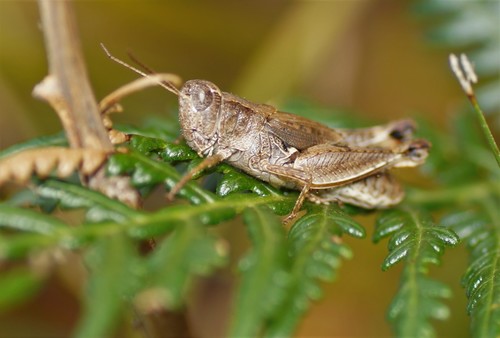
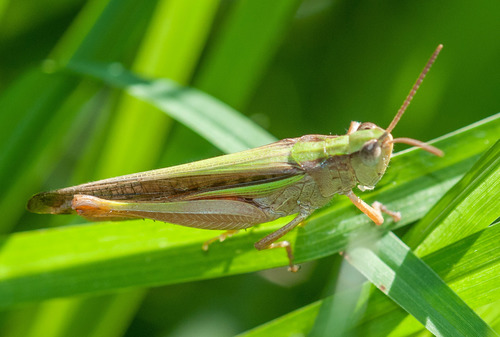
The closest relatives of the Australian Common Garden Katydid that you can see in Hobart (order Orthoptera, Grasshoppers, Crickets, and Katydids) are Wingless Grasshopper (about 10%) and Disappearing Grasshopper (about 10%), with each one's daily chance of a sighting.

Where does the Australian Common Garden Katydid sighting chance come from?

GBIF citizen-science records

It is estimated from how often the Australian Common Garden Katydid is recorded against all the insects logged in Hobart (13 verified sightings), calibrated against known sighting rates. Figures are rounded to the nearest 10% because citizen-science data supports honest approximations, not decimals, and months with records from fewer than five people show "—". How it works.

← Back to Hobart