Common Babbler

Common Babbler

Turdoides caudata

Silhouette: Jiekun He · PhyloPic

Daily sighting probability ~40% · Likely
at Jodhpur

In 3 days ~80% in a week >90%

136 Verified sightings at Jodhpur
1,111 In all 8 parks From 2019 to 2026
September Best month
🌅 Crepuscular When it's spotted

About the Common Babbler

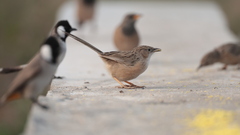
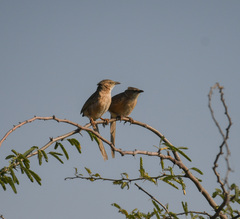
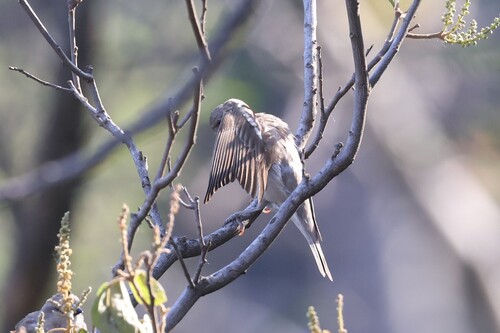
The common babbler (Argya caudata) is a member of the family of Leiothrichidae. They are found in dry open scrub country mainly in India. Two populations are recognized as subspecies and the populations to the west of the Indus river system are now usually treated as a separate species, the Afghan babbler (Turdoides huttoni). The species is distinctly long-tailed, slim with an overall brown or greyish colour, streaked on the upper plumage and having a distinctive whitish throat.

The common babbler was formerly placed in the genus Turdoides but following the publication of a comprehensive molecular phylogenetic study in 2018, it was moved to the resurrected genus Argya. This small, slim babbler with a long tail is buff to grey above with dark streaks. The underside is unstreaked and paler, the throat being nearly whitish.

The species was originally described as Crateropus caudatus before it was moved to the genus Argya and still later to Turdoides. The species ending was, however, retained in these new combinations but the corrected feminine form caudata matches the Latin gender of the genus Turdoides.

The common babbler group includes eclipes (Hume,... Wikipedia →

Sounds

Recording0:19

India · 2024

© Tarun Meena · iNaturalist · CC BY 4.0

Recording0:11

India · 2023

© Malaika Mathew Chawla · iNaturalist · CC BY 4.0

Global Distribution

Parks Where Found

# Park Country Daily sighting probability
1 Keoladeo National Park 🇮🇳 India
~30%
2 Ranthambore National Park 🇮🇳 India
~20%
3 Gir National Park 🇮🇳 India
~10%
4 Satpura National Park 🇮🇳 India
<5%
5 Jim Corbett National Park 🇮🇳 India
<5%
6 Bandhavgarh National Park 🇮🇳 India
<5%
7 Kanha National Park 🇮🇳 India
<5%
8 Chitwan National Park 🇳🇵 Nepal
<5%

Cities Where Found

# City Country Daily sighting probability
1 Jodhpur 🇮🇳 India
~40%
2 Rajkot 🇮🇳 India
~30%
3 Kota 🇮🇳 India
~20%
4 Islamabad 🇵🇰 Pakistan
~10%
5 Gwalior 🇮🇳 India
~10%
6 Jaipur 🇮🇳 India
~10%
7 Karachi 🇵🇰 Pakistan
~10%
8 Vadodara 🇮🇳 India
~10%
9 Surat 🇮🇳 India
~10%
10 Lahore 🇵🇰 Pakistan
~10%

Before you go

What are the chances of seeing a Common Babbler in Jodhpur?

Likely

About 40% of wildlife watchers report a Common Babbler sighting in Jodhpur on a given day, based on 136 verified sightings from GBIF citizen-science data. It is the 20th most-seen of the 127 birds we can rate there. Over three days the chance rises to about 80%, and over a week to over 90%, if each day is a fresh chance.

When is the best time to see a Common Babbler in Jodhpur?

June and September–October

In those months about 60% of wildlife watchers report a Common Babbler in Jodhpur on a given day, against about 30% in January to March, the lowest months.

What time of day is best to see a Common Babbler?

Between 3 and 6 am

Across all the parks we cover, that three-hour window holds the most Common Babbler sightings with a recorded time, and about 6 in 10 of them come between 6 pm and 6 am: it is most active around dawn and dusk.

Is Jodhpur the best place to see a Common Babbler?

Yes

Of the 23 cities where we can rate Common Babbler sightings, Jodhpur has the highest daily chance: about 40%. Next come Rajkot (India, about 30%) and Kota (India, about 20%).

Which relatives of the Common Babbler live in Jodhpur?

Same genus: Turdoides

The closest relatives of the Common Babbler that you can see in Jodhpur (genus Turdoides, Turdoides Babblers) are Large Grey Babbler (about 40%) and Jungle Babbler (about 30%), with each one's daily chance of a sighting.

Where does the Common Babbler sighting chance come from?

GBIF citizen-science records

It is estimated from how often the Common Babbler is recorded against all the birds logged in Jodhpur (136 verified sightings), calibrated against known sighting rates. Figures are rounded to the nearest 10% because citizen-science data supports honest approximations, not decimals, and months with records from fewer than five people show "—". How it works.

← Back to Jodhpur