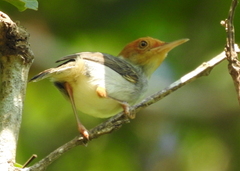
Ashy Tailorbird

Ashy Tailorbird

Orthotomus ruficeps

Silhouette: Sheatherius · PhyloPic

LCLeast ConcernNTVUENCR
Daily sighting probability ~20% · Possible
at Johor Bahru

In 3 days ~40% in a week ~70%

20 Verified sightings at Johor Bahru
3,927 In all 10 parks From 2019 to 2026
August Best month
🌅 Crepuscular When it's spotted

About the Ashy Tailorbird

The ashy tailorbird (Orthotomus ruficeps) is a species of songbird from Southeast Asia, formerly placed in the "Old World warbler" assemblage, it but now placed in the family Cisticolidae. The ashy tailorbird was described by the French ornithologist René Lesson in 1830. It was once treated as being conspecific (the same species) as the olive-backed tailorbird, but the two species are genetically distinct and act as such where their range overlaps in Java. Nine subspecies have been described.

The species is found across Southeast Asia, ranging from southern Myanmar and southern Thailand through the Malay Peninsula and Singapore. It is found widely across Greater Sunda Islands, namely Borneo, Sumatra and Java, as well as smaller islands near these, including the Philippine island of Mapun (which is close to Borneo). Another disjunct population is found in southern Vietnam and Cambodia.

Its natural habitats is typically lowland forests close to the coast, but it has been recorded up to 900 m (3,000 ft) on Sumatra and Borneo. It can occupy a range of forested habitats including mangrove forest, secondary forest, swamp forest and scrubland... Wikipedia →

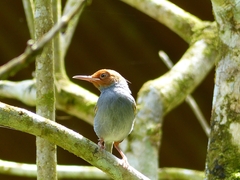
Sounds

Call0:37

Singapore · 2026

© Joan Theng · XC1180082 · CC BY-NC-SA 4.0

Song0:09

Malaysia · 2024

© Lim Ying Hien 林勇贤 · XC1160795 · CC BY-NC-ND 4.0

Duet0:21

Singapore · 2025

© Ding Li Yong · XC1032795 · CC BY-NC-ND 4.0

Global Distribution

Parks Where Found

# Park Country Daily sighting probability
1 Sepilok 🇲🇾 Malaysia
~60%
2 Bako National Park 🇲🇾 Malaysia
~50%
3 Way Kambas National Park 🇮🇩 Indonesia
~50%
4 Kinabatangan Wildlife Sanctuary 🇲🇾 Malaysia
~40%
5 Gunung Leuser National Park 🇮🇩 Indonesia
~30%
6 Danum Valley Conservation Area 🇲🇾 Malaysia
~20%
7 Tanjung Puting National Park 🇮🇩 Indonesia
~10%
8 Kinabalu Park 🇲🇾 Malaysia
~10%
9 Taman Negara National Park 🇲🇾 Malaysia
<5%
10 Kerinci Seblat National Park 🇮🇩 Indonesia
<5%

Cities Where Found

# City Country Daily sighting probability
1 Ho Chi Minh City 🇻🇳 Vietnam
~50%
2 Kuching 🇲🇾 Malaysia
~30%
3 Cần Thơ 🇻🇳 Vietnam
~20%
4 Singapore 🇸🇬 Singapore
~20%
5 Johor Bahru 🇲🇾 Malaysia
~20%
6 Padang 🇮🇩 Indonesia
~10%
7 Jakarta 🇮🇩 Indonesia
~10%
8 Phnom Penh 🇰🇭 Cambodia
~10%
9 Kuala Lumpur 🇲🇾 Malaysia
~10%

Before you go

What are the chances of seeing an Ashy Tailorbird in Johor Bahru?

Possible

About 20% of wildlife watchers report an Ashy Tailorbird sighting in Johor Bahru on a given day, based on 20 verified sightings from GBIF citizen-science data. It is the 26th most-seen of the 60 birds we can rate there. Over three days the chance rises to about 40%, and over a week to about 70%, if each day is a fresh chance.

When is the best time to see an Ashy Tailorbird in Johor Bahru?

August

In that month about 40% of wildlife watchers report an Ashy Tailorbird in Johor Bahru on a given day, against about 10% in July and October, the lowest months.

What time of day is best to see an Ashy Tailorbird?

Between 2 and 5 am

Across all the parks we cover, that three-hour window holds the most Ashy Tailorbird sightings with a recorded time, and about 6 in 10 of them come between 6 pm and 6 am: it is most active around dawn and dusk.

Is Johor Bahru the best place to see an Ashy Tailorbird?

5th of 9

Of the 9 cities where we can rate Ashy Tailorbird sightings, Johor Bahru ranks 5th at about 20%. The best odds are in Ho Chi Minh City (Vietnam, about 50%), Kuching (Malaysia, about 30%) and Cần Thơ (Vietnam, about 20%).

Where does the Ashy Tailorbird sighting chance come from?

GBIF citizen-science records

It is estimated from how often the Ashy Tailorbird is recorded against all the birds logged in Johor Bahru (20 verified sightings), calibrated against known sighting rates. Figures are rounded to the nearest 10% because citizen-science data supports honest approximations, not decimals, and months with records from fewer than five people show "—". How it works.

← Back to Johor Bahru