White-headed Munia

White-headed Munia

Lonchura maja

Silhouette: Ferran Sayol · PhyloPic

LCLeast ConcernNTVUENCR
Daily sighting probability ~10% · With luck
at Kuala Lumpur

In 3 days ~20% in a week ~40%

165 Verified sightings at Kuala Lumpur
194 In all 5 parks From 2019 to 2026
December Best month
🌅 Crepuscular When it's spotted

About the White-headed Munia

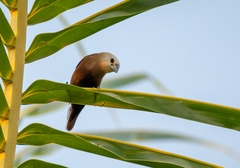
The white-headed munia (Lonchura maja) is a small passerine bird belonging to the estrildid finch family. This species is often confused with, and referred to as, the Pale-headed munia (Lonchura pallida) which can be differentiated by tan coloured flanks which are lighter than the brown wings and also by the absence of the black belly.

The white-headed munia was formally described in 1766 by the Swedish naturalist Carl Linnaeus in the twelfth edition of his Systema Naturae under the binomial name Loxia maja. Linnaeus cited George Edwards's "The Malacca Gros-beak" and Mathurin Jacques Brisson's "Le Maia de la Chine". The English naturalist John Ray used the word "Maia" for a Cuban bird in 1768. Linnaeus specified the locality as East India. This was amended to Malacca in 1924. The white-headed munia is now placed in the genus Lonchura that was introduced by the English naturalist William Henry Sykes in 1832. It is treated as monotypic: no subspecies are recognised.

The White-headed munia has a distinctive chocolate-brown body and a contrasting white head and throat. They are typically 11 cm in length and weigh around 11 grams. Adult birds have... Wikipedia →

Sounds

Call0:32

Malaysia · 2023

© Lim Ying Hien · XC863244 · CC BY-NC-ND 4.0

Uncertain0:14

Vietnam · 2026

© Tim Dinh / Annambirding · XC1155037 · CC BY-NC-SA 4.0

Call0:28

Vietnam · 2023

© Bram Piot · XC841666 · CC BY-NC-SA 4.0

Global Distribution

Parks Where Found

# Park Country Daily sighting probability
1 Bali Barat National Park 🇮🇩 Indonesia
~10%
2 Way Kambas National Park 🇮🇩 Indonesia
~10%
3 Kerinci Seblat National Park 🇮🇩 Indonesia
<5%
4 Gunung Leuser National Park 🇮🇩 Indonesia
<5%
5 Taman Negara National Park 🇲🇾 Malaysia
<5%

Cities Where Found

# City Country Daily sighting probability
1 Yogyakarta 🇮🇩 Indonesia
~50%
2 Semarang 🇮🇩 Indonesia
~40%
3 Denpasar 🇮🇩 Indonesia
~40%
4 Surabaya 🇮🇩 Indonesia
~20%
5 Jakarta 🇮🇩 Indonesia
~20%
6 Ho Chi Minh City 🇻🇳 Vietnam
~10%
7 Kuala Lumpur 🇲🇾 Malaysia
~10%
8 Singapore 🇸🇬 Singapore
<5%

Before you go

What are the chances of seeing a White-headed Munia in Kuala Lumpur?

With luck

About 10% of wildlife watchers report a White-headed Munia sighting in Kuala Lumpur on a given day, based on 165 verified sightings from GBIF citizen-science data. It is the 75th most-seen of the 228 birds we can rate there. Over three days the chance rises to about 20%, and over a week to about 40%, if each day is a fresh chance.

When is the best time to see a White-headed Munia in Kuala Lumpur?

December

In that month about 20% of wildlife watchers report a White-headed Munia in Kuala Lumpur on a given day, against under 5% in February and September–November, the lowest months.

What time of day is best to see a White-headed Munia?

Between 2 and 5 am

Across all the parks we cover, that three-hour window holds the most White-headed Munia sightings with a recorded time, and about half of them come between 6 am and 6 pm: it is most active around dawn and dusk.

Is Kuala Lumpur the best place to see a White-headed Munia?

7th of 8

Of the 8 cities where we can rate White-headed Munia sightings, Kuala Lumpur ranks 7th at about 10%. The best odds are in Yogyakarta (Indonesia, about 50%), Semarang (Indonesia, about 40%) and Denpasar (Indonesia, about 40%).

Where does the White-headed Munia sighting chance come from?

GBIF citizen-science records

It is estimated from how often the White-headed Munia is recorded against all the birds logged in Kuala Lumpur (165 verified sightings), calibrated against known sighting rates. Figures are rounded to the nearest 10% because citizen-science data supports honest approximations, not decimals, and months with records from fewer than five people show "—". How it works.

← Back to Kuala Lumpur