Bohemian Waxwing

Bohemian Waxwing

Bombycilla garrulus

Silhouette: Andy Wilson · PhyloPic

LCLeast ConcernNTVUENCR
Daily sighting probability ~10% · With luck
at Lanzhou

In 3 days ~20% in a week ~50%

6 Verified sightings at Lanzhou
1,042 In all 19 parks From 2019 to 2026
February Best month
☀️ Diurnal When it's spotted

About the Bohemian Waxwing

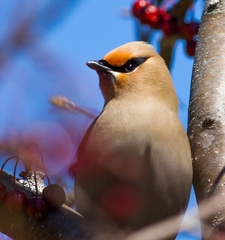
The Bohemian waxwing (Bombycilla garrulus) is a starling-sized passerine bird that breeds in the northern forests of the Palearctic and North America. It has mainly buff-grey plumage, black face markings and a pointed crest. Its wings are patterned with white and bright yellow, and some of the wing feathers have red tips, the resemblance of which to sealing wax gives these birds their common name. The two or three subspecies show only minor differences in appearance. Females are similar to males, although young birds are less well-marked and have few or no waxy wingtips. Although the Bohemian waxwing's range overlaps those of the cedar and Japanese waxwings, it is easily distinguished from them by size and plumage differences.

The breeding habitat is coniferous forests, usually near water. The pair build a lined cup-shaped nest in a tree or bush, often close to the trunk. The clutch of 3–7 eggs is incubated by the female alone for 13–14 days to hatching. The chicks are altricial and naked, and are fed by both parents, initially mostly with insects, but thereafter mainly fruit. They fledge about 14–16 days after leaving the egg. Many birds desert their nesting range in winter and migrate farther south. In some years, large numbers of Bohemian waxwings irrupt well beyond their normal winter range in search of the fruit that makes up most of their diet.

Waxwings can be very tame in winter, entering towns and gardens in search of food, rowan berries being a particular favourite. They can metabolise alcohol produced in fermenting fruit, but can still become intoxicated, sometimes fatally. Other hazards include predation by birds of prey, infestation by parasites, and collisions with cars or windows. The large numbers and very large breeding area mean that it is classified as being of least concern by the International Union for Conservation of Nature. Wikipedia →

Sounds

Alarm call0:21

Latvia · 2026

© Kaspars Funts · XC1186579 · CC BY-NC-SA 4.0

Call0:21

Poland · 2023

© Jarek Matusiak · XC883767 · CC BY-NC-ND 4.0

Begging call0:53

United States · 2014

© Andrew Spencer · XC187688 · CC BY-NC-SA 4.0

Global Distribution

Parks Where Found

# Park Country Daily sighting probability
1 Wrangell-St. Elias National Park 🇺🇸 United States
~10%
2 Denali National Park 🇺🇸 United States
~10%
3 Gauja National Park 🇱🇻 Latvia
~10%
4 Kluane National Park 🇨🇦 Canada
~10%
5 Jasper National Park 🇨🇦 Canada
~10%
6 Białowieża National Park 🇵🇱 Poland
<5%
7 Nikko National Park 🇯🇵 Japan
<5%
8 Biebrza National Park 🇵🇱 Poland
<5%
9 Banff National Park 🇨🇦 Canada
<5%
10 Riding Mountain National Park 🇨🇦 Canada
<5%
11 Vatnajokull National Park 🇮🇸 Iceland
<5%
12 Glacier National Park 🇺🇸 United States
<5%
13 Cairngorms National Park 🇬🇧 United Kingdom
<5%
14 Cape Breton Highlands National Park 🇨🇦 Canada
<5%
15 Acadia National Park 🇺🇸 United States
<5%
16 Yellowstone National Park 🇺🇸 United States
<5%
17 Wadden Sea National Park 🇩🇪 Germany
<5%
18 Grand Teton National Park 🇺🇸 United States
<5%
19 Rocky Mountain National Park 🇺🇸 United States
<5%

Cities Where Found

# City Country Daily sighting probability
1 Yekaterinburg 🇷🇺 Russia
~30%
2 Novosibirsk 🇷🇺 Russia
~20%
3 Mashhad 🇮🇷 Iran
~20%
4 Edmonton 🇨🇦 Canada
~20%
5 Kharkiv 🇺🇦 Ukraine
~20%
6 Kyiv 🇺🇦 Ukraine
~10%
7 Nizhny Novgorod 🇷🇺 Russia
~10%
8 Lanzhou 🇨🇳 China
~10%
9 Minsk 🇧🇾 Belarus
~10%
10 Anchorage 🇺🇸 United States
~10%

Zoos & Centres Where Found

# Zoo / Centre Country
1 Zoo Pilsen 🇨🇿 Czechia In captivity
2 Beijing Wildlife Park 🇨🇳 China In captivity
3 Yaroslavl Zoo 🇷🇺 Russia In captivity

Before you go

What are the chances of seeing a Bohemian Waxwing in Lanzhou?

With luck

About 10% of wildlife watchers report a Bohemian Waxwing sighting in Lanzhou on a given day, based on 6 verified sightings from GBIF citizen-science data. It is the 37th most-seen of the 44 birds we can rate there. Over three days the chance rises to about 20%, and over a week to about 50%, if each day is a fresh chance.

When is the best time to see a Bohemian Waxwing in Lanzhou?

February

In that month about 20% of wildlife watchers report a Bohemian Waxwing in Lanzhou on a given day, against under 5% in January, July and September, the lowest months. That is one of Lanzhou's driest months, with about 5 mm of rain against 85 mm in August. March and October–November have too few records to rate.

What time of day is best to see a Bohemian Waxwing?

Between 1 and 4 pm

Across all the parks we cover, that three-hour window holds the most Bohemian Waxwing sightings with a recorded time, and about 8 in 10 of them come between 6 am and 6 pm: it is a daytime animal.

Is Lanzhou the best place to see a Bohemian Waxwing?

8th of 44

Of the 44 cities where we can rate Bohemian Waxwing sightings, Lanzhou ranks 8th at about 10%. The best odds are in Yekaterinburg (Russia, about 30%), Novosibirsk (Russia, about 20%) and Mashhad (Iran, about 20%).

Which relatives of the Bohemian Waxwing live in Lanzhou?

Same order: Passeriformes

The closest relatives of the Bohemian Waxwing that you can see in Lanzhou (order Passeriformes, Perching Birds) are Eurasian Tree Sparrow (about 90%), Oriental Magpie (about 80%) and Silver-throated Tit (about 80%), with each one's daily chance of a sighting.

Where does the Bohemian Waxwing sighting chance come from?

GBIF citizen-science records

It is estimated from how often the Bohemian Waxwing is recorded against all the birds logged in Lanzhou (6 verified sightings), calibrated against known sighting rates. Figures are rounded to the nearest 10% because citizen-science data supports honest approximations, not decimals, and months with records from fewer than five people show "—". How it works.

← Back to Lanzhou