Thick-Legged Flower Beetle

Thick-Legged Flower Beetle

Oedemera nobilis

Daily sighting probability ~10% · With luck
at Lisbon

In 3 days ~20% in a week ~40%

48 Verified sightings at Lisbon
212 In all 8 parks From 2019 to 2026
April Best month
☀️ Diurnal When it's spotted

About the Thick-Legged Flower Beetle

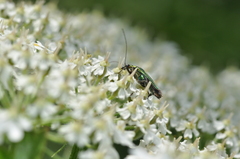
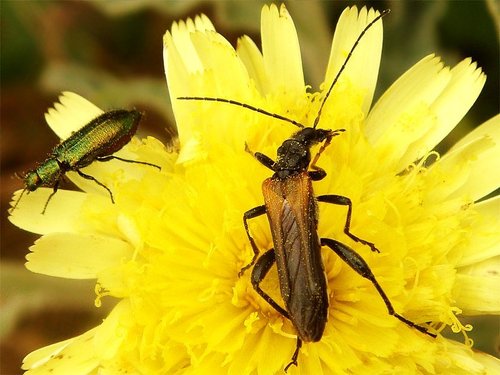
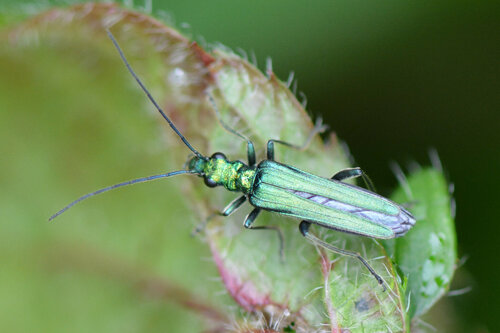
Oedemera nobilis, also known as the false oil beetle, thick-legged flower beetle or swollen-thighed beetle, is a beetle in the family Oedemeridae, a common species in Western Europe, including south and central England. The male of Oedemera nobilis, as in most Oedemera species, possesses hind femora that are very swollen, whereas in the female the femora are thin; the elytra are strongly narrowed towards the apexes, not hiding the membranous hind wings. It is bright green, frequently with a golden or coppery shine; some individuals are blue or violaceous. It can only be confused with Oedemera flavipes (which does not live in the British Isles), from which it differs by its colour, as well as by the long white pubescence on the head, pronotum and hind tibiae of males.

Oedemera nobilis is abundant in spring on several flower species; the males are very conspicuous by their swollen femora and bright green colour. It feeds on pollen and nectar of Asteraceae, Cyperaceae, Convolvulaceae, Cruciferae, Dipsacaceae, Scrophulariaceae, Poaceae, Papaveraceae, Plantaginaceae, Rosaceae, Rubiaceae and Apiaceae. The larvae develop on dry stems of Spartium and... Wikipedia →

Global Distribution

Parks Where Found

# Park Country Daily sighting probability
1 Snowdonia National Park 🇬🇧 United Kingdom
~20%
2 Picos de Europa National Park 🇪🇸 Spain
~20%
3 Cévennes National Park 🇫🇷 France
~10%
4 Aigüestortes National Park 🇪🇸 Spain
~10%
5 Pyrénées National Park 🇫🇷 France
~10%
6 Sierra Nevada National Park 🇪🇸 Spain
~10%
7 Sierra de Guadarrama National Park 🇪🇸 Spain
~10%
8 Wadden Sea National Park 🇩🇪 Germany
~10%

Cities Where Found

# City Country Daily sighting probability
1 Liverpool 🇬🇧 United Kingdom
~30%
2 London 🇬🇧 United Kingdom
~30%
3 Birmingham 🇬🇧 United Kingdom
~30%
4 Manchester 🇬🇧 United Kingdom
~20%
5 Paris 🇫🇷 France
~20%
6 Essen 🇩🇪 Germany
~20%
7 Leeds 🇬🇧 United Kingdom
~20%
8 Lyon 🇫🇷 France
~20%
9 Naples 🇮🇹 Italy
~20%
10 Brussels 🇧🇪 Belgium
~20%

Before you go

What are the chances of seeing a Thick-Legged Flower Beetle in Lisbon?

With luck

About 10% of wildlife watchers report a Thick-Legged Flower Beetle sighting in Lisbon on a given day, based on 48 verified sightings from GBIF citizen-science data. It is the 73rd most-seen of the 441 insects we can rate there. Over three days the chance rises to about 20%, and over a week to about 40%, if each day is a fresh chance.

When is the best time to see a Thick-Legged Flower Beetle in Lisbon?

April

In that month about 20% of wildlife watchers report a Thick-Legged Flower Beetle in Lisbon on a given day, against under 5% in June to March, the lowest months.

What time of day is best to see a Thick-Legged Flower Beetle?

Between 11 am and 2 pm

Across all the parks we cover, that three-hour window holds the most Thick-Legged Flower Beetle sightings with a recorded time, and about 9 in 10 of them come between 6 am and 6 pm: it is a daytime animal.

Is Lisbon the best place to see a Thick-Legged Flower Beetle?

18th of 21

Of the 21 cities where we can rate Thick-Legged Flower Beetle sightings, Lisbon ranks 18th at about 10%. The best odds are in Liverpool (United Kingdom, about 30%), London (United Kingdom, about 30%) and Birmingham (United Kingdom, about 30%).

Which relatives of the Thick-Legged Flower Beetle live in Lisbon?

Same genus: Oedemera

The closest relatives of the Thick-Legged Flower Beetle that you can see in Lisbon (genus Oedemera) are Oedemera barbara (about 10%) and Oedemera simplex (about 10%), with each one's daily chance of a sighting.

Where does the Thick-Legged Flower Beetle sighting chance come from?

GBIF citizen-science records

It is estimated from how often the Thick-Legged Flower Beetle is recorded against all the insects logged in Lisbon (48 verified sightings), calibrated against known sighting rates. Figures are rounded to the nearest 10% because citizen-science data supports honest approximations, not decimals, and months with records from fewer than five people show "—". How it works.

← Back to Lisbon