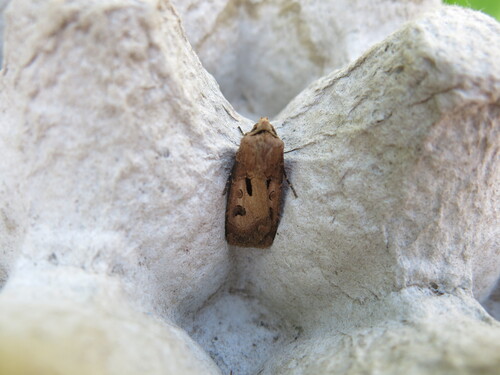
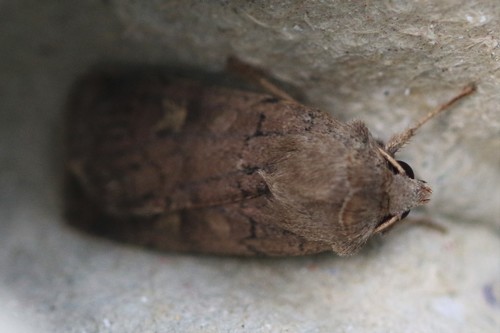
Dingy Skipper

Dingy Skipper

Erynnis tages

Daily sighting probability <5% · Rare
at Liverpool

In 3 days ~10% in a week ~30%

6 Verified sightings at Liverpool
274 In all 10 parks From 2019 to 2026
May Best month
☀️ Diurnal When it's spotted

About the Dingy Skipper

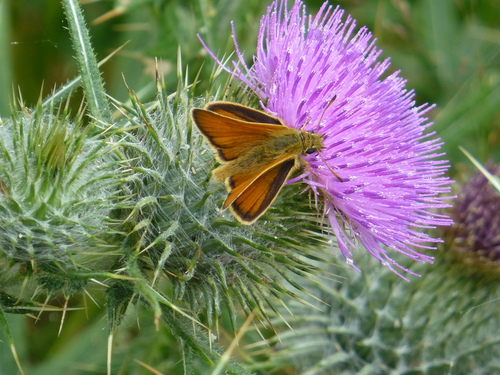
The dingy skipper (Erynnis tages) is a species of butterfly in the family Hesperiidae. Erynnis tages is different from other skippers because of the predominantly monochrome, gray-brown wing coloration and the marbling, which is only present on the upper side of the forewings, as well as a series of small white dots on the wing edge. It is probably the most moth-like British butterfly and normally rests with its wings in a moth-like fashion. This well-camouflaged, brown and grey butterfly can be confused with the grizzled skipper, the Mother Shipton moth or the burnet companion moth. Faded specimens of Carcharodus alceae are distinguished by glass spots in the forewing and by a jagged rear wing edge. A special feature is the restraint of the imagos, which is reminiscent of a deltoid moth with its roof-shaped wings placed one on top of the other.

Th. tages L. (86 c). Forewing grey-brown, with two oblique black bands, which are proximally edged with yellowish grey. A marginal row of small light dots and two apical dots, of which one is transparent. Hindwing black, in quite normal specimens without spots. Throughout Europe and Northern Asia... Wikipedia →

Global Distribution

Parks Where Found

# Park Country Daily sighting probability
1 Triglav National Park 🇸🇮 Slovenia
~30%
2 Mercantour National Park 🇫🇷 France
~20%
3 Aigüestortes National Park 🇪🇸 Spain
~20%
4 Vanoise National Park 🇫🇷 France
~20%
5 Picos de Europa National Park 🇪🇸 Spain
~20%
6 Hohe Tauern National Park 🇦🇹 Austria
~20%
7 Pyrénées National Park 🇫🇷 France
~10%
8 Fertő-Hanság National Park 🇭🇺 Hungary
~10%
9 Ecrins National Park 🇫🇷 France
~10%
10 Cévennes National Park 🇫🇷 France
~10%

Cities Where Found

# City Country Daily sighting probability
1 Prague 🇨🇿 Czechia
~10%
2 Turin 🇮🇹 Italy
~10%
3 Budapest 🇭🇺 Hungary
~10%
4 Vienna 🇦🇹 Austria
~10%
5 Bucharest 🇷🇴 Romania
<5%
6 Liverpool 🇬🇧 United Kingdom
<5%
7 London 🇬🇧 United Kingdom
<5%

Before you go

What are the chances of seeing a Dingy Skipper in Liverpool?

Rare

Under 5% of wildlife watchers report a Dingy Skipper sighting in Liverpool on a given day, based on 6 verified sightings from GBIF citizen-science data. It is the 559th most-seen of the 632 insects we can rate there. Over three days the chance rises to about 10%, and over a week to about 30%, if each day is a fresh chance.

When is the best time to see a Dingy Skipper in Liverpool?

April and May

In those months about 10% of wildlife watchers report a Dingy Skipper in Liverpool on a given day, against under 5% in June to March, the lowest months.

What time of day is best to see a Dingy Skipper?

Between 11 am and 2 pm

Across all the parks we cover, that three-hour window holds the most Dingy Skipper sightings with a recorded time, and about 9 in 10 of them come between 6 am and 6 pm: it is a daytime animal.

Is Liverpool the best place to see a Dingy Skipper?

6th of 7

Of the 7 cities where we can rate Dingy Skipper sightings, Liverpool ranks 6th at under 5%. The best odds are in Prague (Czechia, about 10%), Turin (Italy, about 10%) and Budapest (Hungary, about 10%).

Which relatives of the Dingy Skipper live in Liverpool?

Same family: Hesperiidae

The closest relatives of the Dingy Skipper that you can see in Liverpool (family Hesperiidae, Skippers) are Far Eastern Large Skipper (about 10%) and Small Skipper (about 10%), with each one's daily chance of a sighting.

Where does the Dingy Skipper sighting chance come from?

GBIF citizen-science records

It is estimated from how often the Dingy Skipper is recorded against all the insects logged in Liverpool (6 verified sightings), calibrated against known sighting rates. Figures are rounded to the nearest 10% because citizen-science data supports honest approximations, not decimals, and months with records from fewer than five people show "—". How it works.


← Back to Liverpool