Dartford Warbler

Dartford Warbler

Sylvia undata

Silhouette: Martin Bulla, based on John Cox's illustration · PhyloPic

Daily sighting probability <5% · Rare
at London

In 3 days ~10% in a week ~20%

6 Verified sightings at London
1,320 In all 8 parks From 2019 to 2026
November Best month
☀️ Diurnal When it's spotted

About the Dartford Warbler

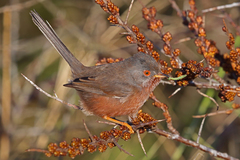
The Dartford warbler (Curruca undata) is a Sylviid warbler from the warmer parts of western Europe and northwestern Africa. It is a small warbler with a long thin tail and a thin pointed bill. The adult male has grey-brown upperparts and is dull reddish-brown below except for the centre of the belly which has a dirty white patch. It has light speckles on the throat and a red eye-ring. The sexes are similar but the adult female is usually less grey above and paler below.

Its breeding range lies west of a line from southern England to the heel of Italy (southern Apulia). The Dartford warbler is usually resident all year in its breeding range, but there is some limited migration. The Dartford warbler was first described in 1776 by the Welsh naturalist, Thomas Pennant. He introduced the English name and based his description on two specimens that had been obtained by the ornithologist John Latham from Bexley Heath, near Dartford in Kent. In 1783 Latham included the warbler in his A General Synopsis of Birds but did not coin the binomial name, Sylvia dartfordiensis, until the supplement to his work was published in 1787. However, in 1783, before the publication... Wikipedia →

Sounds

Recording0:09

Italy · 2024

© Jessica Peruzzo · iNaturalist · CC BY-NC-ND 4.0

Recording0:06

France · 2025

© Sylvain G · iNaturalist · CC BY-NC 4.0

Recording0:11

Spain · 2022

euqirneto · iNaturalist · CC0

Global Distribution

Parks Where Found

# Park Country Daily sighting probability
1 Monfragüe National Park 🇪🇸 Spain
~10%
2 Doñana National Park 🇪🇸 Spain
~10%
3 Sierra Nevada National Park 🇪🇸 Spain
~10%
4 Ordesa y Monte Perdido National Park 🇪🇸 Spain
~10%
5 Sierra de Guadarrama National Park 🇪🇸 Spain
~10%
6 Camargue 🇫🇷 France
<5%
7 Picos de Europa National Park 🇪🇸 Spain
<5%
8 Pyrénées National Park 🇫🇷 France
<5%

Cities Where Found

# City Country Daily sighting probability
1 London 🇬🇧 United Kingdom
<5%
2 Valencia 🇪🇸 Spain
<5%
3 Porto 🇵🇹 Portugal
<5%
4 Madrid 🇪🇸 Spain
<5%
5 Barcelona 🇪🇸 Spain
<5%

Before you go

What are the chances of seeing a Dartford Warbler in London?

Rare

Under 5% of wildlife watchers report a Dartford Warbler sighting in London on a given day, based on 6 verified sightings from GBIF citizen-science data. It is the 91st most-seen of the 203 birds we can rate there. Over three days the chance rises to about 10%, and over a week to about 20%, if each day is a fresh chance.

When is the best time to see a Dartford Warbler in London?

February and November–December

In those months about 10% of wildlife watchers report a Dartford Warbler in London on a given day, against under 5% in January and March–October, the lowest months.

What time of day is best to see a Dartford Warbler?

Between 7 and 10 am

Across all the parks we cover, that three-hour window holds the most Dartford Warbler sightings with a recorded time, and about 9 in 10 of them come between 6 am and 6 pm: it is a daytime animal.

Is London the best place to see a Dartford Warbler?

Yes

Of the 5 cities where we can rate Dartford Warbler sightings, London has the highest daily chance: under 5%. Next come Valencia (Spain, under 5%) and Porto (Portugal, under 5%).

Which relatives of the Dartford Warbler live in London?

Same genus: Sylvia

The closest relatives of the Dartford Warbler that you can see in London (genus Sylvia, Sylvia Warblers) are Blackcap (about 30%) and Whitethroat (about 10%), with each one's daily chance of a sighting.

Where does the Dartford Warbler sighting chance come from?

GBIF citizen-science records

It is estimated from how often the Dartford Warbler is recorded against all the birds logged in London (6 verified sightings), calibrated against known sighting rates. Figures are rounded to the nearest 10% because citizen-science data supports honest approximations, not decimals, and months with records from fewer than five people show "—". How it works.

← Back to London