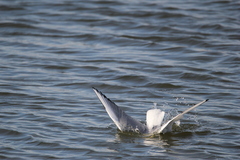
Bonaparte's Gull

Bonaparte's Gull

Chroicocephalus philadelphia

Silhouette: Michael Scroggie · PhyloPic

Daily sighting probability <5% · Rare
at Los Angeles

In 3 days ~10%

2,070 Verified sightings at Los Angeles
13,432 In all 28 parks From 2019 to 2026
January Best month
☀️ Diurnal When it's spotted

About the Bonaparte's Gull

Bonaparte's gull (Chroicocephalus philadelphia) is a gull found mainly in northern North America. At 28 to 38 cm (11 to 15 in) in length, it is one of the smallest species of gull. Its plumage is mainly white with grey upperparts. During breeding season, Bonaparte's gull gains a slaty-black hood. The sexes are similar in appearance.

When George Ord first described Bonaparte's gull in 1815, he gave it the scientific name Sterna philadelphia, and the English name 'Banded-tail Tern'; the description clearly identifies it as a bird in first-winter plumage, while "The slender and tern-like form of the bill probably induced Mr. Ord to put it in Sterna". Most later taxonomists assigned it to the genus Larus, a longtime catch-all for most of the gull species. However, in 1858, George Newbold Lawrence moved the species to the genus Chroicocephalus, and some taxonomists followed suit. Subsequent molecular DNA studies have shown that this species fits neatly into a clade with other Chroicocephalus "hooded" gulls, and that it is in a close-to-basal position in that grouping. Based on these studies, the American Ornithologists' Union, which had previously assigned the... Wikipedia →

Sounds

Call0:05

United Kingdom · 2021

© Andrew Harrop · XC668850 · CC BY-NC-SA 4.0

Flight call0:28

United States · 2012

© Paul Marvin · XC163068 · CC BY-NC-SA 3.0

Call0:24

Canada · 2019

© David Darrell-Lambert · XC476523 · CC BY-NC-SA 4.0

Global Distribution

Parks Where Found

# Park Country Daily sighting probability
1 Point Pelee National Park 🇨🇦 Canada
~50%
2 Katmai National Park 🇺🇸 United States
~30%
3 Great Bear Rainforest 🇨🇦 Canada
~20%
4 Merritt Island National Wildlife Refuge 🇺🇸 United States
~20%
5 El Vizcaíno Biosphere Reserve 🇲🇽 Mexico
~20%
6 Elk Island National Park 🇨🇦 Canada
~10%
7 Kluane National Park 🇨🇦 Canada
~10%
8 Wrangell-St. Elias National Park 🇺🇸 United States
~10%
9 Kenai Fjords National Park 🇺🇸 United States
~10%
10 Channel Islands National Park 🇺🇸 United States
~10%
11 Celestún Biosphere Reserve 🇲🇽 Mexico
<5%
12 Riding Mountain National Park 🇨🇦 Canada
<5%
13 Cabo Pulmo National Park 🇲🇽 Mexico
<5%
14 Acadia National Park 🇺🇸 United States
<5%
15 Redwood National Park 🇺🇸 United States
<5%
16 Wadden Sea National Park 🇩🇪 Germany
<5%
17 Pacific Rim National Park Reserve 🇨🇦 Canada
<5%
18 Padre Island National Seashore 🇺🇸 United States
<5%
19 Cape Breton Highlands National Park 🇨🇦 Canada
<5%
20 Olympic National Park 🇺🇸 United States
<5%
21 Bahía de Loreto National Park 🇲🇽 Mexico
<5%
22 Everglades National Park 🇺🇸 United States
<5%
23 Death Valley National Park 🇺🇸 United States
<5%
24 Jasper National Park 🇨🇦 Canada
<5%
25 Banff National Park 🇨🇦 Canada
<5%
26 Ciénaga de Zapata 🇨🇺 Cuba
<5%
27 Shenandoah National Park 🇺🇸 United States
<5%
28 Rocky Mountain National Park 🇺🇸 United States
<5%

Cities Where Found

# City Country Daily sighting probability
1 Anchorage 🇺🇸 United States
~30%
2 Dallas 🇺🇸 United States
<5%
3 San Diego 🇺🇸 United States
<5%
4 Seattle 🇺🇸 United States
<5%
5 Los Angeles 🇺🇸 United States
<5%
6 Miami 🇺🇸 United States
<5%
7 Orlando 🇺🇸 United States
<5%
8 Vancouver 🇨🇦 Canada
<5%
9 Montreal 🇨🇦 Canada
<5%
10 San Francisco 🇺🇸 United States
<5%

Zoos & Centres Where Found

# Zoo / Centre Country
1 Ralph Perkins II Wildlife Center and Woods Garden 🇺🇸 United States In captivity

Before you go

What are the chances of seeing a Bonaparte's Gull in Los Angeles?

Rare

Under 5% of wildlife watchers report a Bonaparte's Gull sighting in Los Angeles on a given day, based on 2,070 verified sightings from GBIF citizen-science data. It is the 186th most-seen of the 426 birds we can rate there. Over three days the chance rises to about 10%, if each day is a fresh chance.

When is the best time to see a Bonaparte's Gull in Los Angeles?

January

In that month about 10% of wildlife watchers report a Bonaparte's Gull in Los Angeles on a given day, against under 5% in February to December, the lowest months. That is one of Los Angeles's wettest months, with about 75 mm of rain against almost none in June.

What time of day is best to see a Bonaparte's Gull?

Between 2 and 5 pm

Across all the parks we cover, that three-hour window holds the most Bonaparte's Gull sightings with a recorded time, and about 9 in 10 of them come between 6 am and 6 pm: it is a daytime animal.

Is Los Angeles the best place to see a Bonaparte's Gull?

5th of 29

Of the 29 cities where we can rate Bonaparte's Gull sightings, Los Angeles ranks 5th at under 5%. The best odds are in Anchorage (United States, about 30%), Dallas (United States, under 5%) and San Diego (United States, under 5%).

Which relatives of the Bonaparte's Gull live in Los Angeles?

Same family: Laridae

The closest relatives of the Bonaparte's Gull that you can see in Los Angeles (family Laridae, Gulls, Terns, and Skimmers) are Western Gull (about 30%), California Gull (about 20%) and Ring-billed Gull (about 20%), with each one's daily chance of a sighting.

Where does the Bonaparte's Gull sighting chance come from?

GBIF citizen-science records

It is estimated from how often the Bonaparte's Gull is recorded against all the birds logged in Los Angeles (2,070 verified sightings), calibrated against known sighting rates. Figures are rounded to the nearest 10% because citizen-science data supports honest approximations, not decimals, and months with records from fewer than five people show "—". How it works.

← Back to Los Angeles