Cactus Wren

Cactus Wren

Campylorhynchus brunneicapillus

Silhouette: Andy Wilson · PhyloPic

LCLeast ConcernNTVUENCR
Daily sighting probability <5% · Rare
at Los Angeles

In 3 days ~10% in a week ~20%

2,267 Verified sightings at Los Angeles
15,382 In all 9 parks From 2019 to 2026
January Best month
☀️ Diurnal When it's spotted

About the Cactus Wren

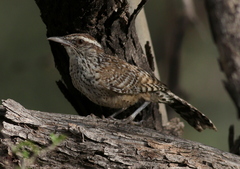
The cactus wren (Campylorhynchus brunneicapillus) is a species of wren that is endemic to the deserts of the southwestern United States and northern and central Mexico. It is the state bird of Arizona, and the largest wren in the United States. Its plumage is brown, with black and white spots as markings. It has a distinctive white eyebrow that sweeps to the nape of the neck. The chest is white, whereas the underparts are cinnamon-buff colored. Both sexes appear similar. The tail, as well as flight feathers, are barred in black and white. Their song is a loud raspy chirrup; akin in the description of some ornithologists to the sound of a car engine that will not start. It is well-adapted to its native desert environment, and the birds can meet their water needs from their diet which consists chiefly of insects, but also of some plant matter. The cactus wren is a poor flier and generally forages for food on the ground. Ornithologists generally recognize seven subspecies, with the exact taxonomy under dispute.

Its common name derives from their frequenting desert cactus plants such as the saguaro and cholla, building nests, roosting, and seeking protection from predators among them. Its bulky and globular nests are constructed of plant material and lined with feathers. They do not migrate; instead, they establish and defend the territories around their nests where they live all year-round. It lives in pairs, or as family groups from late spring through winter. Pairing among cactus wrens is monogamous; in each breeding season, the males chiefly build nests, the females incubate eggs, and both parents feed the young.

Populations have declined as the species faces threats related to human activities and habitat loss, although the species remains abundant. Habitat fragmentation and fire have been of particular concern, as the cactus wren is slow to disperse into new habitats. Introduced species have also hurt populations. Feral cats hunt many birds in urban settings, and invasive grasses take up valuable foraging space, reducing habitat size. Despite these threats, the cactus wren has proved adaptable. Cactus wrens have learned to coexist with humans effectively, using human materials and structures for nesting, and even learning to take insects from vehicle radiator grilles. The population still numbers in the millions, leading the International Union for Conservation of Nature to consider the cactus wren a species of least concern. Wikipedia →


Sounds

Song0:06

United States · 2017

© Pat Goltz · XC1153771 · CC BY-NC-SA 4.0

Duet0:26

United States · 2024

© David Tattersley · XC900262 · CC BY-NC-SA 4.0

Call0:11

United States · 2023

© Bobby Wilcox · XC799698 · CC BY-NC-SA 4.0

Global Distribution

Parks Where Found

# Park Country Daily sighting probability
1 Saguaro National Park 🇺🇸 United States
~70%
2 Cabo Pulmo National Park 🇲🇽 Mexico
~60%
3 Big Bend National Park 🇺🇸 United States
~50%
4 Joshua Tree National Park 🇺🇸 United States
~50%
5 Bahía de Loreto National Park 🇲🇽 Mexico
~50%
6 El Vizcaíno Biosphere Reserve 🇲🇽 Mexico
~20%
7 Cumbres de Monterrey National Park 🇲🇽 Mexico
<5%
8 Guadalupe Mountains National Park 🇺🇸 United States
<5%
9 Death Valley National Park 🇺🇸 United States
<5%

Cities Where Found

# City Country Daily sighting probability
1 Phoenix 🇺🇸 United States
~30%
2 Mesa 🇺🇸 United States
~10%
3 Los Angeles 🇺🇸 United States
<5%
4 Mexico City 🇲🇽 México
<5%
5 San Diego 🇺🇸 United States
<5%

Zoos & Centres Where Found

# Zoo / Centre Country
1 Arizona-Sonora Desert Museum 🇺🇸 United States In captivity
2 Ralph Perkins II Wildlife Center and Woods Garden 🇺🇸 United States In captivity

Before you go

What are the chances of seeing a Cactus Wren in Los Angeles?

Rare

Under 5% of wildlife watchers report a Cactus Wren sighting in Los Angeles on a given day, based on 2,267 verified sightings from GBIF citizen-science data. It is the 175th most-seen of the 426 birds we can rate there. Over three days the chance rises to about 10%, and over a week to about 20%, if each day is a fresh chance.

When is the best time to see a Cactus Wren in Los Angeles?

Any time of year

In every month with enough records, under 5% of wildlife watchers report a Cactus Wren in Los Angeles on a given day, so our monthly data shows no clear season.

What time of day is best to see a Cactus Wren?

Between 7 and 10 am

Across all the parks we cover, that three-hour window holds the most Cactus Wren sightings with a recorded time, and about 8 in 10 of them come between 6 am and 6 pm: it is a daytime animal.

Is Los Angeles the best place to see a Cactus Wren?

3rd of 5

Of the 5 cities where we can rate Cactus Wren sightings, Los Angeles ranks 3rd at under 5%. The best odds are in Phoenix (United States, about 30%) and Mesa (United States, about 10%).

Which relatives of the Cactus Wren live in Los Angeles?

Same family: Troglodytidae

The closest relatives of the Cactus Wren that you can see in Los Angeles (family Troglodytidae, Wrens) are Bewick's Wren (about 30%), House Wren (about 20%) and Marsh Wren (about 10%), with each one's daily chance of a sighting.

Where does the Cactus Wren sighting chance come from?

GBIF citizen-science records

It is estimated from how often the Cactus Wren is recorded against all the birds logged in Los Angeles (2,267 verified sightings), calibrated against known sighting rates. Figures are rounded to the nearest 10% because citizen-science data supports honest approximations, not decimals, and months with records from fewer than five people show "—". How it works.

← Back to Los Angeles