Lesser Goldfinch

Lesser Goldfinch

Spinus psaltria

Silhouette: Andy Wilson · PhyloPic

LCLeast ConcernNTVUENCR
Daily sighting probability ~60% · Likely
at Los Angeles

In 3 days ~90% in a week >90%

68,079 Verified sightings at Los Angeles
16,511 In all 46 parks From 2019 to 2026
May Best month
☀️ Diurnal When it's spotted

About the Lesser Goldfinch

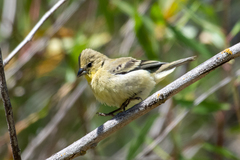
The lesser goldfinch (Spinus psaltria) is a small finch in the genus Spinus native to the Americas. As is the case for most species in the genus Spinus, lesser goldfinch males have a black forehead, which females lack. Males in this species vary strikingly in the color of their back across their range, from green in western North America to black in the eastern Rocky Mountains and Texas south to northern South America; this variation has resulted in five subspecies being recognized.

Together with its relatives the American goldfinch and Lawrence's goldfinch, it forms a clade, termed the 'New World goldfinch' clade, in the genus Spinus. Some authors have suggested treating this clade as a separate genus Astragalinus, but this has not been followed by either the IOC or BirdLife International.

The lesser goldfinch was formally described by the American zoologist Thomas Say in 1822 under the binomial name Fringilla psaltria. The specific epithet psaltria is Ancient Greek for a female harpist. The type locality is Colorado Springs, Colorado. The lesser goldfinch is now placed in the genus Spinus that was introduced in 1816 by the German naturalist Carl Ludwig Koch.

Five subspecies... Wikipedia →

Sounds

Song0:14

United States · 2024

© Denis Dujardin · XC1056078 · CC BY-NC-SA 4.0

Call1:01

Ecuador · 2023

© rudy gelis · XC836865 · CC BY-NC-SA 4.0

Begging call0:26

Mexico · 2022

© Manuel Grosselet · XC755164 · CC BY-NC-SA 4.0

Global Distribution

Parks Where Found

# Park Country Daily sighting probability
1 Saguaro National Park 🇺🇸 United States
~50%
2 Death Valley National Park 🇺🇸 United States
~40%
3 Guadalupe Mountains National Park 🇺🇸 United States
~40%
4 Cumbres de Monterrey National Park 🇲🇽 Mexico
~30%
5 Sequoia and Kings Canyon National Parks 🇺🇸 United States
~30%
6 Zion National Park 🇺🇸 United States
~30%
7 Channel Islands National Park 🇺🇸 United States
~30%
8 Reserva de la Biosfera Mariposa Monarca 🇲🇽 Mexico
~30%
9 Grand Canyon National Park 🇺🇸 United States
~20%
10 Volcán Barú National Park 🇵🇦 Panama
~20%
11 Joshua Tree National Park 🇺🇸 United States
~20%
12 Chagres National Park 🇵🇦 Panama
~20%
13 Celaque National Park 🇭🇳 Honduras
~20%
14 Big Bend National Park 🇺🇸 United States
~20%
15 El Vizcaíno Biosphere Reserve 🇲🇽 Mexico
~20%
16 Cabo Pulmo National Park 🇲🇽 Mexico
~20%
17 Yosemite National Park 🇺🇸 United States
~20%
18 La Amistad International Park (Panama) 🇵🇦 Panama
~10%
19 Chirripó National Park 🇨🇷 Costa Rica
~10%
20 Arrecifes de Cozumel National Park 🇲🇽 Mexico
~10%
21 Irazú Volcano National Park 🇨🇷 Costa Rica
~10%
22 El Triunfo 🇲🇽 Mexico
~10%
23 Kluane National Park 🇨🇦 Canada
~10%
24 Farallones de Cali National Natural Park 🇨🇴 Colombia
~10%
25 La Tigra National Park 🇭🇳 Honduras
~10%
26 Bahía de Loreto National Park 🇲🇽 Mexico
~10%
27 Los Quetzales National Park 🇨🇷 Costa Rica
~10%
28 Rocky Mountain National Park 🇺🇸 United States
~10%
29 Cañón del Sumidero National Park 🇲🇽 Mexico
~10%
30 Chingaza National Natural Park 🇨🇴 Colombia
<5%
31 Henri Pittier National Park 🇻🇪 Venezuela
<5%
32 Redwood National Park 🇺🇸 United States
<5%
33 Parque Natural Metropolitano 🇵🇦 Panama
<5%
34 Calakmul Biosphere Reserve 🇲🇽 Mexico
<5%
35 Los Nevados National Natural Park 🇨🇴 Colombia
<5%
36 Cusuco National Park 🇭🇳 Honduras
<5%
37 Tapantí-Macizo de la Muerte National Park 🇨🇷 Costa Rica
<5%
38 Cerro Azul Meámbar National Park 🇭🇳 Honduras
<5%
39 Podocarpus National Park 🇪🇨 Ecuador
<5%
40 Lago de Yojoa 🇭🇳 Honduras
<5%
41 Braulio Carrillo National Park 🇨🇷 Costa Rica
<5%
42 Sian Ka'an Biosphere Reserve 🇲🇽 Mexico
<5%
43 Palo Verde National Park 🇨🇷 Costa Rica
<5%
44 Poás Volcano National Park 🇨🇷 Costa Rica
<5%
45 Soberanía National Park 🇵🇦 Panama
<5%
46 Monteverde Cloud Forest Reserve 🇨🇷 Costa Rica
<5%

Cities Where Found

# City Country Daily sighting probability
1 Toluca 🇲🇽 México
~70%
2 Sacramento 🇺🇸 United States
~70%
3 Salt Lake City 🇺🇸 United States
~60%
4 Portland 🇺🇸 United States
~60%
5 Los Angeles 🇺🇸 United States
~60%
6 Puebla 🇲🇽 México
~60%
7 Tijuana 🇲🇽 México
~60%
8 Mexico City 🇲🇽 México
~50%
9 Austin 🇺🇸 United States
~50%
10 San Antonio 🇺🇸 United States
~50%

Before you go

What are the chances of seeing a Lesser Goldfinch in Los Angeles?

Likely

About 60% of wildlife watchers report a Lesser Goldfinch sighting in Los Angeles on a given day, based on 68,079 verified sightings from GBIF citizen-science data. It is the 6th most-seen of the 426 birds we can rate there. Over three days the chance rises to about 90%, and over a week to over 90%, if each day is a fresh chance.

When is the best time to see a Lesser Goldfinch in Los Angeles?

March to June

In those months about 70% of wildlife watchers report a Lesser Goldfinch in Los Angeles on a given day, against about 50% in August and November–January, the lowest months.

What time of day is best to see a Lesser Goldfinch?

Between 8 and 11 am

Across all the parks we cover, that three-hour window holds the most Lesser Goldfinch sightings with a recorded time, and about 8 in 10 of them come between 6 am and 6 pm: it is a daytime animal.

Is Los Angeles the best place to see a Lesser Goldfinch?

5th of 34

Of the 34 cities where we can rate Lesser Goldfinch sightings, Los Angeles ranks 5th at about 60%. The best odds are in Toluca (México, about 70%), Sacramento (United States, about 70%) and Salt Lake City (United States, about 60%).

Where does the Lesser Goldfinch sighting chance come from?

GBIF citizen-science records

It is estimated from how often the Lesser Goldfinch is recorded against all the birds logged in Los Angeles (68,079 verified sightings), calibrated against known sighting rates. Figures are rounded to the nearest 10% because citizen-science data supports honest approximations, not decimals, and months with records from fewer than five people show "—". How it works.

← Back to Los Angeles