


Completed


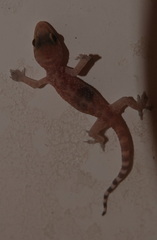
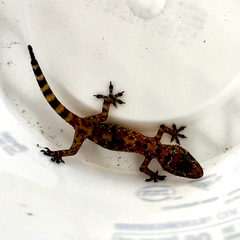

Mediterranean House Gecko
Hemidactylus turcicus
Silhouette: Alex Slavenko · PhyloPic
- KingdomAnimalia (Animals)
- PhylumChordata (Chordates)
- ClassSquamata
- FamilyGekkonidae (Typical Geckos)
- GenusHemidactylus (House Geckos)
- SpeciesHemidactylus turcicus (Mediterranean House Gecko)
In 3 days ~10% in a week ~30%
168 Verified sightings at Los Angeles
200 In all 7 parks From 2019 to 2026
August Best month
🌙 Nocturnal When it's spotted
About the Mediterranean House Gecko
The Mediterranean house gecko (Hemidactylus turcicus) is a species of house gecko native to the Mediterranean region, from which it has spread to many parts of the world including parts of East Africa, South America, the Caribbean, and the Southern and Southeastern United States. It is commonly referred to as the Turkish gecko as represented in its Latin name and also as the moon lizard because it tends to emerge in the evening.
A study in Portugal found H. turcicus to be totally nocturnal, with its highest activity around 02:00. It is insectivorous, rarely exceeds 15 cm (5.9 in) in length, has large, lidless eyes with elliptical pupils, and purple or tan-colored skin with black spots, often with stripes on the tail. Its belly or undersides are somewhat translucent. What impact this gecko has on native wildlife in the regions to which it has been introduced is unknown.
In many parts of the world, the range of H. turcicus is increasing, and unlike many other reptiles, it appears to be highly resistant to pesticides. The increase may be explained as a consequence of having few predators in places where it has been introduced, and also of its tendency to take shelter in the cracks and unseen areas of human homes, for example inside walls. Reliance on human habitation has thus contributed to the species' proliferation, similar to rodents. In some Eastern Mediterranean countries such as Greece, Turkey and Cyprus, harming H. turcicus is taboo due to its benign nature, and it is often kept as a house pet. Wikipedia →
Sounds
Recording0:22
Greece · 2024
© Sotirios Liakas · iNaturalist · CC BY-NC 4.0
Recording0:29
Türkiye · 2026
© Liva Erkul · iNaturalist · CC BY 4.0
Recent sightings of Mediterranean House Gecko in Los Angeles
LIVEiNaturalistGlobal Distribution
Parks Where Found
| # | Park | Country | Daily sighting probability |
|---|---|---|---|
| 1 | Big Bend National Park | 🇺🇸 United States | |
| 2 | Death Valley National Park | 🇺🇸 United States | |
| 3 | Cumbres de Monterrey National Park | 🇲🇽 Mexico | |
| 4 | Saguaro National Park | 🇺🇸 United States | |
| 5 | Padre Island National Seashore | 🇺🇸 United States | |
| 6 | Bahía de Loreto National Park | 🇲🇽 Mexico | |
| 7 | Joshua Tree National Park | 🇺🇸 United States |
Zoos & Centres Where Found
| # | Zoo / Centre | Country | |
|---|---|---|---|
| 1 | Omaha’s Henry Doorly Zoo and Aquarium | 🇺🇸 United States | |
| 2 | Toledo Zoo | 🇺🇸 United States | |
| 3 | Lincoln Park Zoo | 🇺🇸 United States |
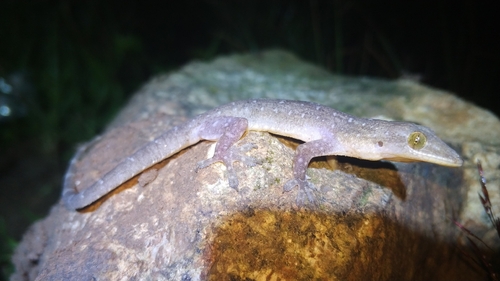
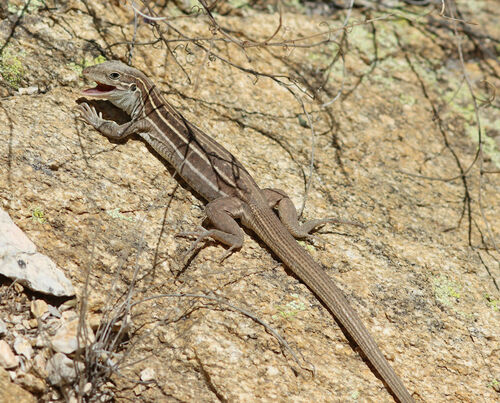
Closest Relatives at Los Angeles




Before you go
What are the chances of seeing a Mediterranean House Gecko in Los Angeles?
Rare
Under 5% of wildlife watchers report a Mediterranean House Gecko sighting in Los Angeles on a given day, based on 168 verified sightings from GBIF citizen-science data. It is the 12th most-seen of the 37 reptiles we can rate there. Over three days the chance rises to about 10%, and over a week to about 30%, if each day is a fresh chance.
When is the best time to see a Mediterranean House Gecko in Los Angeles?
July to October
In those months about 10% of wildlife watchers report a Mediterranean House Gecko in Los Angeles on a given day, against under 5% in November to June, the lowest months. Those are among Los Angeles's driest months, with about 5 mm of rain a month against 75 mm in February.
What time of day is best to see a Mediterranean House Gecko?
Between 9 pm and midnight
Across all the parks we cover, that three-hour window holds the most Mediterranean House Gecko sightings with a recorded time, and about 7 in 10 of them come between 6 pm and 6 am: it is mostly seen at night.
Is Los Angeles the best place to see a Mediterranean House Gecko?
28th of 32
Of the 32 cities where we can rate Mediterranean House Gecko sightings, Los Angeles ranks 28th at under 5%. The best odds are in Izmir (Turkey, about 40%), Austin (United States, about 40%) and Ciudad Juárez (México, about 40%).
Where does the Mediterranean House Gecko sighting chance come from?
GBIF citizen-science records
It is estimated from how often the Mediterranean House Gecko is recorded against all the reptiles logged in Los Angeles (168 verified sightings), calibrated against known sighting rates. Figures are rounded to the nearest 10% because citizen-science data supports honest approximations, not decimals, and months with records from fewer than five people show "—". How it works.
