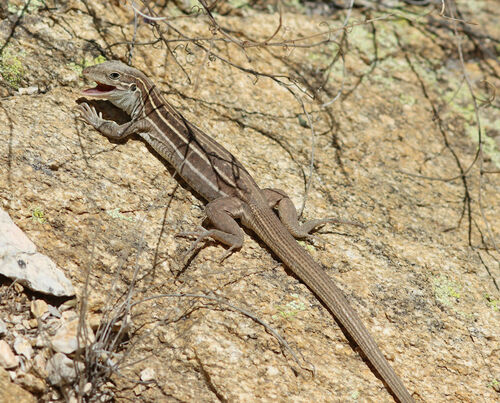
Western Whiptail

Western Whiptail

Aspidoscelis tigris

Silhouette: Jose Carlos Arenas-Monroy · PhyloPic

LCLeast ConcernNTVUENCR
Daily sighting probability ~10% · With luck
at Los Angeles

In 3 days ~20% in a week ~40%

297 Verified sightings at Los Angeles
1,621 In all 9 parks From 2019 to 2026
June Best month
☀️ Diurnal When it's spotted

About the Western Whiptail

The western whiptail (Aspidoscelis tigris) is a species of lizard in the family Teiidae. The species is found throughout most of the southwestern United States and northern Mexico. Most of its populations appear stable, and it is not listed as endangered in any of the states comprising its range. It lives in a wide variety of habitats, including deserts and semiarid shrubland, usually in areas with sparse vegetation; it also may be found in woodland, open dry forest, and riparian growth. It lives in burrows. Major differences between this species and the checkered whiptail (Aspidoscelis tesselatus) include the lack of enlarged scales anterior to the gular fold and the presence of enlarged postantebrachial scales. It was previously known as Cnemidophorus tigris, until phylogenetic analyses concluded that the genus Cnemidophorus was polyphyletic. Since it does not migrate, a number of forms have developed in different regions, several of which have been given subspecific names – for example the California whiptail, Aspidoscelis tigris munda.

Including the nominotypical subspecies, 16 subspecies of Aspidoscelis tigris are recognized as being valid. A... Wikipedia →

Global Distribution

Parks Where Found

# Park Country Daily sighting probability
1 Joshua Tree National Park 🇺🇸 United States
~70%
2 Zion National Park 🇺🇸 United States
~50%
3 Death Valley National Park 🇺🇸 United States
~40%
4 Grand Canyon National Park 🇺🇸 United States
~40%
5 Saguaro National Park 🇺🇸 United States
~30%
6 El Vizcaíno Biosphere Reserve 🇲🇽 Mexico
~20%
7 Sequoia and Kings Canyon National Parks 🇺🇸 United States
~20%
8 Yosemite National Park 🇺🇸 United States
~20%
9 Bahía de Loreto National Park 🇲🇽 Mexico
~10%

Cities Where Found

# City Country Daily sighting probability
1 Phoenix 🇺🇸 United States
~20%
2 Las Vegas 🇺🇸 United States
~20%
3 Mesa 🇺🇸 United States
~20%
4 Los Angeles 🇺🇸 United States
~10%
5 Sacramento 🇺🇸 United States
~10%
6 San Diego 🇺🇸 United States
~10%
7 Salt Lake City 🇺🇸 United States
~10%

Before you go

What are the chances of seeing a Western Whiptail in Los Angeles?

With luck

About 10% of wildlife watchers report a Western Whiptail sighting in Los Angeles on a given day, based on 297 verified sightings from GBIF citizen-science data. It is the 8th most-seen of the 37 reptiles we can rate there. Over three days the chance rises to about 20%, and over a week to about 40%, if each day is a fresh chance.

When is the best time to see a Western Whiptail in Los Angeles?

April to September

In those months about 10% of wildlife watchers report a Western Whiptail in Los Angeles on a given day, against under 5% in October to March, the lowest months. Those are among Los Angeles's driest months, with about 5 mm of rain a month against 75 mm in February.

What time of day is best to see a Western Whiptail?

Between 9 am and noon

Across all the parks we cover, that three-hour window holds the most Western Whiptail sightings with a recorded time, and nearly all of them come between 6 am and 6 pm: it is a daytime animal.

Is Los Angeles the best place to see a Western Whiptail?

4th of 7

Of the 7 cities where we can rate Western Whiptail sightings, Los Angeles ranks 4th at about 10%. The best odds are in Phoenix (United States, about 20%), Las Vegas (United States, about 20%) and Mesa (United States, about 20%).

Where does the Western Whiptail sighting chance come from?

GBIF citizen-science records

It is estimated from how often the Western Whiptail is recorded against all the reptiles logged in Los Angeles (297 verified sightings), calibrated against known sighting rates. Figures are rounded to the nearest 10% because citizen-science data supports honest approximations, not decimals, and months with records from fewer than five people show "—". How it works.

← Back to Los Angeles