Blue-winged Parrot

Blue-winged Parrot

Neophema chrysostoma

Silhouette: Farelli (photo), John E. McCormack, Michael G. Harvey, Brant C. Faircloth, Nicholas G. Crawford, Travis C. Glenn, Robb T. Brumfield & T. Michael Keesey · PhyloPic

LCNTVUVulnerableENCR Endemic
Daily sighting probability <5% · Rare
at Melbourne

In 3 days <5%

44 Verified sightings at Melbourne
730 In all 4 parks From 2019 to 2026
October Best month
☀️ Diurnal When it's spotted

About the Blue-winged Parrot

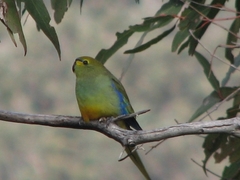
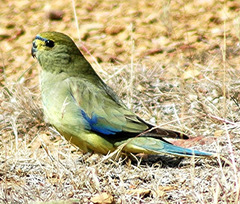
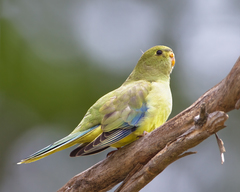
The blue-winged parrot (Neophema chrysostoma), also known as the blue-banded parakeet or blue-banded grass-parakeet, is a small parrot found in Tasmania and southeast mainland Australia. It is partly migratory, with populations of blue-winged parrots travelling to Tasmania for the summer. The parrot is sexually dimorphic – the males have more blue on the wings and a two-toned blue frontal band on the head, while females are duller and have more green on the wings and a wingbar. Both sexes have predominantly olive-green plumage. Predominantly a feeder on the ground, the blue-winged parrot mainly eats seeds of grasses. It adapts readily to captivity.

German naturalist Heinrich Kuhl described the blue-winged parrot in 1820 as Psittacus chrysostomus, noting that it had been confused with the turquoise parrot (N. pulchella). However, the material used to describe it contained specimens of both this species and the elegant parrot. The species' name is from the Ancient Greek words khrysos "golden" and stoma "mouth", from the yellow skin around the eyes. In 1821, Coenraad Jacob Temminck gave the species the name Psittacus venustus, however Kuhl had used this binomial name for... Wikipedia →

Sounds

Flight call0:17

Australia · 2019

© Ramit Singal · XC501238 · CC BY-NC-SA 4.0

Flight call0:15

Australia · 2020

© Marc Anderson · XC609259 · CC BY-NC-ND 4.0

Recording0:09

Australia · 2025

© Tom Hunt · iNaturalist · CC BY-NC 4.0

Global Distribution

Parks Where Found

# Park Country Daily sighting probability
1 Great Otway National Park 🇦🇺 Australia
~20%
2 Grampians National Park 🇦🇺 Australia
~10%
3 Wilsons Promontory National Park 🇦🇺 Australia
<5%
4 Hattah-Kulkyne National Park 🇦🇺 Australia
<5%

Cities Where Found

# City Country Daily sighting probability
1 Melbourne 🇦🇺 Australia
<5%

Before you go

What are the chances of seeing a Blue-winged Parrot in Melbourne?

Rare

Under 5% of wildlife watchers report a Blue-winged Parrot sighting in Melbourne on a given day, based on 44 verified sightings from GBIF citizen-science data. It is the 196th most-seen of the 236 birds we can rate there. Over three days the chance rises to under 5%, if each day is a fresh chance.

When is the best time to see a Blue-winged Parrot in Melbourne?

Any time of year

In every month with enough records, under 5% of wildlife watchers report a Blue-winged Parrot in Melbourne on a given day, so our monthly data shows no clear season.

What time of day is best to see a Blue-winged Parrot?

Between 10 am and 1 pm

Across all the parks we cover, that three-hour window holds the most Blue-winged Parrot sightings with a recorded time, and about 9 in 10 of them come between 6 am and 6 pm: it is a daytime animal.

Where else can you see a Blue-winged Parrot?

Only Melbourne, in our data

Melbourne is the only city on Wallace's Line with enough records to rate Blue-winged Parrot sightings: under 5% of wildlife watchers there report one on a given day.

Which relatives of the Blue-winged Parrot live in Melbourne?

Same family: Psittacidae

The closest relatives of the Blue-winged Parrot that you can see in Melbourne (family Psittacidae, New World and African Parrots) are Coconut Lorikeet (about 90%), Sulphur-crested Cockatoo (about 40%) and Galah (about 30%), with each one's daily chance of a sighting.

Where does the Blue-winged Parrot sighting chance come from?

GBIF citizen-science records

It is estimated from how often the Blue-winged Parrot is recorded against all the birds logged in Melbourne (44 verified sightings), calibrated against known sighting rates. Figures are rounded to the nearest 10% because citizen-science data supports honest approximations, not decimals, and months with records from fewer than five people show "—". How it works.

← Back to Melbourne