Eastern Boxelder Bug

Eastern Boxelder Bug

Boisea trivittata

Daily sighting probability <5% · Rare
at Mexico City

In 3 days ~10% in a week ~20%

29 Verified sightings at Mexico City
200 In all 5 parks From 2019 to 2026
September Best month
☀️ Diurnal When it's spotted

About the Eastern Boxelder Bug

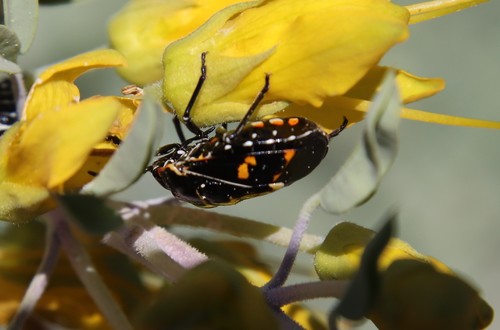
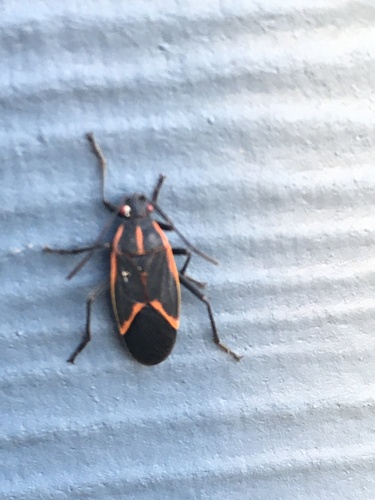
Boisea trivittata, also called the eastern boxelder bug, box bug, or maple bug, is a species of true bug native to eastern North America. The western boxelder bug, Boisea rubrolineata, is a relative of this species and is native to western North America. Eastern boxelder bugs are found primarily on boxelder, other maples, and ash trees.

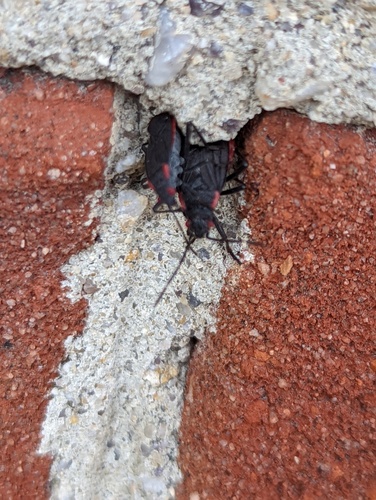
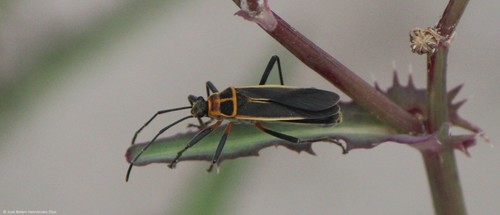
Trivittata is from the Latin tri (three) + vittata (banded). The adults are about 13 millimetres (0.51 in) long with a dark brown or black coloration, relieved by red wing veins and markings on the abdomen, with dark red eyes; nymphs are bright red.

Eastern boxelder bugs feed almost entirely on the developing seeds of boxelder, maple, and ash trees. Eastern boxelder bugs feed, lay eggs and develop on boxelder trees, most commonly occurring on female trees as they produce seeds. Eastern boxelder bugs prefer seeds; however, they also suck leaves. They can be frequently observed on maples, as these trees provide them with seeds as well. Eastern boxelder bugs overwinter in plant debris or protected human-inhabited places and other suitable structures.

The eastern boxelder bug... Wikipedia →
Global Distribution

Parks Where Found

# Park Country Daily sighting probability
1 Zion National Park 🇺🇸 United States
~40%
2 Guadalupe Mountains National Park 🇺🇸 United States
~20%
3 Shenandoah National Park 🇺🇸 United States
~10%
4 Great Smoky Mountains National Park 🇺🇸 United States
~10%
5 Cumbres de Monterrey National Park 🇲🇽 Mexico
<5%

Cities Where Found

# City Country Daily sighting probability
1 Santiago 🇨🇱 Chile
~40%
2 Mendoza 🇦🇷 Argentina
~30%
3 Salt Lake City 🇺🇸 United States
~30%
4 Minneapolis [Saint Paul] 🇺🇸 United States
~20%
5 Baltimore 🇺🇸 United States
~20%
6 Calgary 🇨🇦 Canada
~20%
7 Toronto 🇨🇦 Canada
~20%
8 Montreal 🇨🇦 Canada
~10%
9 Detroit 🇺🇸 United States
~10%
10 Philadelphia 🇺🇸 United States
~10%

Before you go

What are the chances of seeing an Eastern Boxelder Bug in Mexico City?

Rare

Under 5% of wildlife watchers report an Eastern Boxelder Bug sighting in Mexico City on a given day, based on 29 verified sightings from GBIF citizen-science data. It is the 221st most-seen of the 557 insects we can rate there. Over three days the chance rises to about 10%, and over a week to about 20%, if each day is a fresh chance.

When is the best time to see an Eastern Boxelder Bug in Mexico City?

September and November

In those months about 10% of wildlife watchers report an Eastern Boxelder Bug in Mexico City on a given day, against under 5% in October and December–August, the lowest months.

What time of day is best to see an Eastern Boxelder Bug?

Between noon and 3 pm

Across all the parks we cover, that three-hour window holds the most Eastern Boxelder Bug sightings with a recorded time, and about 9 in 10 of them come between 6 am and 6 pm: it is a daytime animal.

Is Mexico City the best place to see an Eastern Boxelder Bug?

19th of 20

Of the 20 cities where we can rate Eastern Boxelder Bug sightings, Mexico City ranks 19th at under 5%. The best odds are in Santiago (Chile, about 40%), Mendoza (Argentina, about 30%) and Salt Lake City (United States, about 30%).

Where does the Eastern Boxelder Bug sighting chance come from?

GBIF citizen-science records

It is estimated from how often the Eastern Boxelder Bug is recorded against all the insects logged in Mexico City (29 verified sightings), calibrated against known sighting rates. Figures are rounded to the nearest 10% because citizen-science data supports honest approximations, not decimals, and months with records from fewer than five people show "—". How it works.

← Back to Mexico City