Household Casebearer

Household Casebearer

Phereoeca uterella

Daily sighting probability <5% · Rare
at Mexico City

In 3 days ~10% in a week ~20%

10 Verified sightings at Mexico City
November Best month

About the Household Casebearer

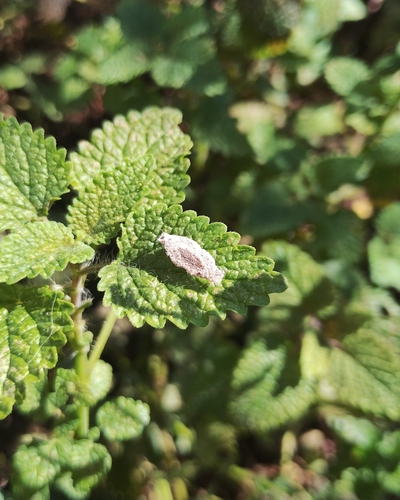
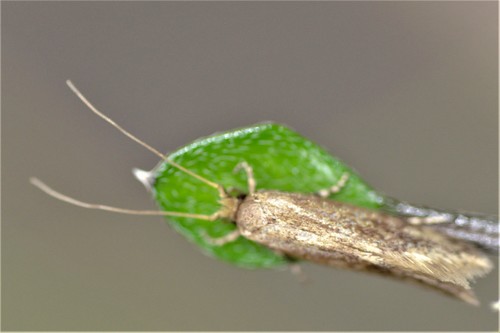
Phereoeca uterella, known by the vernacular names plaster bagworm and household casebearer, is a moth species in family Tineidae. It occurs in tropical climates, where it is common in houses, and is presumed native to the Neotropical realm. In the Americas, it has been recorded from Brazil, Guyana, and the southern United States as well as the Virgin Islands and Trinidad, and tentatively identified from Tobago.

As with other species of its genus, Phereoeca uterella has been the subject of taxonomical confusion, some of which is not yet fully resolved. The Sri Lankan case-bearing moth described as Tinea pachyspila and subsequently transferred to genus Phereoeca may either be considered to be this species, or to instead be Phereoeca allutella. Similarly, the Ugandan case-bearing moth originally described as Tinea barysticta may either be considered Phereoeca uterella or a valid species (as Phereoeca barysticta).

The adult female has a wingspan of up to 13 mm. The forewings are gray with distinct dark spots and the plain hindwings are fringed with long gray hairs. The male is smaller (wingspan up to 9 mm) and more slender with less distinct markings. The reduced mouthparts... Wikipedia →
Global Distribution

Parks Where Found

# Park Country Daily sighting probability

More parks will be added in future updates.

Cities Where Found

# City Country Daily sighting probability
1 Santo Domingo 🇩🇴 Dominican Republic
~10%
2 Tel Aviv 🇮🇱 Israel
~10%
3 Brasilia 🇧🇷 Brazil
~10%
4 Kolkata 🇮🇳 India
~10%
5 Kochi 🇮🇳 India
~10%
6 Hyderabad 🇮🇳 India
~10%
7 Colombo [Sri Jayawardenepura Kotte] 🇱🇰 Sri Lanka
~10%
8 Zhuhai [Macau] 🇨🇳 China
~10%
9 Maceió 🇧🇷 Brazil
~10%
10 Mumbai 🇮🇳 India
<5%

Before you go

What are the chances of seeing a Household Casebearer in Mexico City?

Rare

Under 5% of wildlife watchers report a Household Casebearer sighting in Mexico City on a given day, based on 10 verified sightings from GBIF citizen-science data. It is the 388th most-seen of the 557 insects we can rate there. Over three days the chance rises to about 10%, and over a week to about 20%, if each day is a fresh chance.

When is the best time to see a Household Casebearer in Mexico City?

Any time of year

In every month with enough records, under 5% of wildlife watchers report a Household Casebearer in Mexico City on a given day, so our monthly data shows no clear season.

Is Mexico City the best place to see a Household Casebearer?

18th of 19

Of the 19 cities where we can rate Household Casebearer sightings, Mexico City ranks 18th at under 5%. The best odds are in Santo Domingo (Dominican Republic, about 10%), Tel Aviv (Israel, about 10%) and Brasilia (Brazil, about 10%).

Where does the Household Casebearer sighting chance come from?

GBIF citizen-science records

It is estimated from how often the Household Casebearer is recorded against all the insects logged in Mexico City (10 verified sightings), calibrated against known sighting rates. Figures are rounded to the nearest 10% because citizen-science data supports honest approximations, not decimals, and months with records from fewer than five people show "—". How it works.

← Back to Mexico City