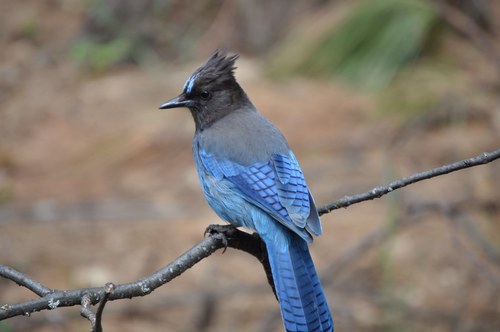
Woodhouse's Scrub-Jay

Woodhouse's Scrub-Jay

Aphelocoma woodhouseii

Silhouette: Sheatherius · PhyloPic

Daily sighting probability <5% · Rare
at Mexico City

In 3 days <5% in a week ~10%

180 Verified sightings at Mexico City
5,252 In all 6 parks From 2019 to 2026
January Best month
☀️ Diurnal When it's spotted

About the Woodhouse's Scrub-Jay

Woodhouse's scrub jay (Aphelocoma[a] woodhouseii) is a species of scrub jay native to western North America, ranging from southeastern Oregon and southern Idaho to central Mexico. Woodhouse's scrub jay was until recently considered the same species as the California scrub jay, and collectively called the western scrub jay. Prior to that both of them were also considered the same species as the island scrub jay and the Florida scrub jay; the taxon was then called simply the scrub jay. Woodhouse's scrub jay is nonmigratory and can be found in urban areas, where it can become tame and will come to bird feeders. While many refer to scrub jays as "blue jays", the blue jay is a different species of bird entirely. Woodhouse's scrub jay is named for the American naturalist and explorer Samuel Washington Woodhouse.

Woodhouse's scrub jay is a medium-sized bird, approximately 27–31 cm (11–12 in) in length (including its tail), with a 39 cm (15 in) wingspan, and about 80 g (2.8 oz) in weight. The species has a blue head, wings, and tail; a gray-brown back; and grayish underparts. The throat is whitish with a partial blue breast band ("necklace"). The call is described as "harsh... Wikipedia →

Sounds

Call0:22

United States · 2013

© Tero Linjama · XC942747 · CC BY-NC-SA 4.0

Flight call0:07

United States · 2018

© Paul Marvin · XC452523 · CC BY-NC-SA 4.0

Begging call0:22

Mexico · 2016

© Esau Toaki Villarreal · XC332004 · CC BY-NC-SA 4.0

Global Distribution

Parks Where Found

# Park Country Daily sighting probability
1 Guadalupe Mountains National Park 🇺🇸 United States
~50%
2 Zion National Park 🇺🇸 United States
~50%
3 Grand Canyon National Park 🇺🇸 United States
~50%
4 Death Valley National Park 🇺🇸 United States
<5%
5 Saguaro National Park 🇺🇸 United States
<5%
6 Rocky Mountain National Park 🇺🇸 United States
<5%

Cities Where Found

# City Country Daily sighting probability
1 Salt Lake City 🇺🇸 United States
~20%
2 Puebla 🇲🇽 México
~20%
3 Denver 🇺🇸 United States
<5%
4 Las Vegas 🇺🇸 United States
<5%
5 Mexico City 🇲🇽 México
<5%
6 Phoenix 🇺🇸 United States
<5%
7 Austin 🇺🇸 United States
<5%

Before you go

What are the chances of seeing a Woodhouse's Scrub-Jay in Mexico City?

Rare

Under 5% of wildlife watchers report a Woodhouse's Scrub-Jay sighting in Mexico City on a given day, based on 180 verified sightings from GBIF citizen-science data. It is the 204th most-seen of the 332 birds we can rate there. Over three days the chance rises to under 5%, and over a week to about 10%, if each day is a fresh chance.

When is the best time to see a Woodhouse's Scrub-Jay in Mexico City?

Any time of year

In every month with enough records, under 5% of wildlife watchers report a Woodhouse's Scrub-Jay in Mexico City on a given day, so our monthly data shows no clear season.

What time of day is best to see a Woodhouse's Scrub-Jay?

Between 11 am and 2 pm

Across all the parks we cover, that three-hour window holds the most Woodhouse's Scrub-Jay sightings with a recorded time, and about 8 in 10 of them come between 6 am and 6 pm: it is a daytime animal.

Is Mexico City the best place to see a Woodhouse's Scrub-Jay?

5th of 7

Of the 7 cities where we can rate Woodhouse's Scrub-Jay sightings, Mexico City ranks 5th at under 5%. The best odds are in Salt Lake City (United States, about 20%), Puebla (México, about 20%) and Denver (United States, under 5%).

Where does the Woodhouse's Scrub-Jay sighting chance come from?

GBIF citizen-science records

It is estimated from how often the Woodhouse's Scrub-Jay is recorded against all the birds logged in Mexico City (180 verified sightings), calibrated against known sighting rates. Figures are rounded to the nearest 10% because citizen-science data supports honest approximations, not decimals, and months with records from fewer than five people show "—". How it works.

← Back to Mexico City