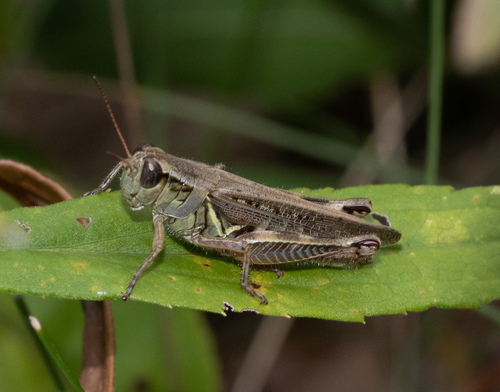
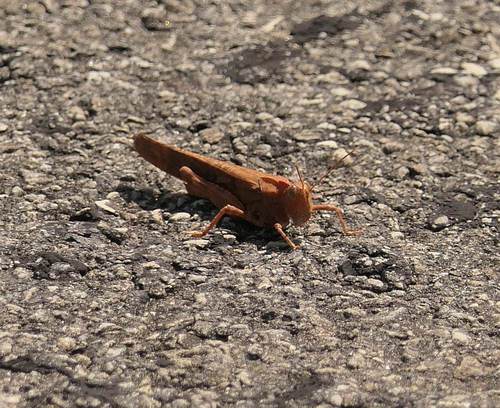
Greater Anglewing

Greater Anglewing

Microcentrum rhombifolium

Daily sighting probability ~10% · With luck
at Minneapolis [Saint Paul]

In 3 days ~20% in a week ~50%

117 Verified sightings at Minneapolis [Saint Paul]
7 In 1 park From 2019 to 2026
September Best month
☀️ Diurnal When it's spotted

About the Greater Anglewing

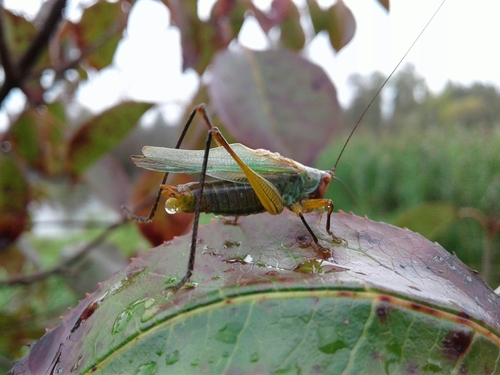
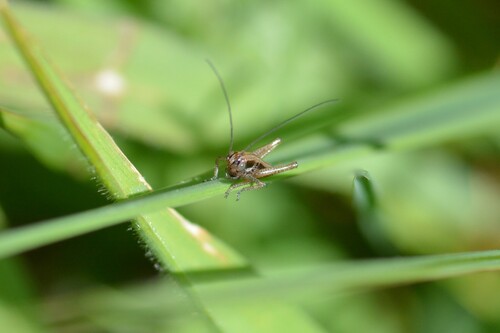
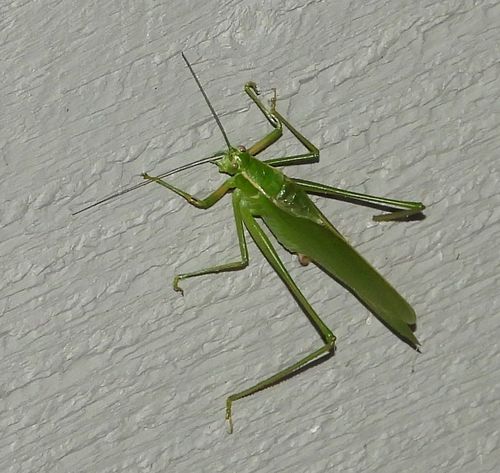
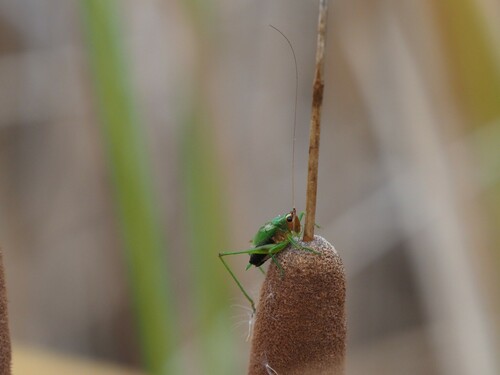
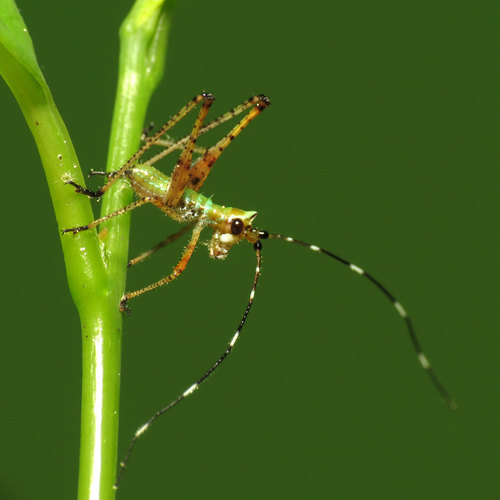
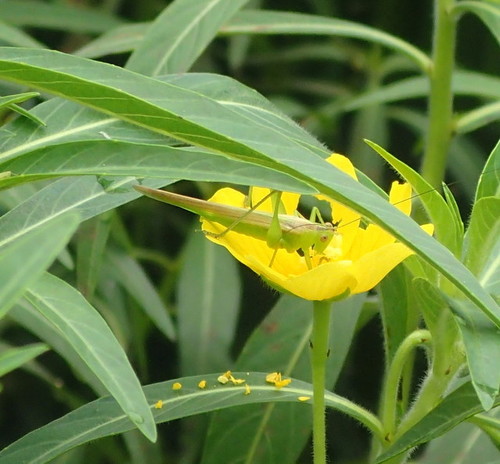
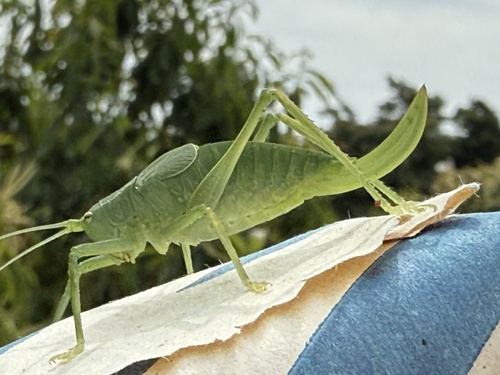
Microcentrum rhombifolium is a species of insect in the family Tettigoniidae. Common names include greater angle-wing katydid, broad-winged katydid, and angular-winged katydid. They live across North America in trees and shrubs. Adults are active in late summer and autumn and have a "ticking" call. They have been reported to chew on the peels of citrus crops, resulting in minor damage.

Microcentrum rhombifolium have a green, leaf-like appearance with long, threadlike antennae and feet divided into four segments. Adults reach 50–65 millimetres (2.0–2.6 in) in length and are rhombus-shaped. M. rhombifolium looks similar to M. retinerve, but the two species may be distinguished by the shape of their pronota. In M. rhombifolium, the front edge of the pronotum has a small bump in the middle. M. retinerve does not have this bump.

Ross H. Arnett (30 July 2000). American Insects: A Handbook of the Insects of America North of Mexico. CRC Press. ISBN 978-0-8493-0212-1. Field Guide To Grasshoppers, Katydids, And Crickets Of The United States, Capinera, Scott, Walker. 2004. Cornell University Press.

Otte, Daniel (1997). Tettigonioidea.... Wikipedia →

Global Distribution

Parks Where Found

# Park Country Daily sighting probability
1 Zion National Park 🇺🇸 United States
~10%

More parks will be added in future updates.

Cities Where Found

# City Country Daily sighting probability
1 Denver 🇺🇸 United States
~10%
2 Salt Lake City 🇺🇸 United States
~10%
3 Minneapolis [Saint Paul] 🇺🇸 United States
~10%
4 Boston 🇺🇸 United States
~10%
5 San Luis Potosí 🇲🇽 México
~10%
6 Detroit 🇺🇸 United States
~10%
7 Chicago 🇺🇸 United States
~10%
8 Toronto 🇨🇦 Canada
~10%
9 San Diego 🇺🇸 United States
<5%
10 Philadelphia 🇺🇸 United States
<5%

Before you go

What are the chances of seeing a Greater Anglewing in Minneapolis [Saint Paul]?

With luck

About 10% of wildlife watchers report a Greater Anglewing sighting in Minneapolis [Saint Paul] on a given day, based on 117 verified sightings from GBIF citizen-science data. It is the 79th most-seen of the 672 insects we can rate there. Over three days the chance rises to about 20%, and over a week to about 50%, if each day is a fresh chance.

When is the best time to see a Greater Anglewing in Minneapolis [Saint Paul]?

September and October

In those months about 20% of wildlife watchers report a Greater Anglewing in Minneapolis [Saint Paul] on a given day, against under 5% in November to July, the lowest months.

What time of day is best to see a Greater Anglewing?

Between noon and 3 pm

Across all the parks we cover, that three-hour window holds the most Greater Anglewing sightings with a recorded time, and about 9 in 10 of them come between 6 am and 6 pm: it is a daytime animal.

Is Minneapolis [Saint Paul] the best place to see a Greater Anglewing?

Among the best

Of the 21 cities where we can rate Greater Anglewing sightings, Minneapolis [Saint Paul] ranks 3rd at about 10%, level with the leaders once rounded. The best odds are in Denver (United States, about 10%) and Salt Lake City (United States, about 10%).

Which relatives of the Greater Anglewing live in Minneapolis [Saint Paul]?

Same family: Tettigoniidae

The closest relatives of the Greater Anglewing that you can see in Minneapolis [Saint Paul] (family Tettigoniidae, Katydids) are Black-Legged Meadow Katydid (about 10%) and Roesel's Bush-Cricket (about 10%), with each one's daily chance of a sighting.

Where does the Greater Anglewing sighting chance come from?

GBIF citizen-science records

It is estimated from how often the Greater Anglewing is recorded against all the insects logged in Minneapolis [Saint Paul] (117 verified sightings), calibrated against known sighting rates. Figures are rounded to the nearest 10% because citizen-science data supports honest approximations, not decimals, and months with records from fewer than five people show "—". How it works.

← Back to Minneapolis [Saint Paul]