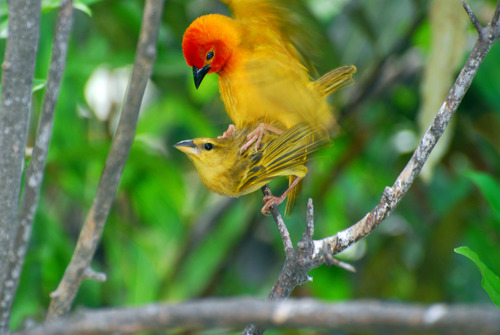
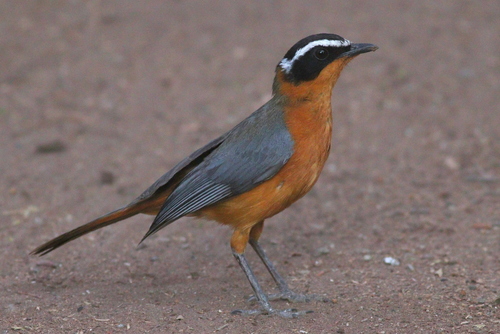
Red-cheeked Cordon-bleu

Red-cheeked Cordon-bleu

Uraeginthus bengalus

Silhouette: Sheatherius · PhyloPic

LCLeast ConcernNTVUENCR
Daily sighting probability ~70% · Very likely
at Mombasa

In 3 days >90%

173 Verified sightings at Mombasa
6,460 In all 23 parks From 2019 to 2026
April Best month
☀️ Diurnal When it's spotted

About the Red-cheeked Cordon-bleu

The red-cheeked cordon-bleu or red-cheeked cordonbleu (Uraeginthus bengalus) is a small passerine bird in the family Estrildidae. This estrildid finch is a resident breeding bird in drier regions of tropical Sub-Saharan Africa. Red-cheeked cordon-bleu has an estimated global extent of occurrence of 7,700,000 km2.

In 1760 the French zoologist Mathurin Jacques Brisson included a description of the red-cheeked cordon-bleu in his Ornithologie based on a specimen that he mistakenly believed had been collected in Bengal. He used the French name Le Bengali and the Latin Bengalus. Although Brisson coined Latin names, these do not conform to the binomial system and are not recognised by the International Commission on Zoological Nomenclature. When in 1766 the Swedish naturalist Carl Linnaeus updated his Systema Naturae for the twelfth edition, he added 240 species that had been previously described by Brisson. One of these was the red-cheeked cordon-bleu. Linnaeus included a brief description, coined the binomial name Fringilla bengalus and cited Brisson's work. The specific name bengalus is based on the erroneous belief that the species came from Bengal. The type location was... Wikipedia →

Sounds

Song and call1:19

Senegal · 2026

© Peter Boesman · XC1081454 · CC BY-NC-ND 4.0

Call0:18

Gambia · 2021

© Joost van Bruggen · XC690785 · CC BY-NC-ND 4.0

Call0:47

Kenya · 2017

© James Bradley · XC363620 · CC BY-NC-SA 4.0

Global Distribution

Parks Where Found

# Park Country Daily sighting probability
1 Kidepo Valley National Park 🇺🇬 Uganda
~70%
2 Lake Nakuru National Park 🇰🇪 Kenya
~70%
3 Akagera National Park 🇷🇼 Rwanda
~60%
4 Murchison Falls National Park 🇺🇬 Uganda
~60%
5 Ruaha National Park 🇹🇿 Tanzania
~50%
6 Nairobi National Park 🇰🇪 Kenya
~50%
7 Lake Mburo National Park 🇺🇬 Uganda
~40%
8 Mkomazi National Park 🇹🇿 Tanzania
~40%
9 Meru National Park 🇰🇪 Kenya
~40%
10 Tarangire National Park 🇹🇿 Tanzania
~40%
11 Awash National Park 🇪🇹 Ethiopia
~30%
12 Niokolo-Koba National Park 🇸🇳 Senegal
~30%
13 Tsavo West National Park 🇰🇪 Kenya
~20%
14 Serengeti National Park 🇹🇿 Tanzania
~20%
15 Masai Mara National Reserve 🇰🇪 Kenya
~20%
16 Lake Manyara National Park 🇹🇿 Tanzania
~20%
17 Aberdare National Park 🇰🇪 Kenya
~10%
18 Tsavo East National Park 🇰🇪 Kenya
~10%
19 Mikumi National Park 🇹🇿 Tanzania
~10%
20 Samburu National Reserve 🇰🇪 Kenya
<5%
21 Ngorongoro Conservation Area 🇹🇿 Tanzania
<5%
22 Amboseli National Park 🇰🇪 Kenya
<5%
23 Queen Elizabeth National Park 🇺🇬 Uganda
<5%

Cities Where Found

# City Country Daily sighting probability
1 Mombasa 🇰🇪 Kenya
~70%
2 Ouagadougou 🇧🇫 Burkina Faso
~70%
3 Serrekunda 🇬🇲 Gambia
~60%
4 N'Djamena 🇹🇩 Chad
~60%
5 Abuja 🇳🇬 Nigeria
~50%
6 Maiduguri 🇳🇬 Nigeria
~40%
7 Kigali 🇷🇼 Rwanda
~30%
8 Addis Ababa 🇪🇹 Ethiopia
~10%
9 Kampala 🇺🇬 Uganda
~10%
10 Nairobi 🇰🇪 Kenya
~10%

Zoos & Centres Where Found

# Zoo / Centre Country
1 San Diego Zoo 🇺🇸 United States In captivity
2 Nuremberg Zoo 🇩🇪 Germany In captivity
3 Tiergarten Am Tiergarten 28 in Nürnberg 🇩🇪 Germany In captivity
4 Kano Zoo 🇳🇬 Nigeria In captivity
5 Granby Zoo 🇨🇦 Canada In captivity
6 Berlin Zoological Garden 🇩🇪 Germany In captivity
7 Parc Zoologique et Botanique de Mulhouse 🇫🇷 France In captivity
8 Schönbrunn Zoo 🇦🇹 Austria In captivity
9 Cambridge Butterfly Conservatory 🇨🇦 Canada In captivity
10 Aquarium Berlin 🇩🇪 Germany In captivity
11 Birdworld Kuranda 🇦🇺 Australia In captivity
12 Bloedel Conservatory 🇨🇦 Canada In captivity
13 Kuranda Koala Gardens 🇦🇺 Australia In captivity
14 Tiergarten Am Tiergarten 12 in Nürnberg 🇩🇪 Germany In captivity
15 Tiergarten Am Tiergarten 14 in Nürnberg 🇩🇪 Germany In captivity
16 Tiergarten Am Tiergarten 6 in Nürnberg 🇩🇪 Germany In captivity
17 Audu Bako Zoo 🇳🇬 Nigeria In captivity
18 Butterfly World 🇺🇸 United States In captivity

Before you go

What are the chances of seeing a Red-cheeked Cordon-bleu in Mombasa?

Very likely

About 70% of wildlife watchers report a Red-cheeked Cordon-bleu sighting in Mombasa on a given day, based on 173 verified sightings from GBIF citizen-science data. It is the 3rd most-seen of the 146 birds we can rate there. Over three days the chance rises to over 90%, if each day is a fresh chance.

When is the best time to see a Red-cheeked Cordon-bleu in Mombasa?

April and October

In those months about 80% of wildlife watchers report a Red-cheeked Cordon-bleu in Mombasa on a given day, against about 60% in July and December–January, the lowest months. Those are among Mombasa's wettest months, with about 110 mm of rain a month against 15 mm in February.

What time of day is best to see a Red-cheeked Cordon-bleu?

Between 9 am and noon

Across all the parks we cover, that three-hour window holds the most Red-cheeked Cordon-bleu sightings with a recorded time, and about 9 in 10 of them come between 6 am and 6 pm: it is a daytime animal.

Is Mombasa the best place to see a Red-cheeked Cordon-bleu?

Yes

Of the 12 cities where we can rate Red-cheeked Cordon-bleu sightings, Mombasa has the highest daily chance: about 70%. Next come Ouagadougou (Burkina Faso, about 70%) and Serrekunda (Gambia, about 60%).

Which relatives of the Red-cheeked Cordon-bleu live in Mombasa?

Same family: Estrildidae

The closest relatives of the Red-cheeked Cordon-bleu that you can see in Mombasa (family Estrildidae, Waxbills and Allies) are Red-billed Firefinch (about 50%) and Bronze Mannikin (about 50%), with each one's daily chance of a sighting.

Where does the Red-cheeked Cordon-bleu sighting chance come from?

GBIF citizen-science records

It is estimated from how often the Red-cheeked Cordon-bleu is recorded against all the birds logged in Mombasa (173 verified sightings), calibrated against known sighting rates. Figures are rounded to the nearest 10% because citizen-science data supports honest approximations, not decimals, and months with records from fewer than five people show "—". How it works.

← Back to Mombasa