Cut-throat

Cut-throat

Amadina fasciata

Silhouette: Sheatherius · PhyloPic

LCLeast ConcernNTVUENCR
Daily sighting probability <5% · Rare
at Mombasa

In 3 days ~10% in a week ~20%

6 Verified sightings at Mombasa
1,331 In all 21 parks From 2019 to 2026
September Best month
☀️ Diurnal When it's spotted

About the Cut-throat

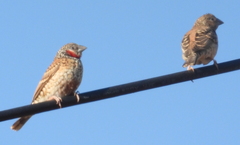
The cut-throat finch (Amadina fasciata) is a common species of estrildid finch found throughout Africa; it is also known as the bearded finch, the ribbon finch, the cut throat, and the weaver finch. The cut-throat finch was formally described in 1789 by the German naturalist Johann Friedrich Gmelin in his revised and expanded edition of Carl Linnaeus's Systema Naturae. He placed it with the crossbills in the genus Loxia and coined the binomial name Loxia fasciata. The specific epithet is from Late Latin faciatus meaning "banded". Gmelin based his account on the "fasciated grossbeak" that had been described and illustrated in 1776 by the English naturalist Peter Brown. Neither Brown nor Gmelin specified a locality but in 1805 the French ornithologist Louis Pierre Vieillot designated Senegal. The cut-throat finch is now placed with the red-headed finch in the genus Amadina that was introduced in 1827 by the English naturalist William Swainson.

Four subspecies are recognised: Wikipedia →

Sounds

Call0:32

Tanzania · 2019

© Peter Boesman · XC509854 · CC BY-NC-ND 4.0

Begging call1:10

South Africa · 2021

© Derek Solomon · XC646188 · CC BY-NC-SA 4.0

Song0:06

Niger · 2018

© Étienne Leroy · XC447198 · CC BY-NC-SA 4.0

Global Distribution

Parks Where Found

# Park Country Daily sighting probability
1 Samburu National Reserve 🇰🇪 Kenya
~30%
2 Tsavo East National Park 🇰🇪 Kenya
~30%
3 Awash National Park 🇪🇹 Ethiopia
~20%
4 Mkomazi National Park 🇹🇿 Tanzania
~20%
5 Tsavo West National Park 🇰🇪 Kenya
~20%
6 Meru National Park 🇰🇪 Kenya
~10%
7 Mana Pools National Park 🇿🇼 Zimbabwe
~10%
8 Hwange National Park 🇿🇼 Zimbabwe
~10%
9 Tarangire National Park 🇹🇿 Tanzania
~10%
10 Amboseli National Park 🇰🇪 Kenya
~10%
11 Liwonde National Park 🇲🇼 Malawi
<5%
12 Kidepo Valley National Park 🇺🇬 Uganda
<5%
13 Ruaha National Park 🇹🇿 Tanzania
<5%
14 Serengeti National Park 🇹🇿 Tanzania
<5%
15 Mikumi National Park 🇹🇿 Tanzania
<5%
16 Lower Zambezi National Park 🇿🇲 Zambia
<5%
17 Ngorongoro Conservation Area 🇹🇿 Tanzania
<5%
18 Kruger National Park 🇿🇦 South Africa
<5%
19 Nairobi National Park 🇰🇪 Kenya
<5%
20 Lake Nakuru National Park 🇰🇪 Kenya
<5%
21 Chobe National Park 🇧🇼 Botswana
<5%

Cities Where Found

# City Country Daily sighting probability
1 Pretoria 🇿🇦 South Africa
~20%
2 Mombasa 🇰🇪 Kenya
<5%
3 Johannesburg 🇿🇦 South Africa
<5%

Zoos & Centres Where Found

# Zoo / Centre Country
1 Zoopark Limpopo 🇷🇺 Russia In captivity
2 National Aviary 🇺🇸 United States In captivity

Before you go

What are the chances of seeing a Cut-throat in Mombasa?

Rare

Under 5% of wildlife watchers report a Cut-throat sighting in Mombasa on a given day, based on 6 verified sightings from GBIF citizen-science data. It is the 141st most-seen of the 146 birds we can rate there. Over three days the chance rises to about 10%, and over a week to about 20%, if each day is a fresh chance.

When is the best time to see a Cut-throat in Mombasa?

September

In that month about 20% of wildlife watchers report a Cut-throat in Mombasa on a given day, against under 5% in October to August, the lowest months. That is one of Mombasa's driest months, with about 40 mm of rain against 220 mm in May.

What time of day is best to see a Cut-throat?

Between 7 and 10 am

Across all the parks we cover, that three-hour window holds the most Cut-throat sightings with a recorded time, and about 9 in 10 of them come between 6 am and 6 pm: it is a daytime animal.

Is Mombasa the best place to see a Cut-throat?

2nd of 3

Of the 3 cities where we can rate Cut-throat sightings, Mombasa ranks 2nd at under 5%. The best odds are in Pretoria (South Africa, about 20%).

Where does the Cut-throat sighting chance come from?

GBIF citizen-science records

It is estimated from how often the Cut-throat is recorded against all the birds logged in Mombasa (6 verified sightings), calibrated against known sighting rates. Figures are rounded to the nearest 10% because citizen-science data supports honest approximations, not decimals, and months with records from fewer than five people show "—". How it works.

← Back to Mombasa